Principles of Biochemistry Volume 1 - A. Lehninger 1985
Biomolecules
Proteins: Covalent Structure and Biological Functions
Homologous proteins from different species share homologous sequences
The Study of Amino acid sequences in homologous Proteins isolated from different species has led to several important Conclusions. Homologous proteins are defined as those that perform identical Functions across different species. A classic example is Hemoglobin, which carries out the exact same oxygen-transport function in all vertebrates. The polypeptide chains of homologous proteins from different species are typically identical or nearly identical in length. Furthermore, The amino acid sequences of homologous proteins feature the exact same Amino Acids at many positions—these are referred to as invariant residues. At the same time, significant differences are observed at other positions, where amino acids vary from one species to another; such amino acid residues are called variable residues. The entire array of similarities in the amino acid sequences of homologous proteins is encompassed by the term Structure/154.html">Sequence Homology. The existence of such homology strongly implies that the animals from which these proteins were isolated share a common evolutionary origin.
The Biological Significance of sequence homology is best illustrated by cytochrome c, an iron-containing mitochondrial protein that functions as an electron carrier in Biological Oxidation processes within Eukaryotic Cells. The Molecular Weight of this protein is approximately 12,500 in most species, and its polypeptide chain consists of 100 or slightly more amino acid residues. The amino acid sequences of cytochrome c have been determined for more than 60 species, and in all the proteins examined, 27 positions in the polypeptide chain were found to be occupied by identical amino acid residues (Fig. 6-14). This indicates that all of these residues play a critical role in maintaining the biological activity of cytochrome c. At other positions, the amino acid residues may vary from species to species. A second major Conclusion derived from the analysis of cytochrome c amino acid sequences is that the number of residues by which the Cytochromes c of any two species differ is proportional to the phylogenetic distance between those species. For example, the cytochrome c molecules of the horse and Yeast (evolutionarily very distant species) differ by 48 amino acid residues, whereas the cytochromes c of much closer species—the chicken and the duck—differ by only two residues. As for the cytochromes c of the chicken and the turkey, they share identical amino acid sequences. The cytochrome c molecules of the pig, cow, and sheep are likewise identical. Data on the number of differences in the amino acid sequences of homologous proteins from various species are used to construct evolutionary trees that reflect the sequential stages in the emergence and development of various animal and plant species throughout evolution (Fig. 6-14).
Class="center">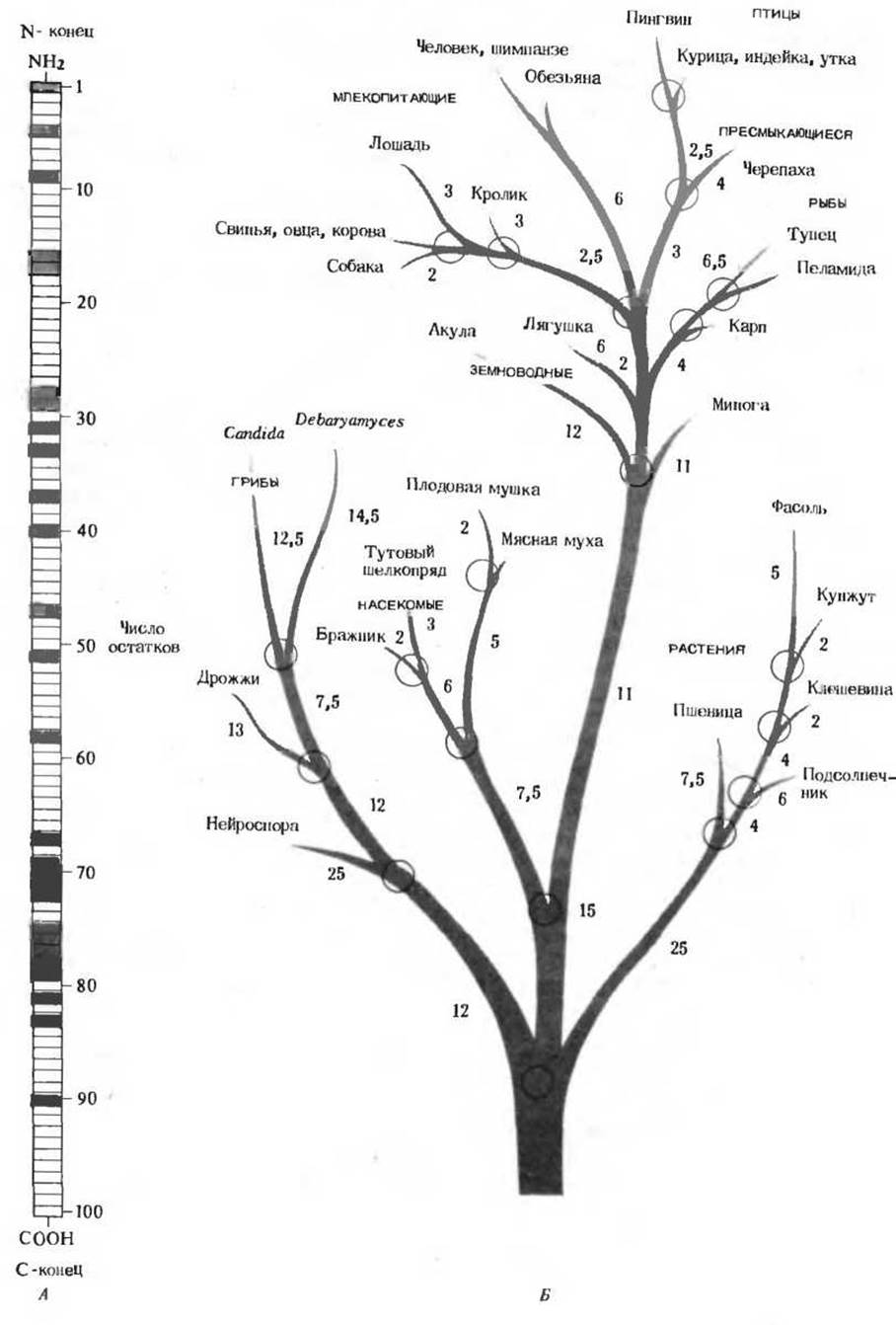
Fig. 6-14. A. Location OF THE 27 invariant residues in cytochrome c from more than 60 species, including mammals, fish, reptiles, amphibians, birds, insects, and other invertebrates, as well as plants and Fungi. As the number of investigated cytochromes c increases, the number of invariant residues may decrease slightly. B. Main Branches of the evolutionary tree constructed from data on the number of Amino Acid Substitutions in cytochrome c molecules across various species. The numbers indicate the number of residues by which the cytochrome c of a given Lineage differs from the cytochromes c of its ancestors. The circles denote points of evolutionary divergence.
Last update: 06/08/2026
Editorial and Educational Adaptation: This material has been compiled based on the primary/original source text. The project team performed an editorial review, corrected technical inaccuracies, structured sections, and adapted the content for an educational format.
What was processed:
- elimination of formatting defects (OCR errors, structural breaks, corrupted characters);
- editorial organization of content;
- standardization of terminology in accordance with academic sources;
- verification of factual statements against the original source text.
All mentions of the author, publication year, and origin of the primary text have been preserved in accordance with the source.