Principles of Biochemistry Volume 1 - A. Lehninger 1985
Biomolecules
Proteins: Covalent Structure and Biological Functions
Currently, the sequences of many other proteins are known
Sanger's success immediately inspired A number of other researchers to determine the Amino acid sequences of even longer polypeptide chains. Very soon, the Amino Acid Sequence of adrenocorticotropic hormone (corticotropin, ACTH)—a hormone of the anterior Pituitary Gland that stimulates the growth and activity of the adrenal cortex—was established. This hormone consists of a single polypeptide chain containing 39 amino acid residues, with a Molecular Weight of approximately 4600. By the late 1950s, The sequence of the first enzyme, Ribonuclease, had been determined; this work was carried out by Stanford Moore and William Stein of the Rockefeller Institute, as well as Christian Anfinsen and his colleagues at the National Institutes of Health (USA). The bovine ribonuclease molecule contains 124 amino acid residues in its single chain and four intrachain —S—S— bonds (Fig. 6-13).
The next major milestone was the Determination of the amino acid sequence of the Two Types of polypeptide chains in Hemoglobin. This was the first sequence established for an oligomeric protein. The hemoglobin molecule consists of four polypeptide chains, called globins—two identical a-globins (141 residues) and two identical ß-globins (146 residues). In the hemoglobin molecule, these chains are not connected by covalent bonds, but are closely associated with one another via Hydrogen Bonds and hydrophobic interactions (Chap. 7). Following the Separation of the a- and ß-globins, their amino acid sequences were determined by two groups of researchers in the United States and one in the Federal Republic of Germany. Among the longer polypeptide chains for which the complete amino acid sequence has been established are bovine trypsinogen (229 residues), bovine chymotrypsinogen (245 residues), glyceraldehyde-3-phosphate dehydrogenase (333 residues), and single-chain human serum albumin (582 residues).
Many of the steps involved in determining The amino acid sequences of long polypeptide chains, along with the simultaneous recording of all results, are now carried out by automated, computer-controlled amino acid analyzers. Even Edman Degradation is performed using a specialized program-controlled device known as a sequenator. In this instrument, Reagents are automatically mixed in the required proportions, reaction products are separated and identified, and the results are recorded on a chart recorder. The Use of such devices has drastically reduced the labor and time required to determine the amino acid sequence of Polypeptides. Furthermore, these modern Methods are characterized by exceptionally high sensitivity. Amino acid analyzers can rapidly determine The amount of each amino acid present in a single fingerprint! To establish the complete amino acid sequence, it is often sufficient to have as little as one milligram of protein.
Class="center">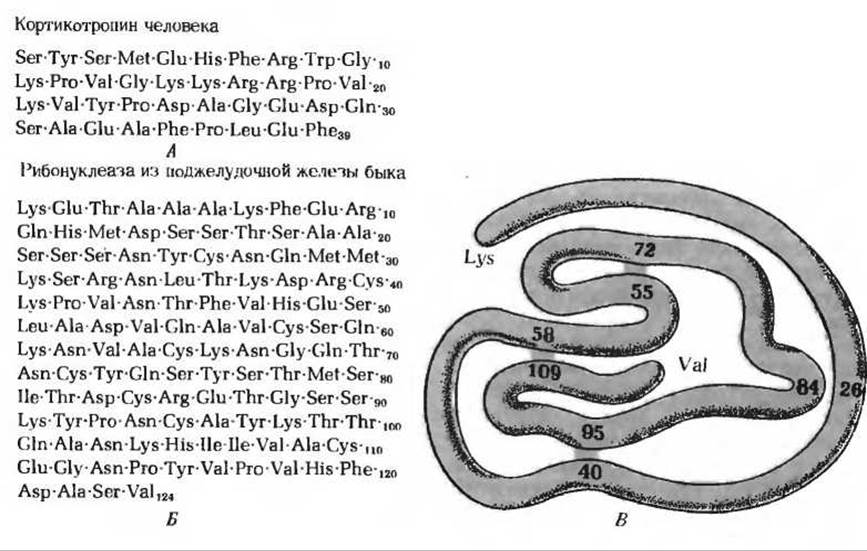
Fig. 6-13. A. Amino acid sequence of pituitary adrenocorticotropic hormone (39 residues). B. Amino acid sequence of bovine pancreatic ribonuclease (124 residues). C. Schematic representation of the ribonuclease molecule showing the arrangement of the four disulfide cross-links formed by cystine residues.
Last update: 06/08/2026
Editorial and Educational Adaptation: This material has been compiled based on the primary/original source text. The project team performed an editorial review, corrected technical inaccuracies, structured sections, and adapted the content for an educational format.
What was processed:
- elimination of formatting defects (OCR errors, structural breaks, corrupted characters);
- editorial organization of content;
- standardization of terminology in accordance with academic sources;
- verification of factual statements against the original source text.
All mentions of the author, publication year, and origin of the primary text have been preserved in accordance with the source.