Principles of Biochemistry Volume 1 - A. Lehninger 1985
Biomolecules
Proteins: Covalent Structure and Biological Functions
Insulin is the first protein for which the amino acid sequence was determined
We now understand the general workflow for determining the Amino Acid Sequence of polypeptide chains. Let us examine the results obtained by Sanger in elucidating The amino acid sequence of bovine Insulin, which is shown in Fig. 6-11. Bovine insulin has a Molecular Weight of approximately 5700 and consists of two polypeptide chains: the A-chain, containing 21 amino acid residues, and the B-chain, containing 30 amino acid residues. These two chains are linked by two interchain disulfide (—S—S—) cross-links, with an additional intrachain disulfide bond present in one of the chains. To determine the sequence, the cross-linking Disulfide Bonds were first cleaved to allow the Separation of the chains. For this purpose, Sanger used performic acid as an oxidizing agent, which converts each cystine residue into two cysteic acid residues (Fig. 6-12), one in each chain. Following chain separation, their respective Amino acid sequences were determined. No apparent regularity was found in the distribution of any amino acid, nor were there any periodic repeats of particular amino acid residues. Furthermore, the sequences of the two chains proved to be completely different.
Class="center">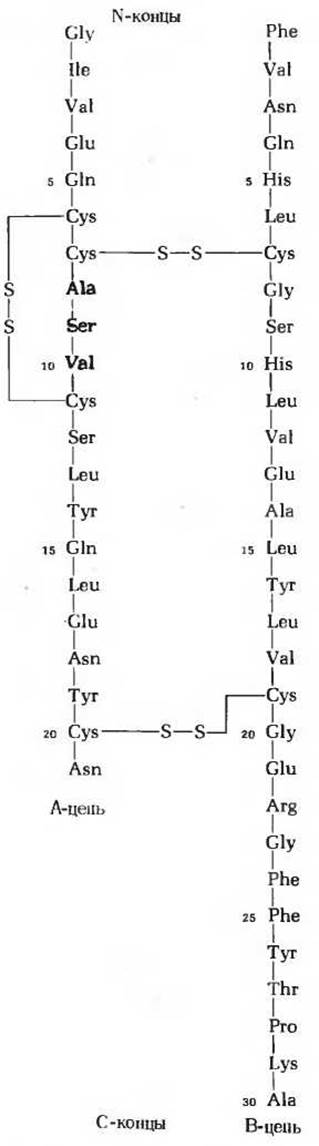
Fig. 6-11. Introduction/19.html">Primary Structure of bovine insulin, showing the amino acid sequences of both chains and their cross-links. The A-chains of human, pig, dog, rabbit, and sperm whale insulins are identical. Similarly, the B-chains of bovine, porcine, canine, goat, and equine insulins are identical. Amino Acid Substitutions in the A-chain typically occur at positions 8, 9, and 10 (highlighted in red).
The successful Determination of the amino acid sequence of insulin chains spurred intensive research into the relationship between The structure of insulins from various species and their biological activity in regulating glucose METABOLISM. Both the A- and B-chains are required for the biological activity of insulin, as is the integrity of both interchain disulfide cross-links. The removal of a portion of residues from either chain via selective Cleavage leads to a partial or complete loss of activity. Although insulins isolated from the Pancreas of several animal species—such as cattle, pigs, sheep, and sperm whales—retain hormonal activity in humans and can be used to treat diabetes, they are not identical to human insulin. Nevertheless, it is highly significant that specific amino acid residues at certain positions in each insulin chain are conserved across all species from which the insulin is isolated, whereas variations occur at other positions among different species. These observations provide compelling evidence that the biological activity of insulin depends on the amino acid sequence of its chains, as well as the presence of cross-links between the chains at specific locations.
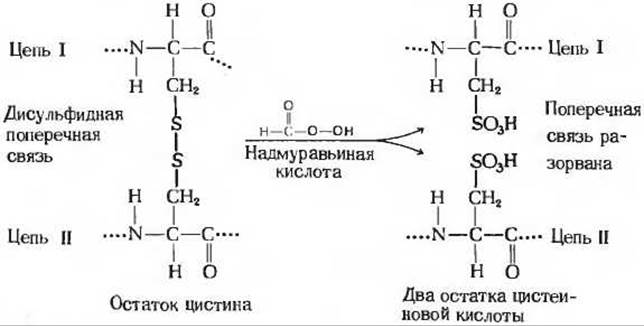
Fig. 6-12. Cleavage of disulfide cross-links by performic acid.
Last update: 06/08/2026
Editorial and Educational Adaptation: This material has been compiled based on the primary/original source text. The project team performed an editorial review, corrected technical inaccuracies, structured sections, and adapted the content for an educational format.
What was processed:
- elimination of formatting defects (OCR errors, structural breaks, corrupted characters);
- editorial organization of content;
- standardization of terminology in accordance with academic sources;
- verification of factual statements against the original source text.
All mentions of the author, publication year, and origin of the primary text have been preserved in accordance with the source.