Principles of Biochemistry Volume 1 - A. Lehninger 1985
Biomolecules
Carbohydrates: Structure and Biological Functions
Disaccharides contain two monosaccharide units
Disaccharides consist of two Monosaccharides joined together by covalent bonds. In most disaccharides, the chemical bond linking the monosaccharide units is called a glycosidic bond; it is formed through the interaction of the hydroxyl group of one sugar with the anomeric carbon atom of the second sugar. Glycosidic bonds are readily hydrolyzed by acids, yet they remain stable in the presence of bases. Therefore, disaccharides can be hydrolyzed to yield their free monosaccharide components by boiling them in a dilute acid solution.
Like monosaccharides, disaccharides are widely distributed in nature, with sucrose, lactose, and maltose being the most common (Fig. 11-12). Maltose, the simplest disaccharide, contains two D-glucose residues connected by a glycosidic bond between the first carbon atom (the anomeric carbon) of one glucose residue and the fourth carbon atom of the second residue (Fig. 11-12). The anomeric carbon atom in the glycosidic bond between the two D-glucose residues has the $\alpha$-configuration; accordingly, this bond is designated as $\alpha$(1$\rightarrow$4). In this notation, the first digit, or locant, indicates the monosaccharide residue possessing the anomeric carbon. Both glucose residues in the maltose molecule exist in the pyranose form. Maltose is classified as a reducing sugar because it contains a single potentially free carbonyl group that is capable of undergoing oxidation. The second glucose residue in the maltose molecule can exist in either the $\alpha$- or $\beta$-form; the $\alpha$-form is produced when starch (see Section 24.1, a) is acted upon by amylase, an enzyme present in saliva. Under the action of maltase—an enzyme secreted by the intestinal mucosa that specifically hydrolyzes the $\alpha$(1$\rightarrow$4) bond—maltose is hydrolyzed to yield two molecules of D-glucose. The disaccharide cellobiose also contains two D-glucose residues, but they are linked to each other by a $\beta$(1$\rightarrow$4) bond.
The disaccharide lactose (Fig. 11-12), which upon Hydrolysis yields D-galactose and D-glucose, is found exclusively in milk. The presence of a potentially free carbonyl group within the lactose molecule (located in the glucose moiety) renders it a reducing disaccharide. During Digestion, lactose undergoes Enzymatic hydrolysis through the action of lactase, an enzyme secreted by the mucosal Cells of the intestine. The activity of this enzyme is exceptionally high in infants; however, in adults, intestinal lactase activity is generally confined to Northern Europeans and certain African populations. In the majority of adults—including peoples of East Asian, Arab, and Jewish descent, as well as many Africans, Indians, and Mediterranean populations—intestinal lactase activity is very low, frequently leading to lactose intolerance. This condition is genetically determined. The underlying cause of lactose intolerance is that this disaccharide can be absorbed in the intestine only after being hydrolyzed into its constituent monosaccharides: when lactase activity is low, unabsorbed lactose accumulates in the gut, causing severe diarrhea and abdominal cramps following milk consumption. Lactose intolerance should not be confused with galactosemia, a genetic disorder (Section 15.9).
Class="center">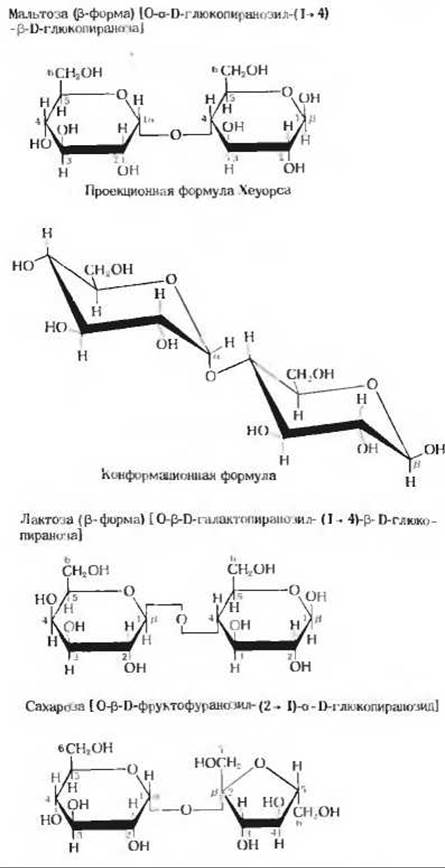
Fig. 11-12. Major disaccharides. The Structure of maltose is depicted using both Haworth projections and conformational formulas.
Sucrose, commonly known as cane sugar, is a disaccharide composed of glucose and fructose. While synthesized by numerous plants, sucrose is entirely absent in higher animals. Unlike maltose and lactose, sucrose lacks a free anomeric carbon atom because both anomeric carbons of its monosaccharide units are mutually linked (Fig. 11-12); consequently, sucrose is a non-reducing sugar. In plant biochemistry, this disaccharide represents a veritable enigma. Although D-Glucose serves as the primary building block for both starch and Cellulose, sucrose Functions as the principal intermediate product of Photosynthesis. In many plants, sugars are transported from the leaves to other PARTS OF THE Organism specifically in the form of sucrose. The advantage of sucrose over glucose as a transport form likely stems from the linkage between its anomeric carbon atoms, which protects sucrose from attack by oxidative or hydrolytic Enzymes as it travels through the plant.
Animals cannot assimilate sucrose directly; however, it becomes available for utilization following the action of the enzyme sucrase (also referred to as invertase), which is localized in the cells lining the Small Intestine (see Fig. 24-2). This enzyme catalyzes the Cleavage of sucrose into D-glucose and D-fructose, both of which are readily absorbed into the bloodstream.
Table 11-1. Relative sweetness of selected sugars and saccharin
|
Sugar |
Relative sweetness |
Sugar |
Relative sweetness |
|
Sucrose |
100 |
Maltose |
30 |
|
Glucose |
70 |
Lactose |
16 |
|
Fructose |
170 |
Saccharin |
40000 |
Sucrose exhibits the highest sweetness among all disaccharides and glucose (Table 11-1). Driven by the steadily rising cost of imported cane sugar (derived from sugarcane and sugar beets) alongside the abundant availability of D-glucose produced via the hydrolysis of corn starch in the United States, a novel industrial technology has recently been developed to yield a product sweeter than glucose. In this process, starch is initially hydrolyzed to produce corn syrup—a concentrated, neutral solution of D-glucose—which is then passed through a large Column packed with an inert support matrix covalently bound to glucose isomerase, a plant-derived enzyme. This immobilized enzyme catalyzes the reversible reaction:
D-glucose ⇄ D-fructose.
As a result of this reaction, corn syrup is converted into an equimolar mixture of D-glucose and D-fructose. Because D-fructose is approximately 2.5 times sweeter than D-glucose (Table 11-1), the overall sweetness of the syrup increases significantly following this Treatment. This product proves to be considerably cheaper than sucrose while offering the exact same nutritional value. It is now widely utilized in the food industry for The production of soft drinks and ice cream. Recently, a new product containing 90% fructose, also obtained via the isomerization reaction, has been introduced to the market; while it can serve as a substitute for ordinary table sugar, it costs twice as much as sucrose. Because fructose is substantially sweeter than sucrose, this product can be consumed in much smaller quantities, thereby reducing dietary caloric intake. On the other hand, the Nutritional Value of fructose is identical to that of sucrose, making the higher price of the new product difficult to justify.

Fig. 11-13. Saccharin, a non-nutritive, sweet-tasting artificial substance.
Primarily for individuals suffering from obesity and diabetes, for whom excessive sugar consumption is detrimental, non-nutritive artificial sweeteners have been developed. These artificial sweeteners stimulate the same taste receptors on the Tongue as natural sugars while remaining metabolically inert (see Chapter 26). The most widely used of these substances is saccharin (Fig. 11-13), which is 400 times sweeter than sucrose.
Last update: 06/08/2026
Editorial and Educational Adaptation: This material has been compiled based on the primary/original source text. The project team performed an editorial review, corrected technical inaccuracies, structured sections, and adapted the content for an educational format.
What was processed:
- elimination of formatting defects (OCR errors, structural breaks, corrupted characters);
- editorial organization of content;
- standardization of terminology in accordance with academic sources;
- verification of factual statements against the original source text.
All mentions of the author, publication year, and origin of the primary text have been preserved in accordance with the source.