Principles of Biochemistry, Volume 1 - A. Lehninger 1985
Biomolecules
Cells
All cells share certain common structural characteristics
Cells are the Structural and functional units of living organisms. The simplest organisms consist of single cells; by contrast, The Human Body contains an estimated 1014 cells or more. There is a vast array of diverse cells, varying greatly in size, shape, and functional specialization. A handful of soil or a Glass of pond Water may contain dozens of different unicellular organisms, whereas any multicellular Organism—whether human or plant—is composed of dozens or hundreds of highly specialized Cell types functioning together within Tissues and Organs. No matter how large and complex an organism may be, the cells of each type retain a distinct individuality and independence.
Despite numerous external differences, cells of various types share a striking similarity in their major structural features (Fig. 2-1). Every cell is surrounded by an extremely thin membrane that encloses its contents and allows it to maintain a degree of autonomy. The Cell membrane, also known as The Plasma Membrane, is selectively permeable. This property allows essential nutrients and salts to enter the cell while letting waste products exit. At the same time, the cell membrane prevents unwanted substances from the surrounding environment from entering. The Molecular Organization of the plasma membrane is remarkably uniform across all cells: it consists of a bilayer of lipid molecules with numerous embedded specific Proteins. Some Membrane Proteins exhibit enzymatic activity, whereas others bind nutrients from the environment and facilitate their transport into the cell. The interior of any cell is filled with Cytoplasm, where the majority of enzyme-catalyzed reactions of cellular METABOLISM take place. It is within the cytoplasm that the chemical energy required for building Cellular Structures and maintaining their integrity, as well as for the mechanical work of contraction and locomotion, is released. Also present in the cytoplasm of all cells are Ribosomes—small granules 18 to 22 nm in diameter, whose function is to mediate Protein Synthesis. In addition, all living cells contain a Nucleus or a nuclear body, where genetic material is replicated and stored in the form of deoxyribonucleic acid (DNA).
Class="center">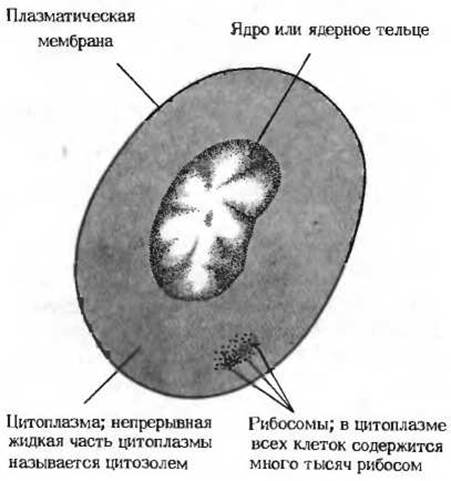
Fig. 2-1. All cells are bounded by a membrane and contain a nucleus or nuclear body and ribosomes. As we will see, There are two Major Classes of cells that differ in other structural elements.
Last update: 06/08/2026
Editorial and Educational Adaptation: This material has been compiled based on the primary/original source text. The project team performed an editorial review, corrected technical inaccuracies, structured sections, and adapted the content for an educational format.
What was processed:
- elimination of formatting defects (OCR errors, structural breaks, corrupted characters);
- editorial organization of content;
- standardization of terminology in accordance with academic sources;
- verification of factual statements against the original source text.
All mentions of the author, publication year, and origin of the primary text have been preserved in accordance with the source.