Biochemical Engineering Fundamentals, Part 1 - Bailey, J., Ollis, D. 1989
Stoichiometry and Energetics of Metabolic Transformations
End Products of Metabolism
Products of Anaerobic Metabolism (Fermentation)
Cells secrete A wide variety of compounds into their environment. In many cases, these compounds are formed through energy-yielding processes. Typical Examples of End products of METABOLISM include alcohols and organic acids. Other metabolic products, such as Antibiotics, toxins, Alkaloids, and growth factors, are more complex molecules that perform specific Functions in cellular activity. Such compounds, the presence of which is not strictly essential for the growth of a Cell culture in a defined nutrient medium, are referred to as secondary metabolites. In this section, we will briefly examine some of the metabolic Pathways leading from intermediate metabolites to end products, as well as the types of the latter depending on The Nature of the producing cells and the cultivation conditions.
First, let us examine the various end products of anaerobic glucose metabolism. Many organisms process glucose to Pyruvate via the Embden — Meyerhof — Parnas (EMP) pathway, the Entner — Doudoroff pathway, or The pentose phosphate shunt. Subsequent pathways from pyruvate to metabolic end products can vary significantly. Economically, the most important process is The conversion of pyruvate into ethanol (Alcoholic Fermentation), which proceeds According to the following scheme:
Class="center">
Table 5.7. End products of Carbohydrate Metabolism in Bacteria via the Embden — Meyerhof — Parnas pathwaya
Fermentation type |
Main metabolic products of pyruvic acid |
Bacteria carrying out this type of fermentation |
1. Lactic acid |
Lactic acid |
Lactic acid bacteria of the genera Streptococcus, Pediococcus, Lactobacillus (some species) |
2. Mixed acid |
Lactic, acetic, succinic, formic (or СO2 and Н2) acids, ethanol |
Various enterobacteria, e.g., Escherichia, Salmonella, Shigella, Proteus, Yersinia |
a. Butanediol |
Same as in type 2 fermentation, plus 2,3-butanediol |
Aerobacter, Serratia, Aeromonas, Bacillus polymyxa |
3. Butyric acid |
Butyric acid, acetic acid, СO2 and H2 |
Many anaerobic spore-forming bacteria (Clostridium); some non-spore-forming anaerobes (Butyribacterium) |
a. Acetone-butanol |
Same as in type 3 fermentation, plus butanol, ethanol, acetone, and isopropanol |
Certain spore-forming anaerobes (Clostridium) |
4. Propionic acid |
Propionic acid, acetic acid, succinic acid, СO2 |
Propionibacterium, Veillonella |
a Stanier R. Y., Doudoroff M., Adelberg E. A., The Microbial World, 3rd ed., p. 183, Prentice-Hall, Inc., Englewood Cliffs, N. J., 1970.
In these reactions, as well as in other carbohydrate fermentation processes discussed below, the NADH generated during The Biosynthesis of pyruvate is reoxidized. Since, unlike Respiration, Anaerobic Metabolism does not involve electron transfer to an external electron acceptor, substrate utilization and fermentation product formation can be described by standard oxidation-reduction equations. Another example of NADH Participation in the formation of anaerobic metabolic products is Lactic acid fermentation, during which pyruvate is converted to lactate in a single step:

Table 5.7 lists Other types of anaerobic carbohydrate metabolism beginning with the conversion to pyruvate via the EMP pathway, and Fig. 5.26 illustrates the corresponding reaction sequences. It should be emphasized that both The Nature and the relative quantities of fermentation end products depend on the Organism itself and its cultivation conditions. For example, during the alcoholic fermentation of a 5% glucose solution by the Yeast Saccharomyces cerevisiae, changing the pH from 3.0 to 7.0 results in a decrease in the ethanol yield from 171.5 to 149.5 mmol (per 100 mmol of initial glucose) and an increase in the glycerol yield from 6.16 to 22.2 mmol (also per 100 mmol of glucose). When sulfite is added to the nutrient medium, the glycerol yield increases even further; a method of glycerol production based on this type of fermentation was widely used during World War I.
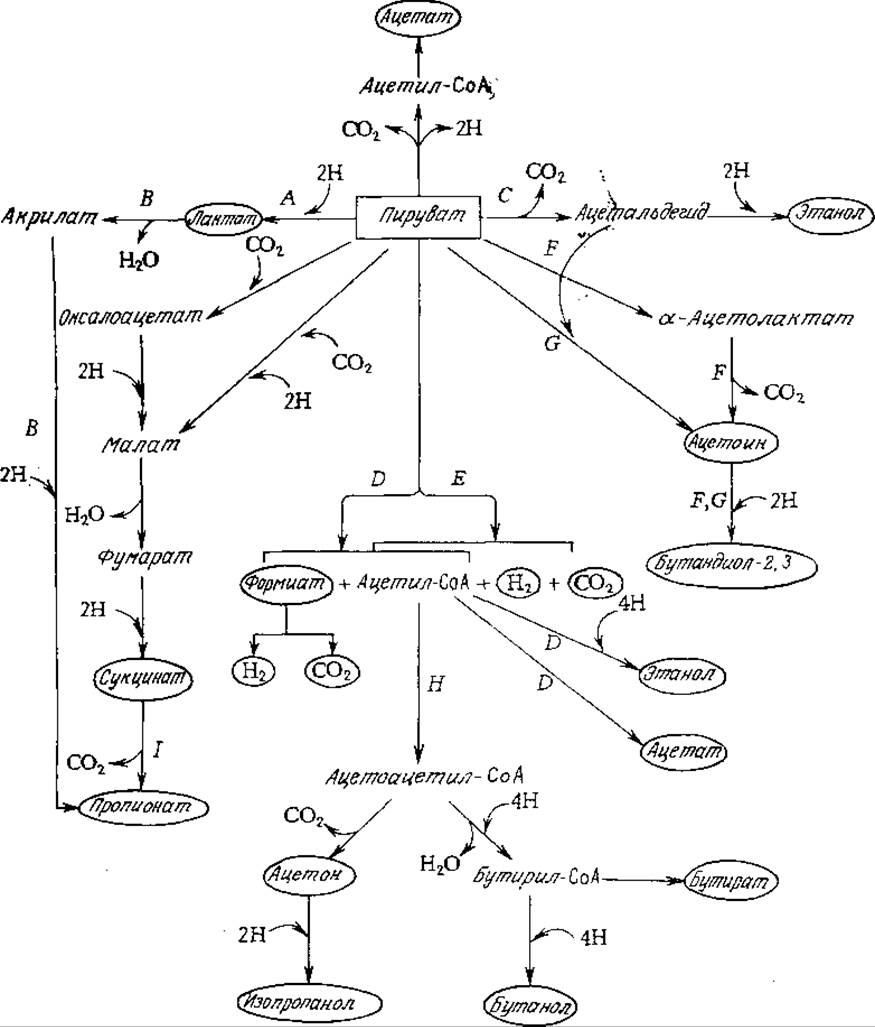
FIG. 5.26. End products (circled) of anaerobic pyruvate metabolism in microorganisms. Letters designate the microorganisms carrying out the indicated reactions: A — lactic acid bacteria (Streptococcus, Lactobacillus); B — Clostridium propionicum; C — Yeasts, acetic acid bacteria, Zymomonas, Sarcina ventriculi, Erwinia amylovora; D — enterobacteria (aerogenic coliform bacteria); E — clostridia; F — aerobacters; G — yeasts; H — clostridia (butyricum, acetobutylicum species); I — propionic acid bacteria. [Reprinted with permission from: Biochemistry of Bacterial Growth, Mandelstam J., McQuillen K. (eds.), 2nd ed., p. 166, Blackwell Scientific Publications, 1973.]
In Conclusion of this Brief Overview of fermentation processes, it should be noted that some organisms are capable of converting Amino Acids present in the nutrient medium into other Organic compounds. Such metabolic processes play a crucial role in The production of alcoholic beverages, as higher aliphatic acids and alcohols formed from nitrogen-containing compounds impart the characteristic taste and aroma to the drinks.
Last update: 06/08/2026
Editorial and Educational Adaptation: This material has been compiled based on the primary/original source text. The project team performed an editorial review, corrected technical inaccuracies, structured sections, and adapted the content for an educational format.
What was processed:
- elimination of formatting defects (OCR errors, structural breaks, corrupted characters);
- editorial organization of content;
- standardization of terminology in accordance with academic sources;
- verification of factual statements against the original source text.
All mentions of the author, publication year, and origin of the primary text have been preserved in accordance with the source.