Biochemical Engineering Fundamentals, Part 1 - Bailey J., Ollis D. 1989
Kinetics of Enzyme-Catalyzed Reactions
Kinetics of simple single- and two-substrate enzymatic reactions
Kinetics of reversible reactions, two-substrate reactions, and enzyme activation by cofactors
The equilibrium of many enzyme-catalyzed reactions, such as biopolymer Hydrolysis, is strongly shifted toward the reaction products; therefore, as a rule, such transformations can be considered irreversible. In other cases, such as the isomerization of glucose to fructose catalyzed by glucose isomerase, an equilibrium state may be established, requiring that THE CONTRIBUTION OF the reverse reaction be taken into account. As the simplest model of a reversible enzymatic reaction, let us consider The kinetics of sequential transformations of the type
Class="center">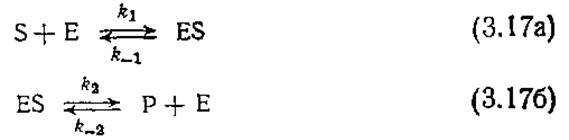
This sequence of elementary steps differs from the reaction sequence proposed by Henri–Michaelis–Menten and expressed by equations (3.4) only in that equation (3.176) now accounts for The formation of the ES complex from the reaction product and the free enzyme.
Table 3.4. Kinetic parameters of some enzymatic reactionsa
Enzyme |
Substrate |
Temperature, °C |
pH |
k2, s-1 |
1/Km, M-1 |
Carbobenzoxy-L-glutamyl-L-Tyrosine ethyl ester |
31.6 |
4.0 |
0.00108 |
530 |
|
Carbobenzoxy-L-glutamyl-L-tyrosine |
31.6 |
4.0 |
0.00141 |
560 |
|
Benzoyl-L-argininamide |
25.5 |
7.8 |
27.0 |
480 |
|
Chymotrypsinogen |
19.6 |
7.5 |
2900 |
<770 |
|
Sturine |
24.5 |
7.5 |
13100 |
400 |
|
Benzoyl-L-Arginine ester |
25.0 |
8.0 |
26.7 |
12 500 |
|
Methyl hydrocinnamate |
25.0 |
7.8 |
0.026 |
256 |
|
dl-α-chloro-β-phenylpropionic acid methyl ester |
25.0 |
7.8 |
0.135 |
83.3 |
|
d-β-phenyllactic acid methyl ester |
25.0 |
7.8 |
0.139 |
28.6 |
|
l-β-phenyllactic acid methyl ester |
25.0 |
7.8 |
1.38 |
100 |
|
Benzoyl-L-phenylalanine methyl ester |
25.0 |
7.8 |
51.0 |
217 |
|
Acetyl-L-Tryptophan ethyl ester |
25.0 |
7.8 |
30.7 |
588 |
|
Acetyl-L-tyrosine ethyl ester |
25.0 |
7.8 |
193.0 |
31.2 |
|
Benzoyl-L-o-nitrotyrosine ethyl ester |
25.0 |
7.8 |
3.27 |
90.9 |
|
Benzoyl-L-tyrosine ethyl ester |
25.0 |
7.8 |
78.0 |
250 |
|
Benzoyl-L-phenylalanine ethyl ester |
25.0 |
7.8 |
37.4 |
167 |
|
Benzoyl-L-Methionine ethyl ester |
25.0 |
7.8 |
0.77 |
1250 |
|
Benzoyl-L-tyrosinamide |
25.0 |
7.8 |
0.625 |
23.8 |
|
Acetyl-L-tyrosinamide |
25.0 |
7.8 |
0.279 |
12.3 |
|
Carboxypeptidase |
Carbobenzoxyglycine-L-tryptophan |
25.0 /25.0 |
7.5/8.2 |
89/94 |
196/164 |
Carbobenzoxyglycyl-L-phenylalanine |
25.0 |
7.5 |
181 |
154 |
|
Adenosine triphosphatase |
Carbobenzoxyglycyl-L-leucine ATP |
25.0/25.0 |
7.5/7.0 |
10.6/104 |
37/79 000 |
Urease |
Urea |
20.8/20.8 |
7.1/8.0 |
20 000/30 800 |
250/256 |
a Reproduced from: Laidler K. The Chemical Kinetics of Enzyme Action, p. 67, Oxford University Press, London, 1958.
As before, we assume that the reaction mixture is in a closed vessel and is efficiently stirred. Then, based on the material balance of the various enzyme forms [equation (3.7)] and taking into account the quasi-steady-state approximation [equation (3.8)], we easily find that

Here, vS and Ks are analogous to vmax and Km in equations (3.10) and (3.11), respectively, and

The vast majority of enzyme-catalyzed reactions involve at least two substrates. At the same time, one of the substrates is most often Water, whose concentration is practically constant and typically 1000 or more times higher than the concentrations of the other substrates. As we will show later in this section, in such cases the reaction can be considered to proceed with a single substrate S, and therefore its kinetics can be studied as described in the previous section. In addition, the kinetic models described below can sometimes explain The Effect of Cofactors on the rates of enzymatic reactions.
In all probability, ternary complexes in which the enzyme is simultaneously bound to two substrates can form in many processes involving two substrates. In this case, for example, the following reaction sequence is possible:

so that

As before, lowercase letters will denote concentrations, and the same letters in parentheses will denote the concentration of a single form, such as the enzyme-substrate complex. Assuming that the first four reactions (3.20) are at equilibrium, we obtain

Deriving this expression is straightforward if we consider that the total Enzyme Concentration e0 must equal the sum of the concentrations of the free enzyme e and the three complexes ES1, ES2, and ES1S2. As with single-substrate reactions, the quasi-equilibrium approximation can be applied to two-substrate enzymatic reactions. In general, however, this yields a rather cumbersome equation with so many parameters that it becomes impractical for actual use. An approximation that is satisfactory in several respects is described by equation (3.22).
Equation (3.22) can be further simplified somewhat by taking into account that the equilibrium conditions require that
K1K12 = K2K21 (3.23)
By appropriately transforming equation (3.22), we can arrive at the already familiar form of the equations:

where

and

From the last three equations, it follows that if s2 is constant and s1 varies, the reaction will obey the Michaelis–Menten Equation. At the same time, equations (3.25) and (3.26) show that the apparent maximum velocity and Michaelis constant depend on the concentration of s2.
Assuming the reaction sequence and the rate equation for a two-substrate reaction presented above are correct, we can verify the validity of the Michaelis–Menten equation (3.3) by assuming that one substrate is in large excess. Then v*max becomes equal to ke0, and K1* approaches a constant value of K21. Consequently, a two-substrate reaction at s2 ≫ K2 can be treated as a single-substrate reaction.

FIG. 3.12. Schematic representation of the proposed Mechanism of Enzymatic catalysis involving a cofactor.
Figure 3.12 schematically illustrates The Mechanism of a single-substrate enzymatic reaction (or a two-substrate reaction at s2 ≫ K12) involving a cofactor, which can be a metal ion or a coenzyme. Since this situation is analogous to the two-substrate mechanism we have just discussed, there is no need to refer back to the assumption of equilibrium sequential reactions. Assuming that the substrate binds only to the apoenzyme-coenzyme complex, we ultimately obtain

where c is the cofactor concentration. If the Substrate Concentration s is assumed to be constant, this expression reduces to the Michaelis–Menten equation, reflecting the dependence of the reaction rate on the cofactor concentration c. Thus, at a low cofactor concentration (c ≪ Kс), the reaction will be first-order with respect to the cofactor concentration c. On the other hand, at c ≫ Кс, we obtain the rate equation for a single-substrate reaction that is independent of the cofactor concentration.
If S1 and S2, or C and S1, bind to the enzyme in a strictly defined order, the corresponding rate equation for the process can be obtained by assuming that Kij of the forbidden reaction approaches an infinitely large value.
Last update: 06/08/2026
Editorial and Educational Adaptation: This material has been compiled based on the primary/original source text. The project team performed an editorial review, corrected technical inaccuracies, structured sections, and adapted the content for an educational format.
What was processed:
- elimination of formatting defects (OCR errors, structural breaks, corrupted characters);
- editorial organization of content;
- standardization of terminology in accordance with academic sources;
- verification of factual statements against the original source text.
All mentions of the author, publication year, and origin of the primary text have been preserved in accordance with the source.