Fundamentals of Biochemical Engineering, Part 1 - Bailey, J., & Ollis, D. 1989
Molecular Genetics and Regulatory Systems
Growth and Self-Reproduction of an Isolated Cell
Cell Cycle of E. coli
The simple prokaryote E. coli multiplies by binary fission; in a nutrient-rich medium, The Cell number of this Organism can double in less than 20 min. E. coli Bacteria are rod-shaped, and their length serves as a reliable measure of cell volume and mass. Direct microscopic examination of individual E. coli Cells has shown that cell length increases continuously throughout the Cell Cycle, and the time dependence of cell length is well described by an increasing exponential function. The total content of all cellular Proteins varies in a similar manner over the course of the cell cycle.
At the same time, the DNA content throughout the E. coli cell cycle varies in a rather complex manner, making E. coli sharply distinct from Eukaryotic cells in this regard. The coordination of DNA Synthesis AND Cell Division in E. coli depends on A number of regulatory and kinetic parameters, which we will examine below.
Under A wide variety of growth conditions where division occurs at different time intervals, the duration of E. coli Chromosome Replication remains approximately constant (about 40 min). During DNA synthesis*, the movement velocity of the Replication fork (the region of the DNA molecule where strand Separation and DNA synthesis take place) also remains constant. Consequently, The rate of DNA synthesis is directly proportional to the number of active replication forks. METABOLISM/36.html">DNA replication always initiates at a specific chromosomal locus known as THE ORIGIN OF replication. Two forks move in opposite directions from the origin around the circular E. coli chromosome and converge upon the completion of replication.
The Regulation of Cell division is linked to DNA synthesis; a bacterial cell divides approximately 20 min after the replication forks reach the end of the chromosome. As shown in Fig. 6.32, the situation remains relatively straightforward when E. coli grows in a medium that allows cells to divide on average once an hour. In this case, DNA synthesis proceeds at a constant rate During the first forty minutes of the cell cycle, and during the remaining twenty minutes preceding division, the cell does not synthesize DNA. The growth of an E. coli cell with a fifty-minute cell cycle (for example, at a slightly elevated Temperature) exhibits a more complex pattern of DNA synthesis; under these conditions, a new set of replication forks initiates DNA synthesis 10 min before cell division. Consequently, during the final 10 min of this cell cycle, DNA is synthesized twice as fast as at any point during the slower (one-hour) cycle. It is easy to see that The kinetics of DNA synthesis in E. coli, and likely in certain other bacteria, is generally quite complex and characterized by alternating periods of declining and rising synthetic activity—a pattern that depends on cell age and the duration of the cell cycle.
There is relatively little data concerning the dependence of RNA Synthesis on the timing of the cell cycle. It is generally assumed that RNA synthesis occurs continuously. At the same time, fluctuations have been demonstrated for an RNA fraction that appears to represent mRNA. Consequently, the synthesis rate of individual proteins may also vary cyclically.
* In this section, DNA synthesis refers exclusively to the synthesis of chromosomal DNA; plasmid replication will be discussed later.
experimental studies focusing primarily on Enzymes whose activity can be induced or repressed. The synthesis of a wide variety of inducible enzymes in bacteria can be stimulated at any point in the cell cycle. In a synchronized culture, the rate of synthesis of inducible enzymes changes in a step-like fashion, which is presumably due to the doubling of the number of genes corresponding to these enzymes
Class="center">
FIG. 6.32. Dependence of the rate of DNA synthesis and Chromosome Structure in E. coli on cell age and the duration of its doubling period. The right-hand side of the figure schematically depicts one-half of the E. coli chromosome from the origin of replication to the terminus of replication. Black dots indicate replication forks.
Such behavior has indeed been observed for a number of genes at the moment of DNA replication. In the case of enzyme repression, several possibilities exist. If bacteria grow under conditions where the end product of a metabolic pathway represses enzyme synthesis to a maximum or minimum degree, the rate of enzyme synthesis remains constant for a time interval equal to the duration of the CELL CYCLE AND then doubles. Intermediate levels of repression are characterized by regular, periodic variations in the rate of enzyme synthesis. Some experimental data suggest that these periodic changes are caused by sustained oscillations in a feedback-regulated system.
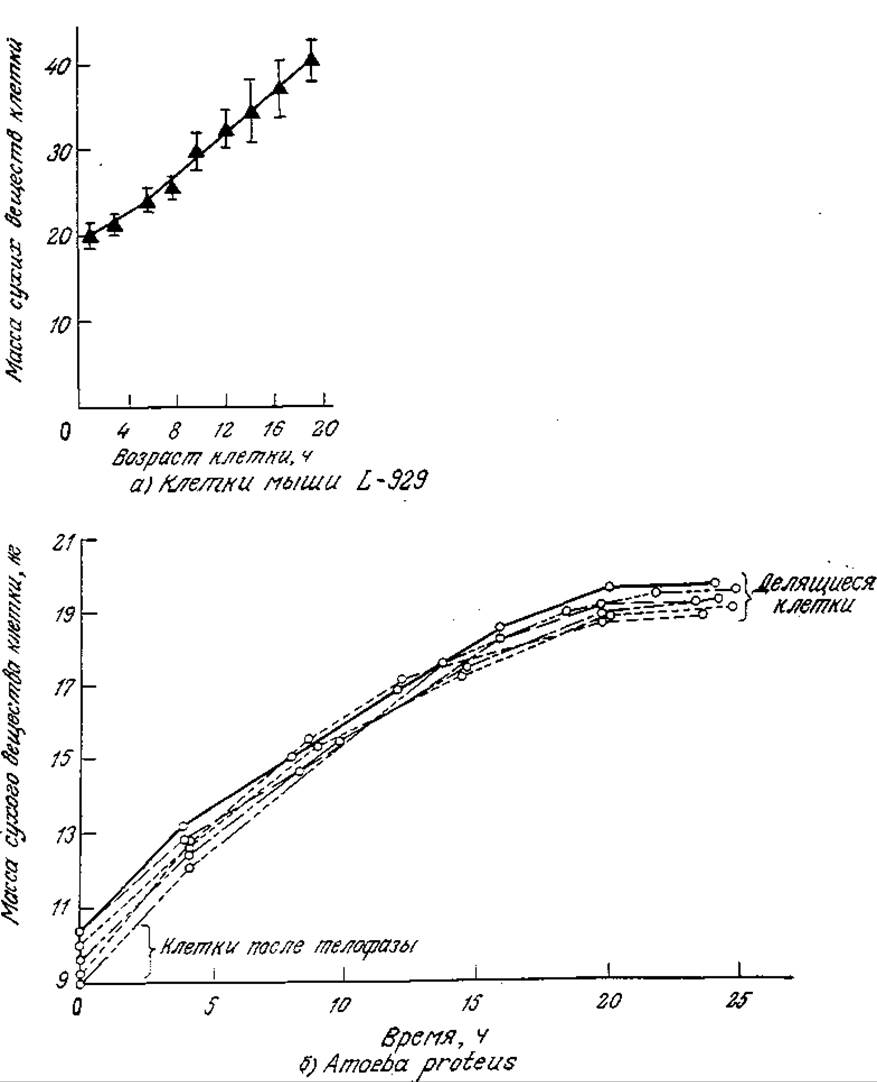
FIG. 6.33. a — Increase in cell mass of mouse tissue during the cell cycle. [Reproduced from: Killander D., Zetterberg A., Quantitative Cytochemical Studies on Interphase Growth. I. Determination of DNA, RNA and Mass Content of Age Determined Mouse Fibroblasts in vitro and of Intercellular Variation in Generation Time, Exp. Cell Res., 38, 272 (1965).] b — increase in mass of Amoeba proteus during the cell cycle; each curve corresponds to one of six different individual cells. [Reproduced from: Prescott M., Relations Between Cell Growth and Cell Division. I. Reduced Weight, Cell Volume, Protein Content, and Nuclear Volume of Amoeba proteus from Division to Division, Exp. Cell Res., 9, 328 (1955).]
Last update: 06/08/2026
Editorial and Educational Adaptation: This material has been compiled based on the primary/original source text. The project team performed an editorial review, corrected technical inaccuracies, structured sections, and adapted the content for an educational format.
What was processed:
- elimination of formatting defects (OCR errors, structural breaks, corrupted characters);
- editorial organization of content;
- standardization of terminology in accordance with academic sources;
- verification of factual statements against the original source text.
All mentions of the author, publication year, and origin of the primary text have been preserved in accordance with the source.