Biochemistry and Molecular Biology - Belyasova N.A. 2002
Metabolism. Processes Requiring Energy Input
Biological Role and Patterns of Antibiotic Biosynthesis
Patterns of Antibiotic Biosynthesis
Antibiotics are secondary metabolites—low-molecular-weight compounds whose Functions are not essential for the growth of pure cultures. Secondary metabolites (antibiotics, Alkaloids, plant growth Hormones, and toxins) are produced by a limited number of taxonomic groups. Unlike primary metabolites, secondary metabolites feature a more complex chemical Structure and are typically formed via lengthy metabolic pathways.
It is well established that The production of antibiotics enhances their producers' competitiveness and serves as a powerful factor in the Struggle for Existence. However, this is not their only role: it has recently been discovered that these substances act as control and regulatory agents in metabolic processes, serving as specific effectors that govern The activity of various enzyme systems. Furthermore, some researchers suggest that antibiotics may act as cellular vehicles through which The Cell rids itself of excess metabolites and reducing equivalents accumulated due to various metabolic factors.
The Biosynthesis of most secondary metabolites, including antibiotics, typically occurs at a specific stage of microbial development under conditions where core anabolic processes—such as the Biosynthesis of Nucleic acids, Proteins, Lipids, and Polysaccharides—are suppressed. Two fundamentally distinct stages of an antibiotic-producer population's development can be distinguished. The First stage, known as the trophophase or balanced growth phase, is characterized by the intensive synthesis of compounds required for cell growth, accompanied by the rapid depletion of key nutrient components in the medium. This phase corresponds to the logarithmic growth phase of a batch microbial culture. Once certain medium ingredients (primarily carbon, nitrogen, and molecular oxygen) are depleted and metabolic products accumulate, the second phase begins (the idiophase, or unbalanced growth phase). The idiophase is marked by a significant slowdown or cessation of microbial population growth, corresponding to the transition into the stationary phase of a batch culture. At this point, proteolytic processes begin to predominate, and autolytic cell breakdown occurs. It is precisely during the idiophase that many microorganisms begin to synthesize secondary metabolites, including antibiotics. These observed patterns are illustrated graphically in Fig. 18.3.
Class="center">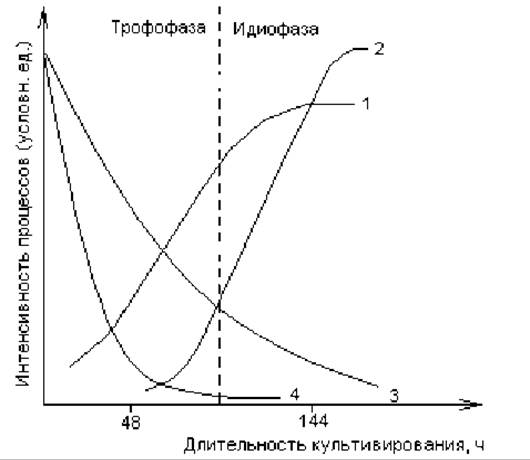
Fig. 18.3. Dynamics of Biochemical Changes in the antibiotic producer culture: 1 — culture growth; 2 — antibiotic accumulation; 3 — carbohydrate consumption; 4 — phosphorus consumption in mineral compounds
In most cases, the peak accumulation of the antibiotic in the culture broth occurs after the peak biomass accumulation. This is because the synthesis of Enzymes responsible for antibiotic production is suppressed (repressed) during the trophophase.
Antibiotic biosynthesis is a genetically fixed trait of living organisms. The genes responsible for these processes can be located on Chromosomes (nucleoids in prokaryotes) as well as on Plasmids.
The regulation of antibiotic synthesis is achieved through various mechanisms: most commonly via catabolite repression, end-product repression of enzyme synthesis, and allosteric inhibition of key biosynthetic enzymes by the antibiotic itself. Additionally, important medium components influencing antibiotic biosynthesis include glucose and phosphates. As a rule, an excess of these substances has a negative impact on antibiotic production.
The antibiotic productivity of an Organism reflects The amount of antibiotic (in micrograms or units) produced per unit mass (typically 1 mg) of dry producer Cells per unit of time (typically 1 h). This parameter depends primarily on the microorganism species, cell growth phase, medium composition, and cultivation conditions. Antibiotic preparations vary in their degree of purity and, consequently, their potency, which is expressed in units of antibiotic activity (U) contained in 1 mg or 1 ml of the preparation. One unit of antibiotic activity is defined as the minimum quantity of pure antibiotic substance capable of inhibiting the growth of a specific number of cells of a standard microorganism strain (the test microbe) per unit volume of culture broth. For example, 1 U of streptomycin is equivalent to 1 mcg of the pure base of this substance, whereas 1 U of penicillin corresponds to 0.6 mcg of benzylpenicillin sodium salt. In this context, E. coli is used as the test microbe for streptomycin, and Staphylococcus aureus for penicillin.
Last update: 06/08/2026
Editorial and Educational Adaptation: This material has been compiled based on the primary/original source text. The project team performed an editorial review, corrected technical inaccuracies, structured sections, and adapted the content for an educational format.
What was processed:
- elimination of formatting defects (OCR errors, structural breaks, corrupted characters);
- editorial organization of content;
- standardization of terminology in accordance with academic sources;
- verification of factual statements against the original source text.
All mentions of the author, publication year, and origin of the primary text have been preserved in accordance with the source.