Biochemistry and Molecular Biology - Belyasova N.A. 2002
Metabolism. Processes Leading to Energy Storage
Respiration
Characteristics of Respiratory Chain Components
The Components of the Respiratory Chain are Carriers of Reducing equivalents, including both hydrogen and electron carriers. Their arrangement within the membrane is strictly ordered: hydrogen carriers alternate with electron carriers, and superior electron Donors always precede superior acceptors.
Since electron and hydrogen transport are coupled and equivalent processes, the respiratory chain can be viewed as an Electron Transport Chain. Its core components are Flavoproteins, iron-sulfur Proteins, Quinones, and Cytochromes.
Flavoproteins. These are Enzymes containing FMN or FAD as prosthetic groups. These carriers of reducing equivalents are detailed in Chapter 7. It should be emphasized that flavin Cofactors transport hydrogen and are stronger oxidizing agents than NAD+.
Iron-sulfur proteins. These redox systems contain iron atoms coordinated, on the one hand, with the sulfur of Cysteine amino acid residues and, on the other hand, with inorganic sulfide sulfur. Iron-sulfur centers (Fig. 12.1) can be regarded as prosthetic groups of enzymes, albeit with a Structure distinct from heme. Consequently, iron-sulfur proteins are also referred to as Non-heme iron proteins.
The number of iron and sulfide sulfur atoms in these proteins can vary, but the most prevalent forms contain 2Fe, 2S2- and 4Fe, 4S2-. Iron-sulfur proteins transfer electrons exclusively. Specifically, 2Fe, 2S2- centers transport one electron at a time. In this process, electrons are not localized on atoms of any single type, but rather interact with both iron and sulfur nuclei, existing in a delocalized state.
Iron-sulfur proteins participate in MOLECULAR Nitrogen Fixation by Nitrogenase systems, sulfite and nitrite reduction, Photosynthesis, and alkane oxidation.
Quinones. These are low-molecular-weight hydrogen carriers present within Cell/29.html">The Lipid Bilayer of mitochondrial membranes in a 10- to 15-fold excess compared to Other components of The electron transport system. Owing to a nonpolar hydrophobic chain, quinone molecules move freely within the lipid bilayer. Several families of quinones exist, the most widespread being ubiquinones (derived from the Latin word for ubiquitous), also known as Coenzymes Q (CoQ). The number of isoprenoid units in a quinone molecule is denoted by a subscript (Qn). Mammalian mitochondrial ubiquinones contain 10 isoprenoid units (Q10), whereas bacterial ubiquinones contain 6 (Q6). Figure 12.1 illustrates the structure and redox stages of ubiquinones.
Other quinone groups include plastoquinones (found in chloroplast membranes, mediating hydrogen transport in Photosystems), tocopherols (Various Forms of vitamin E with antioxidant Functions), and phylloquinones and menaquinones (members of the vitamin K family involved in hydrogen transport in mycobacteria and Blood Coagulation in mammals). Further details on these compounds can be found in Chapter 17.
Class="center">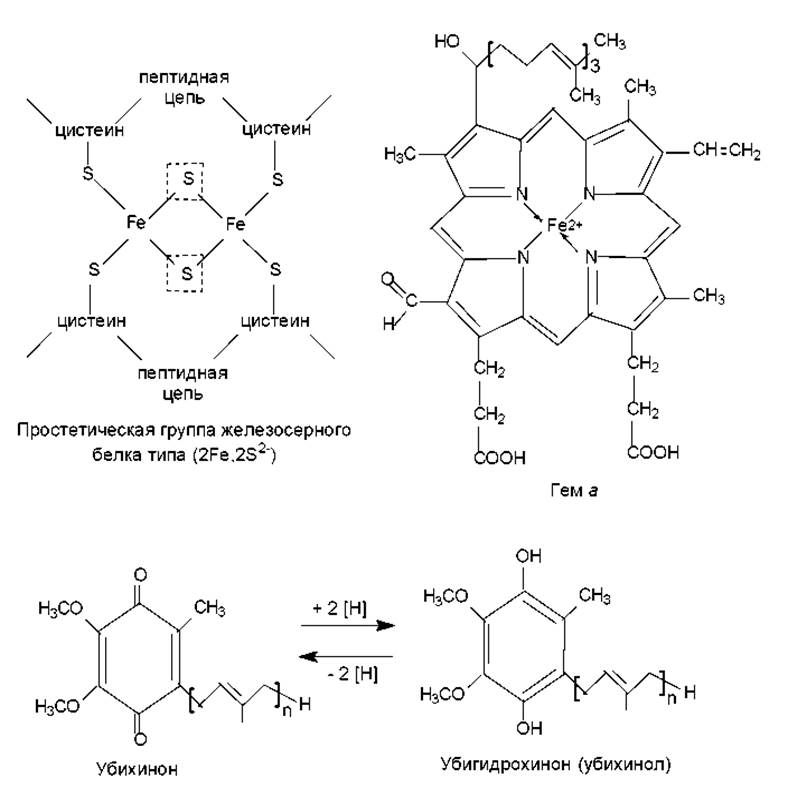
Fig. 12.1. Structure and Functional features of respiratory chain components. Dashed outlines indicate sulfide sulfur capable of being released upon acidification as hydrogen sulfide
Cytochromes. These redox enzyme systems contain heme as a prosthetic group (Fig. 12.1). The central iron atom in heme participates in electron transfer by changing its valence state:
Heme-Fe2+ ↔ Heme-Fe3+ + e
Cytochromes act as electron carriers, and some of them (such as cytochrome oxidase) are capable of transferring electrons directly to molecular oxygen.
Numerous cytochromes have been isolated from various sources. They are conventionally designated by a combination of letters and numbers: letters generally indicate the heme type (e.g., a, b, c, o), while numbers denote the wavelength of the α-band in the absorption spectrum (e.g., 552; 557.5; 450). A crucial feature for the electron transport system is that different cytochromes possess distinct Redox Potentials and are arranged in the membrane in a specific sequential order relative to one another. Cytochrome c is believed to be the only one existing in a solubilized state on the outer surface of The inner mitochondrial membrane.
Last update: 06/08/2026
Editorial and Educational Adaptation: This material has been compiled based on the primary/original source text. The project team performed an editorial review, corrected technical inaccuracies, structured sections, and adapted the content for an educational format.
What was processed:
- elimination of formatting defects (OCR errors, structural breaks, corrupted characters);
- editorial organization of content;
- standardization of terminology in accordance with academic sources;
- verification of factual statements against the original source text.
All mentions of the author, publication year, and origin of the primary text have been preserved in accordance with the source.