BIOCHEMISTRY - Main Regulators and Biological Fluids of the Human Body - 2016
1. ENZYMES
1.4. Factors Affecting Enzyme Activity
The efficiency of enzymatic action depends on several factors: Temperature (the optimum temperature usually ranges from 30 to 50 °С), the pH of the medium, specific substances known as activators and inhibitors, as well as the concentrations of the enzyme and substrate.
1.4.1. Temperature (t, °С)
Because Enzymes are proteinaceous in nature, they are thermolabile. When subjected to elevated temperatures, irreversible Denaturation causes them to lose their native Spatial Structure and, consequently, their biological activity. As a result, The rate of the reaction they catalyze decreases (Fig. 3). However, there are a few thermostable enzymes that retain their catalytic activity at 100 °С, such as myokinase, an enzyme found in Muscle tissue.
Class="center">Fig. 3. Dependence of enzymatic reaction rate on temperature
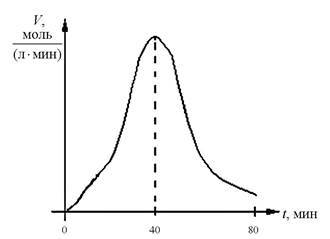
When the temperature drops, enzyme activity decreases, but it is restored once the temperature is raised back to its optimum value.
1.4.2. Medium Reaction (pH)
Changes in the pH of the medium reduce enzyme activity because they alter the charge of the protein molecule and disrupt The structure of the Active Site (Fig. 4).
Fig. 4. Dependence of enzymatic reaction rate on pH
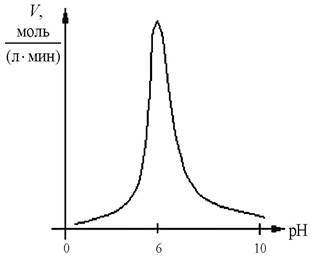
Enzymes exhibit maximal activity at pH = pI (since the net charge of the protein molecule is zero at its isoelectric point).
1.4.3. Substrate Concentration (СE)
As Substrate Concentration increases, the rate of the enzymatic reaction rises up to a certain limit—until all active sites of the enzyme are saturated (Fig. 5).
Fig. 5. Dependence of enzymatic reaction rate on substrate concentration
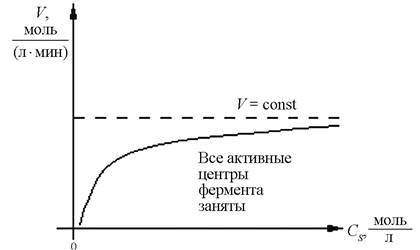
Further increases in substrate concentration have no effect on the reaction rate.
1.4.4. Enzyme Concentration (СЕ)
Increasing the Enzyme Concentration leads to a proportional increase in the rate of the chemical reaction (Fig. 6).
Fig. 6. Dependence of enzymatic reaction rate on enzyme concentration
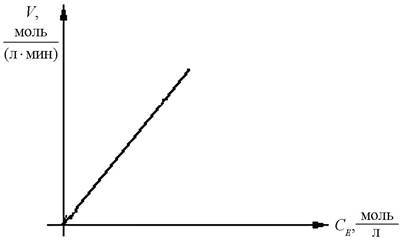
The rate of an enzymatic reaction is directly proportional to the concentration of the respective enzyme.
1.4.5. Activators
Activators increase the rate of a chemical reaction by enhancing enzyme activity. They can be Metal Ions (Na+, К+ , Са2+, Мg2+, Mn2+, Со2+, Ni2+) as well as certain anions, such as Сl-.
For instance, muscle ATPase, which catalyzes The conversion of ATP to ADP, is activated by Са2+ ions:

Сl- ions activate salivary amylase, which breaks down starch into dextrins and maltose.
Many enzymes require the presence of certain non-protein substances—Cofactors—to exhibit catalytic activity.
1.4.6. Inhibitors
Inhibitors suppress enzyme activity. Sometimes the exact same substance can act as both an activator and an inhibitor depending on its concentration. Heavy metal ions (Аg+, Нg2+, Рb2+) inhibit The activity of almost all enzymes.
Last update: 06/08/2026
Editorial and Educational Adaptation: This material has been compiled based on the primary/original source text. The project team performed an editorial review, corrected technical inaccuracies, structured sections, and adapted the content for an educational format.
What was processed:
- elimination of formatting defects (OCR errors, structural breaks, corrupted characters);
- editorial organization of content;
- standardization of terminology in accordance with academic sources;
- verification of factual statements against the original source text.
All mentions of the author, publication year, and origin of the primary text have been preserved in accordance with the source.