BIOCHEMISTRY - Key Regulators and Biological Fluids of the Human Body - 2016
1. ENZYMES
1.3. Mechanism of Enzyme Action
The contact between an enzyme (E) and a substrate (S) occurs via the Active Site, which is typically a small region of the enzyme molecule comprising two distinct zones: the binding site and the catalytic site. The active site incorporates specific segments of the polypeptide chain along with Cofactors. The interaction between the enzyme (E) and the substrate (S) yields an enzyme-substrate complex ES (1) (Fig. 2). Within this enzyme-substrate complex, the chemical bond is less stable than in the free substrate, which lowers the activation energy and leads to The formation of an activated enzyme-substrate complex ES' (2), thereby facilitating the reaction. In the subsequent stage, a chemical reaction takes place converting the substrate into a product (P), resulting in an enzyme-product complex EP (3). This is followed by the release of the reaction product or products (P) from the active site, while the enzyme is regenerated in its unchanged form (E).
Class="center">Fig. 2. METABOLISM/10.html">Mechanism of enzyme Action

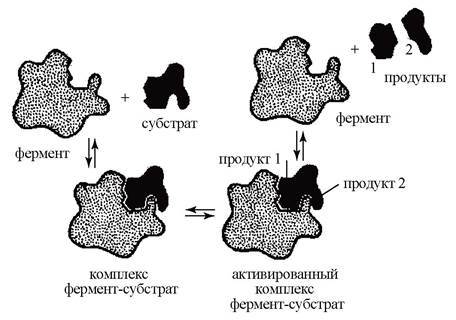
As illustrated in Fig. 2, the enzyme and substrate fit together spatially like a lock and key.
Last update: 06/08/2026
Editorial and Educational Adaptation: This material has been compiled based on the primary/original source text. The project team performed an editorial review, corrected technical inaccuracies, structured sections, and adapted the content for an educational format.
What was processed:
- elimination of formatting defects (OCR errors, structural breaks, corrupted characters);
- editorial organization of content;
- standardization of terminology in accordance with academic sources;
- verification of factual statements against the original source text.
All mentions of the author, publication year, and origin of the primary text have been preserved in accordance with the source.