Fundamentals of Biochemistry - A. A. Anisimov 1986
Lipids
Glycolipids
Glycolipids contain carbohydrate residues (most commonly D-galactose) within their molecules and lack phosphoric acid. They are found predominantly in Brain Tissues, as well as in Blood Cells and other tissues, playing a vital role in the functioning of Introduction/36.html">Biological Membranes. They are represented by glycosyldiacylglycerols and glycosphingolipids.
8.4.1. Glycosyldiacylglycerols. Their molecule comprises glycerol esterified with two fatty acid residues and one or two monosaccharide molecules linked to glycerol via a ß-glycosidic bond. D-galactose is the most frequent carbohydrate component, with D-glucose occurring less commonly. These form the polar HEAD of the lipid. Unlike phosphatidylsugars, the glycosyldiacylglycerol molecule contains no phosphate. Examples of such glycolipids include monogalactosyldiacylglycerol and digalactosyldiacylglycerol. They were isolated from plant leaves, where their concentration is approximately 5 times higher than that of Phospholipids from photosynthetic Bacteria.
Class="center">
Galactolipids appear to be specifically associated with METABOLISM/14.html">Chloroplasts. None of the glycolipids listed above have been detected in animal tissues.
8.4.2. Glycosphingolipids. Structurally similar to sphingophospholipids, they can be considered derivatives of ceramide, yet they contain no phosphorus or nitrogenous bases. Glycosphingolipids incorporate one or more carbohydrate residues. Depending on the number and composition of their monosaccharide residues, they are classified into cerebrosides, ceramideligosaccharides, and gangliosides.
Cerebrosides. These are ceramide Monosaccharides. Glycolipids of this type are abundant in nerve Cell membranes (in myelin sheaths). Upon Hydrolysis of 1 mol of cerebroside, 1 mol each of sphingosine, a fatty acid, and a hexose (most frequently galactose, less commonly glucose) is formed. For this reason, members of this lipid group are often referred to as galactosphingolipids or glucosphingolipids. The hexose residue in cerebroside molecules is attached by a ß-glycosidic bond. The Fatty acids most commonly found in cerebrosides are nervonic, cerebronic, and lignoceric acids, containing 24 carbon atoms.

Esterification of cerebrosides with sulfate at the C-3 position of the hexose yields cerebroside sulfatides. Like cerebrosides, they are located in the White matter OF the brain.
Ceramide Oligosaccharides. The molecular Structure of this group of glycosphingolipids includes heterooligosaccharides linked via a glycosidic bond to ceramide. They can exist as ceramide trisaccharides, ceramide tetrasaccharides, and so forth.
Gangliosides. Structurally similar to ceramide oligosaccharides, gangliosides invariably contain at least one sialic acid residue. They are highly complex, carbohydrate-rich Lipids. Unlike cerebrosides, they are localized in the Gray matter of the brain on the outer surface of cell membranes. Gangliosides contain D-glucose, D-galactose, N-acetylglucosamine, N-acetylgalactosamine, and N-acetylneuraminic acid, which together form a complex hydrophilic head.
Due to the presence of a carboxyl group in the N-acetylneuraminic acid residue, all gangliosides are acidic compounds. In the gray matter of the brain, gangliosides account for approximately 6% of Membrane Lipids.
Gangliosides are synthesized via successive, ordered reactions in which ceramides interact with nucleoside diphosphate sugars, resulting in the attachment of monosaccharide residues and their derivatives to the ceramide. The structure of the resulting ganglioside is determined by the Specificity of the cell's Glycosyltransferases. Altogether, more than 20 different gangliosides have been described to date.
Alongside their continuous synthesis, gangliosides are constantly degraded (within Lysosomes) through the sequential removal of terminal carbohydrate residues. Impairments in a cell's ability to degrade gangliosides lead to severe clinical consequences.
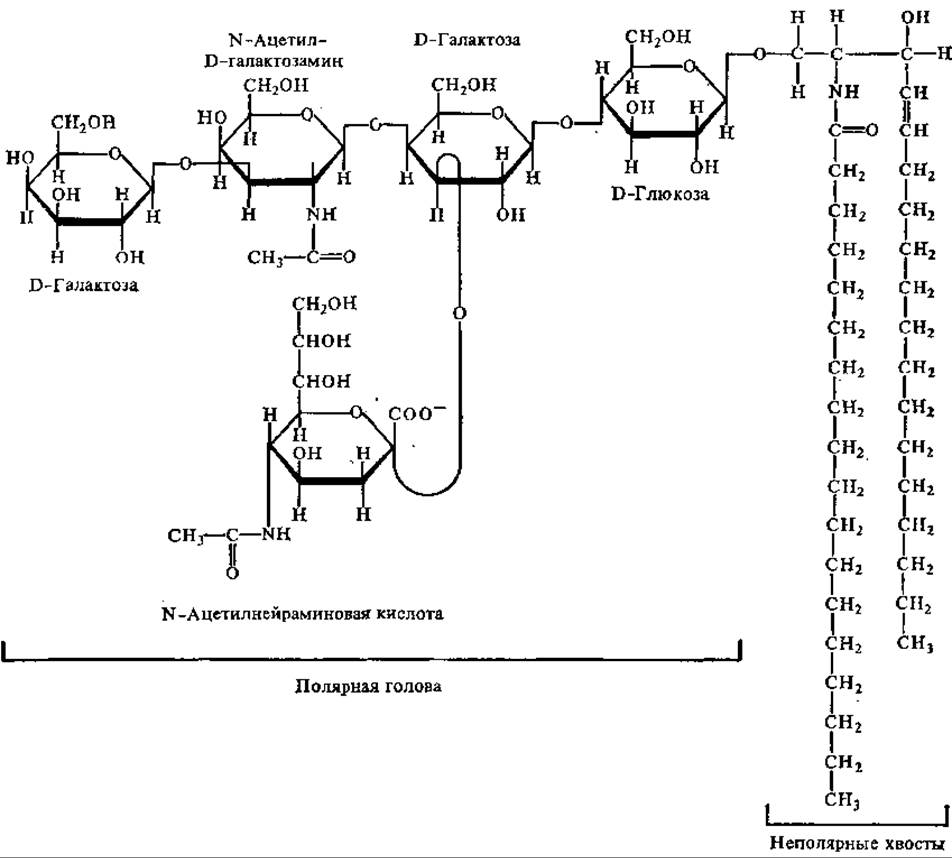
Glycosphingolipids, particularly gangliosides, are involved in signal reception processes in cells. They play an active role in monitoring and regulating intercellular contacts, as well as in the reception of Peptide Hormones, serotonin, certain Viruses, and Bacterial toxins. Because the structure and composition of gangliosides are genetically controlled by glycosyltransferases, they exhibit high tissue specificity and function as cell-surface Antigens.
Last update: 06/08/2026
Editorial and Educational Adaptation: This material has been compiled based on the primary/original source text. The project team performed an editorial review, corrected technical inaccuracies, structured sections, and adapted the content for an educational format.
What was processed:
- elimination of formatting defects (OCR errors, structural breaks, corrupted characters);
- editorial organization of content;
- standardization of terminology in accordance with academic sources;
- verification of factual statements against the original source text.
All mentions of the author, publication year, and origin of the primary text have been preserved in accordance with the source.