Amino Acids, Peptides and Proteins - Dévényi T., Gergely J. 1976
Some methodological aspects of analytical protein research
Study of native proteins
Protein fractionation by gel filtration
Gel filtration, developed by Porath and Flodin in 1959 [15], was a major breakthrough in The Development of protein fractionation by molecular weight. The material used as the stationary phase in this method is known by the trade name Sephadex and is a Water-insoluble, highly hydrophilic cross-linked dextran with a porous Structure. Due to its numerous hydrophilic groups, it is capable of Swelling in water and aqueous salt solutions, forming a gel that can act as a molecular sieve in separating substances of different molecular weights. The pore size of this sieve is determined by the cross-linking density in the dextran. The closer the cross-links are to each other, the denser the spatial framework of the gel and, consequently, the lower the water-binding capacity of Sephadex.
If a solution containing substances of different molecular weights is passed through a Column packed with Sephadex gel, smaller molecules will penetrate into the interior of the gel-forming beads, and As a result, their migration through the column will be retarded. At the same time, substances of higher molecular weight do not penetrate into the gel beads and migrate faster than smaller molecules. These different migration rates lead to the Separation of substances as they pass through the 'molecular sieves'.
Pharmacia (Sweden) manufactures 18 types of Sephadex (without ion-exchange properties), which differ from each other in their cross-linking density. The MOST IMPORTANT PROPERTIES of Sephadex are shown in Table 2. The symbol indicating the type of Sephadex (G-25, G-50, etc.) denotes the porous structure (G) and the water regain value per gram of dry Sephadex weight, i.e., it indicates the cross-linking density of the dextran. For Sephadex types with a high index value, the number indicates the lower limit of molecular weight (in thousands) of substances that do not penetrate into the gel beads. For example, substances with a Molecular Weight of less than 100,000 can penetrate into Sephadex G-100 beads, whereas substances with larger molecules elute in the void volume of the solution.
Due to the properties listed above, Sephadex is widely used in The Study of Cell/13.html">Protein Structure. Most commonly, it is employed for separating Proteins based on molecular weight, purifying protein fractions, concentrating dilute protein solutions, and Desalting protein preparations.
Gel filtration is increasingly used for the fractionation of Serum proteins. Sephadex G-200 is the most suitable for this purpose. Serum proteins elute from a column of this gel in three peaks. The first peak corresponds mainly to Lipoproteins and macroglobulins, the second peak yields IgG, and the third peak contains primarily albumin and transferrin. In principle, gel filtration on G-200 can also be used for the isolation of IMMUNOGLOBULINS.
Class="center">Table 2 Types of Sephadex
Type |
Particle size, µm |
Water regain, ml/g dry gel |
Swelling volume, ml/g dry gel |
Fractionation range (molecular weight) |
G-10 |
40—120 |
1,0 ± 0,1 |
2—3 |
—700 |
G-15 |
40—120 |
1,5 ± 0,2 |
2,5—3,5 |
— 1 500 |
G-25 Coarse |
100—300 |
2,5 ± 0,2 |
4—6 |
1000—5 000 |
G-25 Medium |
50—150 |
2,5 ± 0,2 |
4—6 |
1000—5 000 |
G-25 Fine |
20—80 |
2,5 ± 0,2 |
4—6 |
1000—5 000 |
G-25 Superfine |
10—40 |
2,5 ± 0,2 |
4—6 |
1000—5000 |
G-50 Coarse |
100—300 |
5,0 ± 0,3 |
9—11 |
1500—30 000 |
G-50 Medium |
50—150 |
5,0 ± 0,3 |
9—11 |
1500—30 000 |
G-50 Fine |
20—80 |
5,0 ± 0,3 |
9—11 |
1500—30 000 |
G-50 Superfine |
10—40 |
5,0 ± 0,3 |
9-11 |
1500—30 000 |
G-75 |
40—120 |
7,5 ± 0,5 |
12—15 |
3000—70 000 |
G-75 Superfine |
10—40 |
7,5 ± 0,5 |
12—15 |
3000—70 000 |
G-100 |
40—120 |
10,0 ± 1,0 |
15—20 |
4000—150 000 |
G-100 Superfine |
10—40 |
10,0 ± 1,0 |
15—20 |
4000—150 000 |
G-150 |
40—120 |
15,0 ± 1,5 |
20—30 |
5000—400 000 |
G-150 Superfine |
10—40 |
15,0 ± 1,5 |
20—30 |
5000—400 000 |
G-200 |
40—120 |
20,0 ± 2,0 |
30—40 |
5000—800 000 |
G-200 Superfine |
10—40 |
20,0 ± 2,0 |
30—40 |
5000—800 000 |
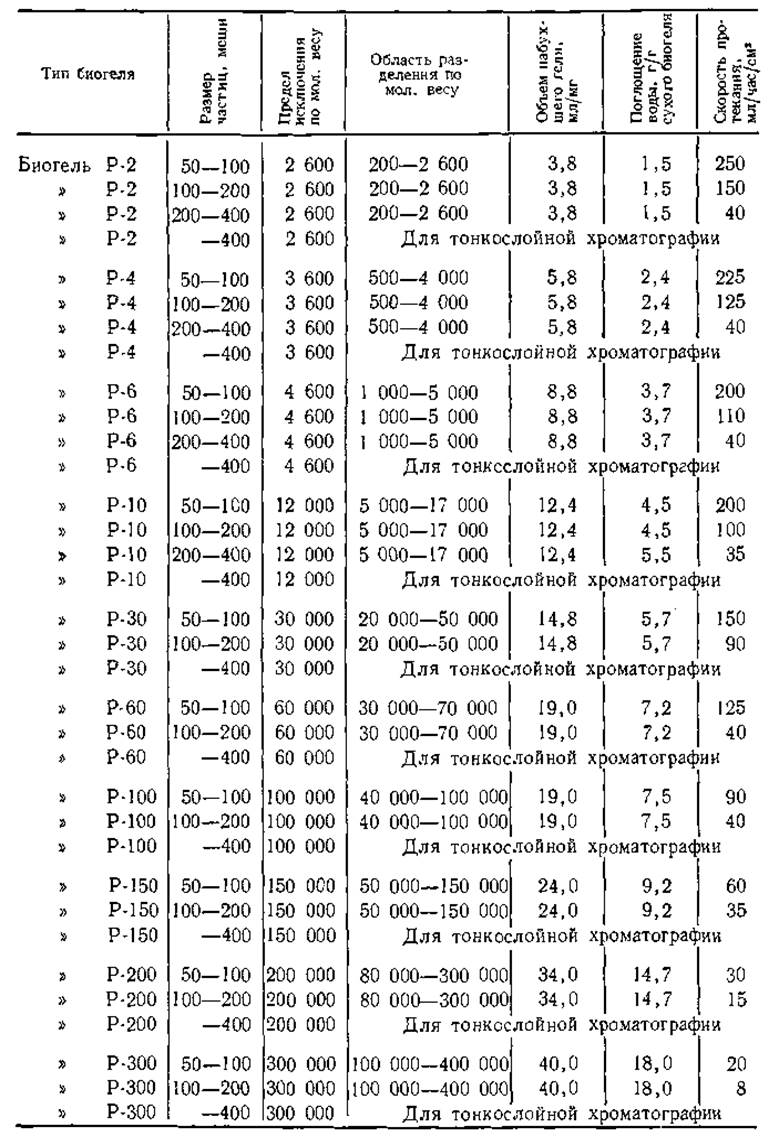
Since 1962, polyacrylamide gels have been used in Chromatography [5, 8]. Bio-Rad Laboratories manufactures more than 30 chromatography gels under the trade name Bio-Gels (Table 3). Dry Bio-Gels, like Sephadex, swell in water and exhibit similar properties over a pH range of 2 to 11. The first report on Gel chromatography in Agar was made by Polson in 1961 [14]. The main feature of agar and agarose gels is their suitability for the fractionation of high-molecular-weight substances that cannot be resolved on Sephadex G-200 or Bio-Gel P-300.
Agar and agarose liquefy upon heating. Consequently, their gels lose stability at temperatures above 50°C. They cannot be used at pH below 4.5 or above 9.0; therefore, when working with these gels, it is extremely important to follow the manufacturer's instructions regarding Temperature and pH. The following agarose gels are commercially available: Sagavac (Seravac Laboratories), Sepharose (Pharmacia Fine Chemicals), Gelarose (Litex), and Bio-Gel A (Bio-Rad Laboratories).
Table 3 Types of Bio-Gels
Last update: 06/08/2026
Editorial and Educational Adaptation: This material has been compiled based on the primary/original source text. The project team performed an editorial review, corrected technical inaccuracies, structured sections, and adapted the content for an educational format.
What was processed:
- elimination of formatting defects (OCR errors, structural breaks, corrupted characters);
- editorial organization of content;
- standardization of terminology in accordance with academic sources;
- verification of factual statements against the original source text.
All mentions of the author, publication year, and origin of the primary text have been preserved in accordance with the source.