Vertebrate Zoology - V. M. Konstantinov 2011
Chordates
Gnathostomes
Class Osteichthyes - Subclass Sarcopterygii - Superorder Dipnoi
Lungfishes (Dipnoi) are a small, ancient, and highly distinctive group of freshwater Fishes that combine primitive features with adaptations for high specialization to life in oxygen-depleted waters. For instance, the greater part of the Skeleton in modern representatives remains cartilaginous throughout life. A well-developed notochord persists. THE Vertebral Column is represented by the rudiments of the upper and lower vertebral arches. The cranium is cartilaginous at the base, with a few dermal bones and bony tooth plates. As in cartilaginous fishes, the intestine features a spiral valve, and The Heart possesses a pulsating conus arteriosus. All these are traits of a primitive Organization.
Along with this, in lungfishes the palatoquadrate Cartilage is fused directly to the cranium (autostyly). The caudal fin merges with the dorsal and anal fins (diphycercal). Paired fins possess a broad, fleshy lobe, but are structured on the plan of biserial fins. In protopterids, they become greatly attenuated and acquire a whip-like shape. The most remarkable feature of lungfishes is the presence of pulmonary Respiration In addition to gill breathing. One or two pulmonary sacs, opening on the ventral side of the Esophagus, function as Organs of aerial respiration. These structures are apparently not homologous to the swim bladder of teleost fishes. The nostrils are patent, leading into the Oral Cavity, and serve for pulmonary respiration. Blood enters the Lungs via specialized vessels branching off from the posterior (IV) pair of gill Arteries. These vessels are evidently homologous to pulmonary arteries. Special vessels carrying blood to the heart depart from the "lungs": they can be considered homologs of the Pulmonary Veins (Fig. 44). The atrium contains a small septum that partially divides it into left and right halves. The left part of the atrium receives blood from the pulmonary veins, while the right receives all other blood from the Cuvierian ducts and the posterior vena cava. It should be emphasized that the vena cava is absent in ray-finned fishes, and this vessel is characteristic of terrestrial vertebrates. The vena cava arises through the splitting of the right cardinal vein.
Progressive features of lungfishes also include the strong Development of the Forebrain. Finally, the Urogenital System is close to that of cartilaginous fishes and amphibians.
The superorder Dipnoi is represented by a single order, Ceratodontiformes, with two families: Ceratodontidae (or Monopneumones) and Lepidosirenidae (or Dipneumones).
Class="center">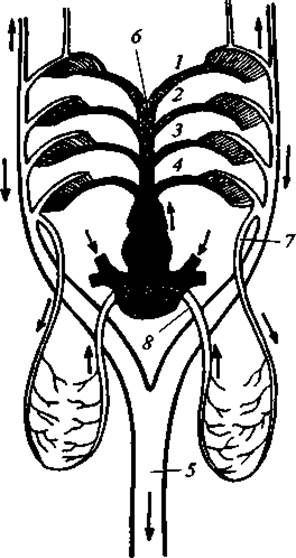
Fig. 44. Diagram of arterial Blood Circulation in a lungfish:
1 — 4 — pairs of gill aortic arches; 5 — dorsal aorta; 6 — ventral aorta; 7 — pulmonary artery; 8 — pulmonary vein
Last update: 13/08/2026
Editorial and Educational Adaptation: This material has been compiled based on the primary/original source text. The project team performed an editorial review, corrected technical inaccuracies, structured sections, and adapted the content for an educational format.
What was processed:
- elimination of formatting defects (OCR errors, structural breaks, corrupted characters);
- editorial organization of content;
- standardization of terminology in accordance with academic sources;
- verification of factual statements against the original source text.
All mentions of the author, publication year, and origin of the primary text have been preserved in accordance with the source.