Vertebrate Zoology - V. M. Konstantinov 2011
Chordates
Gnathostomes
Class Osteichthyes - Subclass Sarcopterygii - Superorder Dipnoi - Order Ceratodontiformes
The only living representative of the family Ceratodontidae is the Australian lungfish, or neoceratodus (Neoceratodus forsteri). It is the largest of all extant lungfishes, reaching up to 175 cm in length. It is native to the rivers of Queensland in northeastern Australia. A key anatomical feature is the presence of a single, unpaired lung sac. The gills are well developed. Neoceratodus is capable of Respiration using both gills and the lung simultaneously, or either organ independently, enabling it to inhabit heavily overgrown Water bodies. In summer, due to decomposing plant debris, severe drought, and oxygen depletion in the water, the neoceratodus relies predominantly or even exclusively on pulmonary breathing. The fish frequently surfaces to gulp air, producing a loud champing sound in the process. In autumn, as the water bodies refill with fresh water, Structure/19.html">The Importance of lung breathing decreases, and Blood oxygenation is maintained primarily through gill respiration. Neoceratoduses inhabit permanent water bodies and do not aestivate. They dwell near the bottom, frequently resting on the substrate. Their diet consists of crustaceans, Molluscs, and worms. They reproduce by spawning and laying eggs among aquatic vegetation.
Class="center">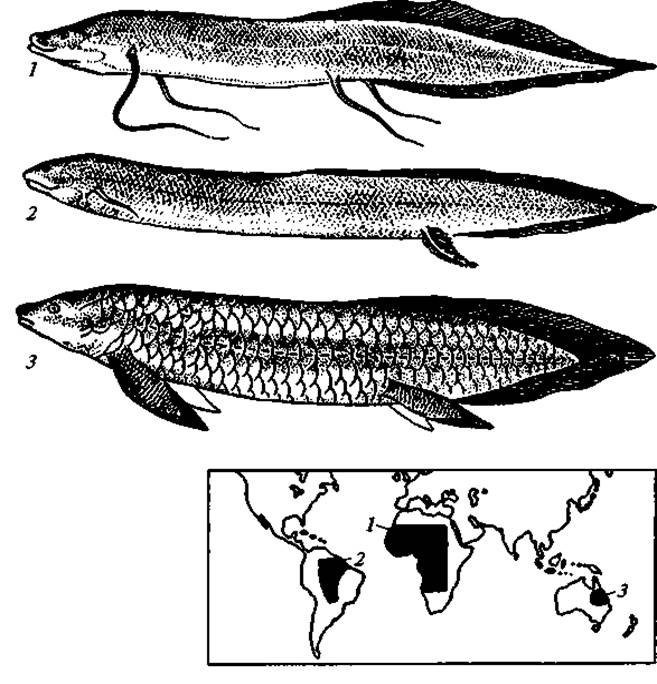
Fig. 45. Lungfishes and their distribution:
1 — African protopterus; 2 — American lepidosiren; 3 — Australian neoceratodus
Family Lepidosirenidae (or Dipnevmones)
The family Lepidosirenidae comprises five species: four belong to the genus Protopterus and inhabit tropical Africa, while a single species of the genus Lepidosiren is native to central South America, specifically the Amazon River basin (Fig. 45).
A notable adaptation is their ability to survive throughout their lives in water bodies that dry up for extended periods—up to 9 months. They aestivate by burrowing into the bottom mud, with Protopterus species even forming a protective mucous cocoon.
Local populations fish for both protopterids and lepidosirens, as these fish possess flavorful and highly palatable meat.
Last update: 13/08/2026
Editorial and Educational Adaptation: This material has been compiled based on the primary/original source text. The project team performed an editorial review, corrected technical inaccuracies, structured sections, and adapted the content for an educational format.
What was processed:
- elimination of formatting defects (OCR errors, structural breaks, corrupted characters);
- editorial organization of content;
- standardization of terminology in accordance with academic sources;
- verification of factual statements against the original source text.
All mentions of the author, publication year, and origin of the primary text have been preserved in accordance with the source.