Vertebrate Zoology: A Tutorial - T. A. Dauda 2014
Metazoans
Fishes
Class Bony Fishes - Subclass Sarcopterygii - Superorder Crossopterygii
Coelacanths were widespread during the Paleozoic era of Earth's history. It was long believed that they had entirely died out. However, in 1938, a specimen of these ancient fish—known as the coelacanth or latimeria (Fig. 18)—was caught in the Indian Ocean. In subsequent years, they have been captured in this ocean on multiple occasions. Unlike their freshwater ancestors, they have adapted to Life in the saline waters of the oceans.
Class="center">
Fig. 18. Latimeria (Coelacanth)
Coelacanths typically range from 125 to 180 cm in length and weigh between 25 and 80 kg. Their mouths are armed with sharp Teeth. Their bodies are covered with thick, rounded or rhombic bony scales. They inhabit depths of 400–1000 m, at Water temperatures ranging from 10 to 14°C, and tend to avoid light.
Several primitive Anatomical Features are readily noticeable: the notochord persists throughout their lifetime; vertebrae are rudimentary; and the Skull is largely cartilaginous. Alongside these traits, however, they also exhibit progressive features. Their body cavity contains a lung filled with fat. Although non-functional today, it likely enabled ancient extinct coelacanths to breathe atmospheric air.
The Skeleton of their paired fins has a unique Structure. It is anchored by a fleshy lobe, at the tip of which fin rays are located. The fin skeleton bears a striking resemblance to a pentadactyl limb, containing distinct elements comparable to a single humerus, two forearm bones, and a series of hand bones.
Limbs of this type could have been used not only for maneuvering in water but also for locomotion across solid surfaces.
Thus, coelacanths represent a group of fish whose ancient freshwater ancestors gave rise to the first amphibians.
REVIEW AND SELF-Test Questions:
1. What general organizational features characterize the superclass Pisces (fish)?
2. What structural traits are characteristic of cartilaginous fish? Describe their size, general appearance, body regions, fin placement, integument, skeleton, musculature, Digestive System, respiratory Organs, Circulatory system, Nervous system, and reproduction.
3. How do representatives of sharks and rays differ from other fish orders?
4. What are the General Structural Features of bony fish?
5. What organizational and ecological features are typical of chondrosteans (cartilaginous ganoids)?
6. What is the internal and External structure of ray-finned fish?
7. What Similarities and differences exist among Representatives of the orders Clupeiformes, Cypriniformes, Anguilliformes, Gasterosteiformes, Esociformes, Perciformes, Gadiformes, and Pleuronectiformes?
8. What makes coelacanths particularly interesting from a biological standpoint?
ORIGIN AND EVOLUTION of Fish
The ESTABLISHMENT OF THE superclass Pisces—marked by the appearance of the most primitive fish and their subsequent divergence—took place during the Early to Mid-Silurian period (Paleozoic era). It is widely believed that fish originated in freshwater environments, and only later did various groups independently colonize the seas.
It is hypothesized that fish diverged from primitive, jawless pteraspidomorphs that inhabited fresh waters. Two distinct groups arose from early, yet independent, primitive jawed vertebrates: placoderms and Gnathostomes.
Cartilaginous fish likely branched off from some primitive gnathostomes in the Early Devonian, whereas a separate Lineage of primitive gnathostomes gave rise to bony fish toward the end of the Silurian.
Due to the scarcity and poor preservation of the fossil record, tracing the precise evolutionary pathways of individual groups remains challenging.
Fish evolution followed complex trajectories: numerous groups emerged, some of which subsequently went extinct. In several instances, evolution proceeded via convergence, whereby distantly related groups developed similar adaptations, leading to secondary morphological and physiological similarities.
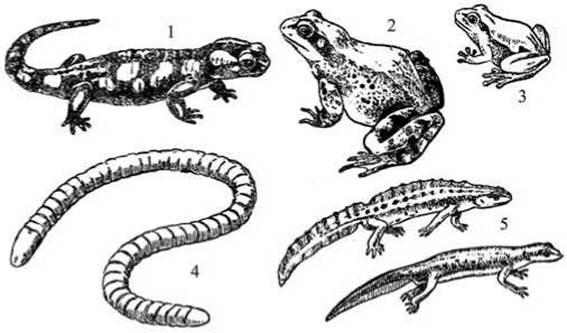
Fig. 19. Representatives of the Class Amphibia:
1 — spotted salamander; 2 — common frog; 3 — tree frog; 4 — ringed caecilian; 5 — smooth newt (top — male, bottom — female).
Last update: 13/08/2026
Editorial and Educational Adaptation: This material has been compiled based on the primary/original source text. The project team performed an editorial review, corrected technical inaccuracies, structured sections, and adapted the content for an educational format.
What was processed:
- elimination of formatting defects (OCR errors, structural breaks, corrupted characters);
- editorial organization of content;
- standardization of terminology in accordance with academic sources;
- verification of factual statements against the original source text.
All mentions of the author, publication year, and origin of the primary text have been preserved in accordance with the source.