Biological Membranes - A. N. Ogurtsov 2012
Structure and Functions of Biomembranes
Structure of Lipid Membranes
Liquid-Crystalline State of Biomembranes
The fundamental difference between a solid and a liquid lies in the presence or absence of long-range order and in the duration molecules spend near their equilibrium positions between successive jumps. The sojourn time of a molecule in a liquid is much shorter than in a solid.
Under physiological conditions, lipid bilayer membranes are in a liquid state, and the sojourn time of phospholipid molecules within the membrane is very short: τ ≈10-7 - 10-8 s. At the same time, molecules within the membrane are not randomly distributed; a long-range order is observed in their arrangement. Phospholipid molecules reside in a double layer, with their hydrophobic tails running approximately parallel to each other. Order is also evident in the orientation of the polar hydrophilic HEAD groups.
The physical state characterized by long-range order in the mutual orientation and arrangement of molecules, combined with a liquid aggregation state, is known as the liquid-crystalline state.
Liquid crystals are not formed by all substances, but rather by substances composed of "long molecules" whose transverse dimensions are smaller than their longitudinal ones (Figure 23).
Several types of liquid-crystalline structures can exist:
✵ nematic (thread-like), in which long molecules are oriented parallel to one another (Figure 23(a));
✵ smectic (soap-like), in which molecules are parallel to each other and arranged in layers (Figure 23(b));
✵ cholesteric, in which molecules lie parallel to one another within a single plane, but their orientations vary across different planes, being rotated by a certain angle in one plane relative to another (Figure 23(d)).
Cell/29.html">The Lipid Bilayer phase of Introduction/36.html">Biological Membranes corresponds to the smectic (Figure 23(b)) liquid-crystalline state.
Liquid-crystalline structures are sensitive to changes in Temperature, pressure, chemical composition, and the presence of an electric field. This accounts for the dynamic nature of lipid bilayer membranes—their structural adaptability to various, even slight, changes in environmental conditions or chemical composition.
Class="center">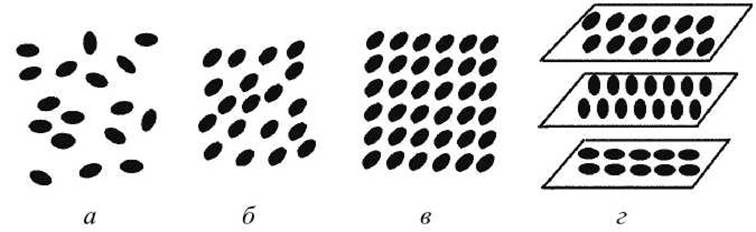
Figure 23 - Possible molecular arrangements in liquid crystals: a - in the amorphous phase, b - in the nematic state, c - in the smectic state, d - in the cholesteric state
The viscosity of the membrane's liquid-crystalline phase and its propensity to undergo a transition into a gel-like state depend on the membrane Lipid Composition, The Structure of the hydrophobic phospholipid tails, and temperature.
The hydrophobic effect and Van der Waals interactions drive the aggregation of non-polar phospholipid tails. Notably, longer tails with saturated C-C bonds exhibit maximal aggregation, resulting in The formation of gel-like membranes. Conversely, Phospholipids with shorter fatty acid tails, which have significantly smaller contact areas with neighboring molecules, form more fluid bilayers.
Similarly, sharp bends in fatty acid tails (kinks) caused by unsaturated C=C bonds weaken van der Waals interactions with neighboring molecules (compared to their saturated counterparts) and consequently lead to the "fluidization" of the bilayer.
Thus, for example, the introduction of an unsaturated bond into the 18-carbon tail of stearic acid (melting point +69.6 °C, Figure 24(a)) yields oleic acid, which has a melting point of +13.4 °C (Figure 24(b)). The 18-carbon linoleic acid, featuring two unsaturated bonds in its tail, melts at -5 °C (Figure 24(c)), whereas linolenic acid (Figure 24(d)) and its isomer γ-linolenic acid (Figure 24(e)), both possessing three kinks in their tails, have a melting point of -11 °C.
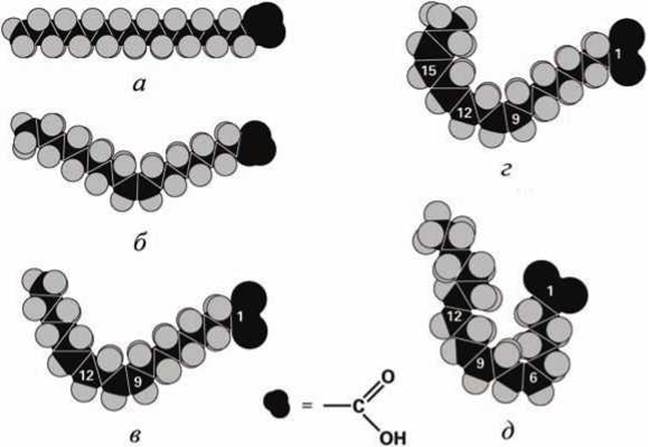
Figure 24 - 18-Carbon Fatty acids: a - stearic, b - oleic, c - linoleic, d - linolenic, e - γ-linolenic
Heating a highly ordered gel-like bilayer increases the amplitude of motion within the lipid fatty acid tails, driving a transition to a more fluid, disordered state known as the gel —> liquid crystal phase transition (Figure 25).
At physiological temperatures, the inner Hydrophobic core of natural membranes typically exhibits low viscosity and behaves as a liquid.

Figure 25 - Gel-to-liquid crystal phase transition upon membrane heating
In the gel state, molecules are packed even more orderly than in the liquid-crystalline state. All hydrophobic hydrocarbon tails of the phospholipid molecules in the gel phase are fully extended and strictly parallel to one another (adopting an all-trans conformation).
In a liquid crystal, thermal motion permits trans-gauche isomerizations; the molecular tails bend, disrupting their parallel alignment in localized regions, particularly near the center of the membrane. Consequently, the thickness of the membrane in the gel phase exceeds that in the liquid-crystalline state.
Upon transitioning from the solid to the liquid-crystalline state, the membrane volume increases slightly due to a significant rise in the surface area per lipid molecule (from 0.48 nm2 to 0.58 nm2). For proper functioning, the membrane must remain in the liquid-crystalline state.
Therefore, living systems exhibit an adaptive shift in The chemical composition of their membranes during prolonged decreases in ambient temperature, which ensures a lower phase transition temperature. This transition temperature decreases as the number of unsaturated bonds in the fatty acid tails increases. A single molecular tail can contain up to four unsaturated bonds. Depending on the lipid membrane's chemical composition, the gel-to-liquid crystal phase transition temperature can range from - 20 °С (for membranes composed of unsaturated Lipids) to +80°С (for saturated lipids).
Microorganisms, as well as PLANT AND ANIMAL Cells, show an increase in the proportion of unsaturated Membrane Lipids when subjected to lower environmental temperatures.
A classic example of cellular membrane adaptation to temperature conditions is the variation in the phase transition temperature—achieved by altering the Chemical composition of membrane lipids—in the reindeer's leg. In winter, the temperature along a reindeer's leg from the hoof to the body can range from -20 °С to +30°С. Consequently, The Cell membranes in the distal portion of the leg contain a higher concentration of unsaturated phospholipids.
It is hypothesized that the primary mechanism of cryoinjury (Damage caused by cooling) in biological membranes is linked to their transition into a gel state. To mitigate this, biological membranes contain significant amounts of Cholesterol, which dampens the structural changes associated with the phase transition.
During phase transitions between the gel and liquid-crystalline states (and vice versa), transmembrane channels with a radius of ~2 nm can form within the lipid bilayer, allowing ions and low-molecular-weight substances to cross the membrane. As a result, ionic conductivity can spike dramatically at the phase transition temperature. This surge in membrane permeability may actually protect the cell from cryoinjury by facilitating the efflux of Water and salts, thereby preventing intracellular ice crystallization.
In certain microorganisms, biological membranes exist at temperatures only slightly above the lipid phase transition point. This temperature-induced increase in ionic conductivity may play a role in sustaining their metabolic activity. Furthermore, this phenomenon is of great interest for explaining thermo- and chemoreception.
Ion transport across membranes forms The basis of biopotential generation, and shifts in ionic conductivity drive nerve impulses. It is entirely plausible that the neural signals indicating a drop or rise in temperature (thermoreception) are triggered by Changes in the ionic permeability of the lipid bilayer during the phase transition of membrane lipids.
Certain types of chemoreception may also be tied to the phase transition of membrane lipids, given that phase transitions can be triggered not only by temperature fluctuations but also by changes in the chemical COMPOSITION OF THE surrounding medium. For instance, at a constant temperature, a phase transition from the liquid-crystalline to the gel state can be induced by increasing the Ca2+ concentration within the physiological range of 1 to 10 mmol/L in the aqueous solution bathing the membrane.
Cells primarily rely on cholesterol to regulate membrane viscosity. While cholesterol cannot form a bilayer on its own, at physiological concentrations, it intercalates between phospholipids. Cholesterol restricts the random movement of polar phospholipid headgroups on the outer surfaces of the membrane, whereas its effect on the mobility of hydrophobic tails depends heavily on its concentration.
At typical cholesterol concentrations, the interaction between the steroid rings and the long hydrophobic tails of phospholipids restricts their free movement, thereby increasing membrane viscosity. Conversely, when cholesterol levels drop, the steroid rings dissociate from the lipid tails and can even push them apart, promoting the dispersion of the lipid phase and resulting in a decrease in biomembrane viscosity.
Last update: 13/08/2026
Editorial and Educational Adaptation: This material has been compiled based on the primary/original source text. The project team performed an editorial review, corrected technical inaccuracies, structured sections, and adapted the content for an educational format.
What was processed:
- elimination of formatting defects (OCR errors, structural breaks, corrupted characters);
- editorial organization of content;
- standardization of terminology in accordance with academic sources;
- verification of factual statements against the original source text.
All mentions of the author, publication year, and origin of the primary text have been preserved in accordance with the source.