General Microbiology - Schlegel, H. 1987
Electron transport under anaerobic conditions
Hydrogen sulfide production via sulfate reduction
The physiological group of sulfate-reducing Bacteria (also referred to as desulfurizing, sulfate-reducing, or sulfide-producing bacteria) is distinguished by their ability to transfer hydrogen from a substrate to sulfate as the terminal electron acceptor, thereby reducing sulfate to sulfide. This process involves electron transfer and utilizes cytochrome c. Energy is conserved via phosphorylation in the Electron Transport Chain under anaerobic conditions:
Class="center">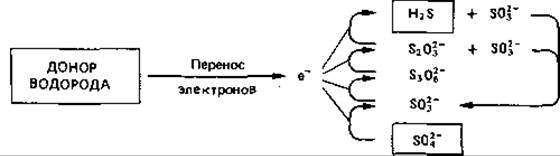
Since this sulfate reduction bears a formal resemblance to Respiration—where oxygen serves as the hydrogen acceptor—it is conventionally termed sulfate respiration or dissimilatory sulfate reduction. The principal product of this process is hydrogen sulfide:

The majority of hydrogen sulfide formed in nature originates from this reaction. Unlike nitrate-reducing bacteria, sulfate-reducing bacteria are obligate anaerobes, meaning they require strictly anaerobic conditions.
Taxonomy. Sulfate-reducing bacteria form a physiological group characterized by The ability to produce hydrogen sulfide from sulfate (Table 9.1). Hydrogen Donors consist of simple low-molecular-weight compounds produced during the anaerobic decomposition of biomass, primarily Cellulose: lactate, acetate, propionate, butyrate, formate, ethanol, Higher Fatty acids, and molecular hydrogen. Based on the utilization of organic acids, sulfate-reducing bacteria are divided into two groups:
1. Bacteria belonging to the first group do not completely oxidize the hydrogen donor and excrete acetic acid. These include species of the spore-forming genus Desulfotomaculum (D. nigrificans, D. orientis, and D. ruminis) and the non-spore-forming genus Desulfovibrio (D. vulgaris, D. desulfuricans, D. gigas, D. thermophilus, and others).
2. The second group comprises genera and species, some of which can grow using alcohols, acetate, higher fatty acids, or benzoate, while others are even capable of chemoautotrophic growth in the presence of hydrogen and formate. This group includes spore formers (Desulfotomaculum acetoxidans), as well as non-spore-forming rods (Desulfobacter), cocci (Desulfococcus), sarcinae (Desulfosarcina), gliding filamentous forms (Desulfonema), and certain other bacteria.
Table 9.1. Major and most widespread sulfate-reducing bacteria
|
Growth on media of various compositions |
||||||||
|
Species |
Cell shape |
Flagellation |
Cytochrome (characteristic) |
Desulfoviridin |
with Pyruvate (without sulfate) |
with malate (and sulfate) |
with formate (and sulfate) |
Thermo- phily |
|
Desulfovibrio desulfuricans |
Vibrios |
Polar, monotrichous |
c3 |
+ |
+ |
+ |
- |
- |
|
c3 |
+ |
- |
- |
- |
- |
|||
|
D. vulgaris D. gigas |
Spirilla |
Polar, polytrichous |
c3 |
+ |
- |
- |
- |
|
|
Desulfotomaculum nigrificans |
Rods |
Peritrichous |
b |
- |
+ |
+ |
||
|
Dm. orientis |
» |
b |
- |
- |
- |
- |
||
|
Dm. ruminis |
Rods |
» |
b |
+ |
+ |
- |
||
|
Dm. acetoxidans |
» |
Polar |
b |
- |
- |
- |
- |
- |
Sulfate Reduction. Almost all bacteria, Fungi, and green plants are capable of utilizing sulfate as a sulfur source. They obtain the sulfide required for the synthesis of Sulfur-Containing Amino Acids via "assimilatory sulfate reduction." The initial reaction in this pathway is common to both dissimilatory and assimilatory sulfate reduction. Subsequently, in dissimilatory sulfate reduction, activated sulfate is directly reduced, whereas assimilatory reduction involves an additional activation step. Sulfate reduction within The Cell begins with its activation, which directly consumes ATP energy (Fig. 9.3); mediated by ATP sulfurylase (sulfate adenylyltransferase), the diphosphate residue of ATP is exchanged for sulfate:


Fig. 9.3. Scheme of dissimilatory sulfate reduction ("sulfate respiration") and assimilatory sulfate reduction. APS — adenosine-5'-phosphosulfate; PAPS — phosphoadenosine-5'-phosphosulfate; PAP — phosphoadenosine-5'-phosphate. Enzymes involved in the reactions (circled numbers): 1 — APS reductase; 2 — PAPS reductase; 3 — sulfite reductase (bisulfite reductase).
Diphosphate (pyrophosphate) is cleaved by pyrophosphatase. The activation product is adenosine-5'-phosphosulfate (APS). Subsequent reactions may vary. In the assimilatory reduction pathway, APS is phosphorylated by ATP in the presence of APS kinase in A number of organisms to form phosphoadenosine phosphosulfate (PAPS); only this doubly activated sulfate is reduced first to sulfite and then to sulfide. In dissimilatory sulfate reduction, APS is reduced to sulfite by APS reductase, accompanied by The formation of AMP.
The reduction of sulfite to sulfide apparently proceeds differently in various bacteria. Mediated by sulfite reductase, sulfite is directly reduced to sulfide (consuming 6 electrons) without the formation of intermediates. Similar to assimilatory sulfite reduction, this type of reduction presumably involves iron-porphyrin compounds (desulfoviridin, desulforubidin). The second mechanism consists of a sequential three-step reduction of sulfite with the formation of intermediates such as trithionate and thiosulfate (Fig. 9.3). It is hypothesized that the electrons required for sulfite reduction are delivered by Cytochromes (cytochrome b in some bacteria, cytochrome c in others).
Electron Transport-Coupled Phosphorylation. The hypothesis regarding this type of phosphorylation in sulfate-reducing bacteria is based on data concerning the presence of cytochromes and iron-sulfur Proteins in Plasma Membranes, as well as a high energy yield. Compared to other cytochromes, cytochrome c3 possesses a very low redox potential (E'0 = -205 mV) and is localized on the outer surface of the membrane or in the periplasmic space.
A constitutive Hydrogenase (H2:cytochrome-c3 oxidoreductase) has been detected in well-studied species of sulfate-reducing bacteria, enabling H2 to be both taken up and activated, as well as released into the environment. Some sulfate-reducing bacteria grow in the presence of H2 and sulfate as their sole Energy Sources. The ability to reduce sulfate using H2 and to produce large quantities of hydrogen sulfide—unaccompanied by appreciable growth—is likely characteristic of most sulfate-reducing bacteria.
Electron transfer using H2 as a donor, coupled with the reduction of 1 mole of sulfate to 1 mole of sulfide, is presumably linked to the regeneration of 3 moles of ATP, of which, however, 2 moles are consumed in sulfate activation.
Oxidation of Organic Substrates. Classical sulfate-reducing bacteria known prior to 1975 (e.g., Desulfovibrio vulgaris) oxidize organic substrates not to H2O and CO2, but to acetic acid. These bacteria lack a complete Tricarboxylic Acid Cycle. Recently, however, several species capable of oxidizing acetate, higher fatty acids, and benzoate have been isolated.
Assimilation of Organic Substrates. The energy derived by sulfate-reducing bacteria through Oxidative Phosphorylation enables the assimilation of Organic compounds (organic acids, amino acids, etc.). Some strains can synthesize cellular components from acetate and CO2 if H2 serves as the hydrogen donor. Organisms that assimilate organic substances while oxidizing an inorganic electron donor may be termed chemolithoheterotrophs. CO2 fixation via The Calvin Cycle has not been detected in this group of microorganisms.
Fermentation Without Sulfate. Some sulfate-reducing bacteria possess the ability to cleave lactate or pyruvate in the absence
of sulfate. Instead of pyruvate oxidation,

they carry out fermentation with the evolution of H2:

Thus, sulfate-reducing bacteria can be classified as microorganisms that carry out fermentation.
Enrichment cultures and isolation. To isolate sulfate-reducing bacteria, it is necessary to use a nutrient medium containing a suitable hydrogen donor, a carbon substrate suitable for assimilation, mineral nutrients, and sulfate; anaerobic conditions and a sufficiently low oxidation-reduction potential (E'0= — 200 mV) must be maintained (Fig. 9.4).
Distribution and role of sulfate-reducing bacteria in nature. Sulfate-reducing bacteria are found predominantly in hydrogen sulfide-rich sludge, where organic matter undergoes anaerobic decomposition. These bacteria appear to be specifically adapted to utilize the products of incomplete carbohydrate degradation—such as fatty acids, hydroxy acids, alcohols, and hydrogen. The bulk of naturally occurring hydrogen sulfide should be considered the end product of sulfate respiration. Polluted waters contain from 104 to 106 sulfate-reducing bacteria per 1 ml, and hydrogen sulfide sludge contains up to 107.
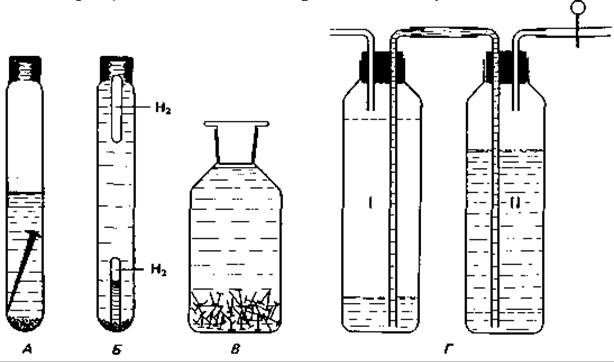
Fig. 9.4. Enrichment cultures of sulfate-reducing bacteria. Growth after inoculation of the medium with hydrogen sulfide sludge. A. The medium contains lactate and sulfate; an iron nail provides a sufficiently low oxidation-reduction potential (via cathodic polarization). B. Evidence of molecular hydrogen utilization by sulfate-reducing bacteria: a Durham tube filled with H2 floats before incubation and sinks to the bottom after incubation of the inoculated medium. C. Bacterial growth in a sealed bottle in the presence of small amounts of organic matter driven by sulfate reduction and anaerobic iron corrosion. D. Accumulation of sulfate-reducing bacteria in a Söhngen double vessel. Vessel II is filled with a medium containing lactate and sulfate; H2 is then introduced into it, and a portion of the liquid passes into vessel I (new levels are indicated by dashed lines); during a two-day [incubation at 30°C, a significant amount of H2 is consumed.
Most developed sulfur deposits (e.g., in Texas, Louisiana, and Mexico) are of non-volcanic origin; they are deposits of biogenic sulfur from past geological epochs. Hydrogen sulfide—and consequently sulfur—can be produced by reducing seawater sulfate using organic waste (sewage) with the help of sulfate-reducing bacteria.
Of great economic importance is the indirect consequence of The activity of sulfate-reducing bacteria (such as Desulfovibrio)—namely, the anaerobic corrosion of iron. In a humid environment, iron ionization can also occur under anaerobic conditions:
(1) Iron oxidation:

The molecular hydrogen film normally formed in this process protects the iron from further degradation. However, in the presence of sulfate-reducing bacteria and when sulfates are present in the medium, cathodic depolarization occurs, causing the iron to oxidize even in the absence of oxygen;
(2) Sulfate reduction:

(3) Formation of iron sulfide (precipitated):

Overall reaction (1-3):

Damage to iron pipes caused by such corrosion is extremely costly.
The ability of sulfate-reducing bacteria to use organic acids, alcohols, and even molecular hydrogen generated during iron polarization as hydrogen donors forms The basis of the method for obtaining enrichment cultures of these bacteria (Fig. 9.4).
Sulfate-reducing bacteria are considered responsible for the high concentration of hydrogen sulfide in the deep layers of the Black Sea (deeper than 200 m). In Venice, gondolas are traditionally painted black; this appears to be a protective measure related to the fact that heavy metal-containing Dyes change their original color under METABOLISM/18.html">The Influence of H2S.
Desulfotomaculum ruminis is involved in The production of hydrogen sulfide in the rumen of ruminants (Sec. 14.1).
Last update: 13/08/2026
Editorial and Educational Adaptation: This material has been compiled based on the primary/original source text. The project team performed an editorial review, corrected technical inaccuracies, structured sections, and adapted the content for an educational format.
What was processed:
- elimination of formatting defects (OCR errors, structural breaks, corrupted characters);
- editorial organization of content;
- standardization of terminology in accordance with academic sources;
- verification of factual statements against the original source text.
All mentions of the author, publication year, and origin of the primary text have been preserved in accordance with the source.