General Microbiology - Schlegel, H. 1987
Microbial Growth
Culture Media and Growth Conditions
Many non-fastidious microorganisms, such as most soil- and Water-inhabiting pseudomonads as well as Escherichia coli, grow well on media whose approximate composition is given in Table 6.1. However, many microorganisms additionally require some of the Trace Elements, Vitamins, or other supplements listed above. When a nutrient solution is formulated from defined chemical compounds, it is referred to as a synthetic medium. Researchers strive to determine the minimum nutritional requirements for each microorganism and to devise a minimal medium containing only those ingredients essential for growth. More fastidious species require A large number of supplementary substances. For Leuconostoc mesenteroides, a synthetic medium containing over 40 components has been formulated.
Complex media. For many particularly fastidious microorganisms, nutritional requirements are not yet fully understood. They are cultivated on media containing Yeast extract, yeast autolysizate, peptone, or meat extract. For the cultivation of various groups of organisms, brewers' wort, hay infusion, plum or carrot juice, and coconut milk are also used, while for coprophilous Fungi, even extracts from horse manure are employed. To reduce costs, nutrient solutions are often supplemented, instead of pure compounds, with highly complex mixtures such as whey, molasses, corn steep liquor, or soybean extract—inexpensive byproducts of various industries. Such nutrient media are termed complex media.
Solid media. To prepare solid media, specific agents that impart a gel-like consistency are added to liquid nutrient solutions. Gelatin is used for this purpose only in specific cases, as it has a rather low melting point (26–30°C) and, moreover, is liquefied by many microorganisms. An almost ideal agent for obtaining solid media is Agar, which Hesse, an associate of R. Koch, introduced into bacteriological practice in 1883. Agar is a complex polysaccharide derived from marine Algae and is heavily cross-linked. It is added to aqueous solutions at a concentration of 15–20 g/L. Agar melts only at 100°C, but upon cooling remains liquid down to 45°C. Only a few Bacteria are capable of degrading it. In cases where solid media free of organic components are required, silica gel is used.
Hydrogen ion concentration. H+ and OH- ions are the most mobile of all ions; consequently, even minor changes in their concentration exert a profound effect on microorganisms. Therefore, establishing and maintaining a predetermined, optimal pH value is essential for growth.
Most organisms grow best when the concentrations of H+ and OH- ions are approximately equal (pH 7). Many bacteria, such as nitrifying and ROOT-nodule bacteria, actinomycetes, and urea-degrading bacteria, prefer higher pH values, i.e., slightly alkaline media. Only a few are tolerant of acidic environments (lactobacilli, Acetobacter, Sarcina ventriculi) or truly acidophilic (e.g., certain Thiobacillus species). Fungi prefer low pH values. If complex nutrient media with varying pH are inoculated with soil, fungi develop predominantly at pH 5.0, whereas bacteria dominate at pH 8.0.
Maintaining a constant pH during growth is especially crucial for microorganisms that produce acids yet lack tolerance to them (lactobacilli, Enterobacteriaceae, many pseudomonads). To prevent bacterial death from self-generated acids, either non-fermentable substances are used (during prolonged cultivation) or buffered media are employed. Inorganic phosphates provide a certain buffering action (though weak at pH above 7.2). When acid production is more robust, The addition of calcium carbonate is recommended, or—if the presence of insoluble components in the medium is undesirable—sodium bicarbonate. In the latter case, it must be kept in mind that bicarbonate ions are in equilibrium with carbon dioxide dissolved in water, and consequently with CO2 in the gas phase (e.g., in air):
Class="center">
The relationship between pH, bicarbonate concentration, and the partial pressure of CO2 in the gas phase is expressed by the Henderson-Hasselbalch equation; the concentration of carbonic acid equals the product of the partial pressure of CO2 and the solubility coefficient a:

However, many bacteria are relatively insensitive to pH fluctuations within the range of 6 to 9. Admittedly, rapid changes may cause a transient, minor shift in intracellular pH, but the original pH value is restored within just 30 minutes.
The disruptions occurring at unfavorable pH values are not related to the direct action of H+ and OH- ions. The latter merely reduce the degree of dissociation of weak acids and bases, which, in their uncharged state, penetrate Cells significantly easier than their dissociated counterparts. Physiologically active forms are invariably the non-dissociated acids. Thus, dibasic succinic acid or tribasic citric acid penetrates The Cell more readily the lower the pH of the medium.
Carbon dioxide. Nutrient solutions intended for the cultivation of autotrophic, CO2-fixing microorganisms are typically supplemented with sodium bicarbonate, and the cultures are incubated in closed vessels in a CO2-enriched atmosphere. Alternatively, ordinary or CO2-enriched air can be sparged through the medium. In all cases, one must account for the aforementioned relationship between pH, bicarbonate concentration in the medium, and the partial pressure of CO2 in the gas phase.
However, heterotrophic microorganisms (i.e., those requiring organic carbon sources) also typically have a requirement for CO2. Many parasitic bacteria inhabiting Blood, Tissues, or the intestines are adapted to higher CO2 levels than those found in ambient air. Consequently, these bacteria are cultivated in gas mixtures or air enriched with CO2
up to 10 vol. %. Furthermore, it should be noted that the removal of carbon dioxide—for instance, by absorption with potassium hydroxide—inhibits the growth of nearly all bacteria (see Section 11.5).
Water content and osmotic pressure. Microorganisms vary significantly in their water requirements. To compare aqueous solutions and solid Materials regarding their content of available water, parameters such as water activity (aw) or relative humidity are utilized. These parameters refer to the vapor phase in equilibrium with the solid material or solution. This is The ratio of the water vapor concentration in the air space above a given material to the water concentration in the air above pure water at a specified Temperature.
Microorganisms are capable of growing at water activities ranging from 0.998 to 0.6. In this regard, the lowest requirements are exhibited by the osmotolerant yeast Saccharomyces rouxii, which grows at aw = 0.6%. For Aspergillus glaucus and other fungi, aw values not lower than 0.8 are required, whereas for most bacteria, they must exceed 0.98. The only exceptions are halophilic bacteria, for which a water activity of 0.75 is sufficient.
Temperature. Microorganisms react differently to temperature. Most soil and water bacteria are mesophilic; their optimal growth temperature lies between 20 and 42°C. Thermotolerant organisms are those that continue to grow even at 50°C (such as Methylococcus capsulatus). Thermophilic bacteria grow fastest at temperatures above 40°C, with an upper limit of 70°C for them (Thermoactinomyces vulgaris, Bacillus stearothermophilus). Extreme thermophiles are organisms whose growth optimum exceeds 65°C (Thermus aquaticus, Sulfolobus). Some of these can grow even at temperatures above 70°C (certain Bacillus and Clostridium species), above 80°C (Sulfolobus acidocaldarius), or even at 105°C (Pyrodictium occultum, a strict sulfur-reducing anaerobe). At the other end of the temperature scale are psychrophilic (or cryophilic) organisms; these are primarily certain marine luminous bacteria and iron bacteria (Gallionella), which reach their maximum growth rate at temperatures below 20°C.
Aeration. All obligate aerobes require molecular oxygen as an electron acceptor. For bacteria growing on agar or in thin layers of liquid in the presence of air, oxygen is usually fully sufficient. In deep liquid cultures, aerobic bacteria can grow only at the surface, because conditions in deeper layers approach anaerobiosis as the distance from the surface increases. Normal growth of aerobic microorganisms in deep liquid cultures requires aeration. Microorganisms can utilize only dissolved oxygen. While mineral salts and organic substances can be added to the medium in concentrations ensuring bacterial growth for several hours or even days, this cannot be done with molecular oxygen due to its very low solubility. A liter of water in equilibrium with atmospheric air at 20°C contains a mere 6.2 mL, or 0.28 mmol, of O2. This amount is sufficient to oxidize no more than 0.046 mmol, or 8.3 mg, of glucose (i.e., roughly one-thousandth of the total glucose content in standard nutrient media). Consequently, it is impossible to establish a substantial reservoir of O2 in the medium—oxygen must be supplied continuously. Fortunately, microorganisms have adapted to very low concentrations of dissolved oxygen; nevertheless, these concentrations should not be allowed to drop below critical levels without impairing cellular Respiration.
The rate of molecular oxygen transfer into solution increases with a larger gas-liquid interface and a higher partial pressure of O2 in the gas phase. Liquid cultures are aerated using either ordinary air or a mixture of O2, N2, and CO2. To increase the interfacial area, various Methods are employed, such as 1) cultivation in a thin layer; 2) liquid agitation by shaking (reciprocal or rotary); 3) rotation of horizontal vessels around their longitudinal axis; 4) sparging air through the liquid under pressure using gas distributors (Glass filters, Kluyver flasks); 5) percolation (Fig. 6.1); 6) mechanical agitation. For submerged cultures of aerobic microorganisms, forced aeration via gas distributors (glass filters, spargers) is frequently combined with mechanical stirring. Apparatuses such as the "tower fermenter without a draft tube" and the "Waldhof system," which generate a vortex through vigorous mixing, are highly convenient. Fig. 6.2 illustrates various vessels whose shapes are designed to maximize liquid-air contact, as well as several laboratory vessels for submerged culture.
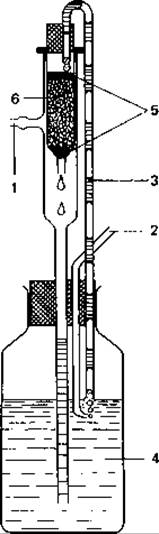
Fig. 6.1. Percolator for passing a nutrient solution and air through a carrier material (soil, glass beads, etc.). If air is slowly and continuously evacuated through the outlet (1), external air enters the vessel via tube (2) and drives the nutrient solution (4) upward through the riser tube (3). This solution, along with air, passes through glass wool (5) and the percolated material (6).

Fig. 6.2. Laboratory glassware for surface and submerged cultures of aerobic microorganisms.
It should be noted that even in well-aerated fermenters or natural water bodies, oxygen is not always distributed uniformly. When bacterial aggregates form, local microenvironments with reduced O2 partial pressure emerge. Suspended particles present in natural aquatic ecosystems serve as nuclei for The formation of such semi-anaerobic microhabitats. In experiments, such conditions can be simulated by adding finely dispersed solid particles (clay, Cellulose, Chitin) to bacterial Suspensions. Under these circumstances, bacteria grow as an "epiphytic flora"—densely packed against one another on the particle surfaces—and similarly suffer from O2 limitation. Convenient model systems for demonstrating this phenomenon are facultatively anaerobic bacteria that switch to Fermentation (Escherichia coli) or nitrate respiration (Pseudomonas denitrificans) under oxygen-limiting conditions.
Anaerobic cultures. When cultivating strictly anaerobic bacteria, the ingress of oxygen must be strictly prevented. Anaerobic culture techniques involve The Use of boiled nutrient media and vessels sealed without air bubbles; the creation of an oxygen-free atmosphere in vacuum desiccators or GasPak jars; the use of oxygen scavengers (alkaline pyrogallol, dithionite, monovalent copper chloride), and other auxiliary agents. It is frequently possible to mitigate or entirely neutralize the harmful effects of oxygen on bacteria by adding reducing agents to the medium (ascorbic acid, thioglycolate, Cysteine, or even sulfide, provided the bacteria tolerate it).
Even extremely oxygen-sensitive bacteria can be subcultured in air if contact between the culture medium and air is prevented by continuously purging the culture vessels with nitrogen (Hungate technique). Alternatively, transfer chambers filled with nitrogen, argon, or hydrogen free of O2 traces can be used. To visually indicate anaerobic conditions, the dye resazurin is added to the medium (which is blue in the presence of O2 and colorless under anaerobic conditions), or a small vessel containing an alkaline solution of glucose and methylene blue (which becomes colorless in the absence of oxygen) is placed inside the anaerobic incubation jars.
Last update: 13/08/2026
Editorial and Educational Adaptation: This material has been compiled based on the primary/original source text. The project team performed an editorial review, corrected technical inaccuracies, structured sections, and adapted the content for an educational format.
What was processed:
- elimination of formatting defects (OCR errors, structural breaks, corrupted characters);
- editorial organization of content;
- standardization of terminology in accordance with academic sources;
- verification of factual statements against the original source text.
All mentions of the author, publication year, and origin of the primary text have been preserved in accordance with the source.