GENERAL MICROBIOLOGY - T.P. Pyrog - 2004
12. METABOLIC ACTIVITY OF AEROBIC HETEROTROPHS
12.2. GROWTH ON REDUCED C1 COMPOUNDS (METHANE, METHANOL)
12.2.2. Assimilatory Metabolism
The anabolic (assimilatory) METABOLISM of methanotrophs diverges from their Energy Metabolism at the formaldehyde level. Two pathways of formaldehyde fixation are known.
The Serine-isocitrate lyase pathway. In scientific literature, it is more commonly referred to as the serine pathway (Fig. 12.4).
Class="center">
Fig. 12.4. The serine pathway of methane assimilation
In this pathway, acetyl-CoA is formed from formaldehyde and CO2. Glycine serves as the formaldehyde acceptor. Serine is produced in a reaction catalyzed by the enzyme serine transhydroxymethylase. Through a Transamination reaction, serine is converted into hydroxypyruvate (via the enzyme serine-glyoxylate aminotransferase). Hydroxypyruvate is then reduced to glycerate by hydroxypyruvate reductase. Glycerate kinase catalyzes The formation of glycerate-3-phosphate, which is subsequently transformed into phosphoenolpyruvate by phosphoglyceromutase and enolase. The reaction catalyzed by phosphoenolpyruvate carboxylase yields oxaloacetate. Finally, oxaloacetate is converted into glyoxylate through the coordinated action of malate dehydrogenase, malyl-CoA synthetase, and malyl-CoA lyase.
The Key Enzymes of the serine pathway are serine transhydroxymethylase and hydroxypyruvate reductase.
The operation of the serine pathway results in the synthesis of acetyl-CoA from formaldehyde and CO2. However, this pathway alone is insufficient to supply The Cell with the phosphoenolpyruvate and oxaloacetate required for Biosynthesis. This demand is met by coupling the serine pathway with citrate synthase, cis-aconitase, and isocitrate lyase (Fig. 12.5).
Acetyl-CoA and oxaloacetate condense to form citrate, which is then isomerized to isocitrate. Isocitrate lyase cleaves isocitrate to yield succinate and glyoxylate. Essentially, this process results in the direct formation of succinate from two molecules of CO2 and two molecules of formaldehyde. CARBOHYDRATES are subsequently synthesized via Gluconeogenesis.
The serine pathway has been identified in methane-oxidizing Bacteria of the genera Methylocystis and Methylosinus, as well as in A number of facultative methylotrophs.
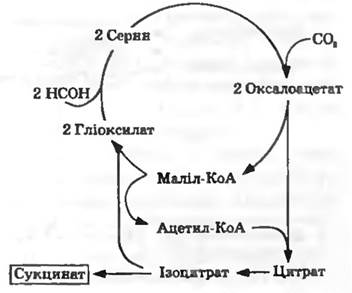
Fig. 12.5. Direct formation of succinate from formaldehyde and carbon dioxide via the serine-isocitrate lyase pathway
The ribulose monophosphate cycle. This cycle is also known as the hexulose monophosphate pathway. The primary Reactions of the cycle (Fig. 12.6) involve the Condensation of ribulose-5-phosphate and formaldehyde, catalyzed by the key enzyme hexulose monophosphate synthase, followed by the isomerization of the reaction product into fructose-6-phosphate. The acceptor (ribulose-5-phosphate) is regenerated through the action of transketolase and transaldolase. As a result of this cycle, three molecules of formaldehyde are converted into one molecule of dihydroxyacetone phosphate, which can then enter assimilatory metabolism.
A notable metabolic feature of methane-oxidizing bacteria that utilize the hexulose monophosphate pathway is a defect in the tricarboxylic acid (TCA) cycle—specifically, the lack of 2-oxoglutarate dehydrogenase. Consequently, the TCA cycle serves an exclusively biosynthetic role, whereas C4 dicarboxylic acids are synthesized via the anaplerotic carboxylation of phosphoenolpyruvate. Carbohydrates are synthesized through gluconeogenesis.
This pathway of C1 compound assimilation is characteristic of bacteria belonging to the genera Methylococcus and Methylomonas.

Fig. 12.6. The ribulose monophosphate cycle of formaldehyde fixation
Last update: 12/08/2026
Editorial and Educational Adaptation: This material has been compiled based on the primary/original source text. The project team performed an editorial review, corrected technical inaccuracies, structured sections, and adapted the content for an educational format.
What was processed:
- elimination of formatting defects (OCR errors, structural breaks, corrupted characters);
- editorial organization of content;
- standardization of terminology in accordance with academic sources;
- verification of factual statements against the original source text.
All mentions of the author, publication year, and origin of the primary text have been preserved in accordance with the source.