Genetics - A. V. Sivolob 2008
Variability of Genetic Material
Modification Variability
Any Organism is an open system: the realization of its hereditary program occurs not only under the control of the genotype, but also under the Influence of the environment. Environmental conditions can determine both the degree of expression of a hereditary trait (expressivity) and the probability of the trait appearing at all (penetrance). Thus, individuals with identical genotypes may exhibit different phenotypes depending on environmental influences. Such Variability is called phenotypic, or modificational. A classic example of phenotypic variations within a single organism is the different leaf blade forms in arrowhead plants, depending on whether the leaves are located in the submerged or emergent part of the plant (Fig. 4.10). Quantitative and qualitative polygenic traits are primarily subject to modificational changes. For instance, height, weight, susceptibility to common diseases, and life span heavily depend on environmental conditions.
Class="center">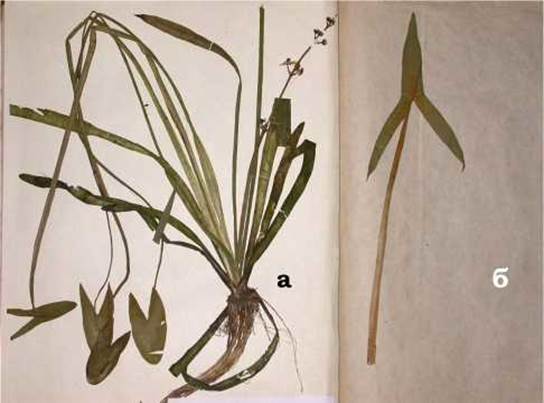
Fig. 4.10. Modification of the leaf blade in arrowhead: submerged (a) and emergent (b) leaves
Modificational variability is caused not by Changes in DNA sequences, but by alterations in Gene Expression (ranging from METABOLISM/31.html">Transcription efficiency to the course of biochemical reactions) under the Influence of Environmental factors. Obviously, such changes are not inherited; however, the limits of modificational variability (the reaction norm) for each specific trait are entirely determined by the genotype. The breadth of the reaction norm is an adaptive trait that defines the range of environmental variations in which an individual—that is, a specific genotype—can survive.
The result of modificational variability can be The Emergence of organisms that phenotypically mimic the manifestation of a particular genotype. Such phenotypic forms are called phenocopies. Essentially, phenocopies represent the manifestation of extreme Variants of the reaction norm. For example, Vitamin D deficiency leads to The Development of Rickets, the symptoms of which are indistinguishable from a hereditary disorder caused by Mutations that result in vitamin D insensitivity.
A distinct type of modificational variability includes so-called long-term modifications, which can be inherited over the course of several generations. A well-known example is The change in coloration in the Colorado potato beetle, which appears after pupae are exposed to high temperatures. The altered coloration persists for several generations and then reverts to its original state. In this case, inheritance occurs exclusively through the maternal line: no changes take place in The Genome, and the duration of the modification is explained by the accumulation of stable mRNAs of heat Shock genes in the Cytoplasm of germline Cells, which are transmitted to offspring via the egg cytoplasm. Naturally, after several generations, these mRNAs will become "diluted": their quantity will eventually become insufficient to maintain the altered coloration.
Selection/41.html">Review Questions and Tasks
1. Define the term "variability." What types of variability exist?
2. What causes hereditary variability?
3. What are mutations? How do somatic mutations differ from germline mutations?
4. Describe the types of point mutations.
5. Describe the types of chromosomal and genomic mutations.
6. What is the source of mutational changes?
7. What DNA damages occur during cellular life processes and As a result of Replication and Repair errors?
8. Describe the mechanisms underlying chromosomal and genomic mutations.
9. Define THE CONCEPT OF a "mutagenic factor." What are Direct and Indirect mutagen action?
10. What types of Chemical Mutagens do you know? Describe the mechanisms of their action. What are promutagens?
11. Explain the mechanisms of the mutagenic action of physical factors.
12. Which mutagenic agents can be classified as biological factors? What are their Mechanisms of action?
13. Which CONSEQUENCES OF MUTATIONAL Variability are negative? Positive?
14. What is modificational variability? What are the main causes of its manifestation? How does modificational variability differ from mutational variability?
15. What are phenocopies?
16. What are long-term modifications? Explain the mechanisms of their formation.
Last update: 11/08/2026
Editorial and Educational Adaptation: This material has been compiled based on the primary/original source text. The project team performed an editorial review, corrected technical inaccuracies, structured sections, and adapted the content for an educational format.
What was processed:
- elimination of formatting defects (OCR errors, structural breaks, corrupted characters);
- editorial organization of content;
- standardization of terminology in accordance with academic sources;
- verification of factual statements against the original source text.
All mentions of the author, publication year, and origin of the primary text have been preserved in accordance with the source.