Military Hygiene and Hygiene in Emergency Situations - K.O. Pashka 2005
Fundamentals of organizing and conducting sanitary surveillance and medical control over the water supply of military personnel and the civilian population in the field
Sources of drinking water and their characteristics
Water sources may include atmospheric, groundwater, and surface water, although they differ significantly in their chemical and biological composition.
Atmospheric water is formed through the Condensation of water vapor. It is a softly mineralized, low-mineral content water that contains few organic substances and is free of pathogenic microorganisms. Its chemical composition depends on the purity of the ambient air and The Nature of the catchment surfaces (soil, roofs, riverbeds, etc.). Passing through atmospheric layers, a single raindrops weighing 50 mg, falling from a height of 1 km, washes 16.3 dm3 of air, thereby absorbing certain amounts of organic, inorganic, and radioactive substances, dust, gases, and microorganisms.
Atmospheric water is collected from building roofs or walled areas with impermeable beds into underground reservoirs. Here, the water settles and is filtered through sand; otherwise, it quickly acquires a musty, putrid odor and an unpleasant taste. To prevent The Development of flora and fauna in the water, the tanks are ventilated and protected from light. The ventilation pipe is extended at least 2 m above the ground surface and covered at the top with a cap fitted with a metal mesh. The cistern must be kept closed, and water should be extracted from it using a pump.
Snow or ice can also be used for water supply. Snow reserves are collected in so-called snowfields, where they are compacted and covered with thermal insulation Materials (straw, sawdust, etc.). Ice for water supply is harvested from clean water bodies.
Atmospheric and spring waters, flowing down natural slopes, gather in lowlands, forming surface water bodies with flowing water (streams, rivers, flowing lakes, and ponds) or standing water (non-flowing lakes, reservoirs, excavated ponds). Open water bodies are characterized by unstable water quality, which varies depending on the season and even the weather (for example, after rain).
Open water bodies can be polluted by rain and meltwater runoff from adjacent areas. This is most frequently observed in water bodies located near populated areas and sites where municipal and industrial wastewater is discharged. From an epidemiological standpoint, the waters of open water bodies are considered hazardous.
The organoleptic properties and Chemical composition of water in open water bodies depend on A number of conditions. Water in marshy areas has a high color index due to humic substances formed during the decay of vegetation. Humus and black soil impurities give the water a muddy, earthy appearance. During summer "blooms"—that is, the mass proliferation of Algae—the water becomes discolored and acquires an unpleasant odor and taste as the algae die off. If a riverbed consists of clay strata, the suspended fine clay particles create a persistent turbidity. It is also possible that substances entering the water may be detrimental to human health. Surface waters are lightly mineralized and soft, but in stagnant, shallow water bodies, salt concentrations can increase significantly due to evaporation.
Despite almost constant contamination, a steady deterioration of water quality in open water bodies is not typically observed. This is due to numerous physicochemical and biological processes that facilitate the self-purification of the body of water.
Groundwater is formed by the percolation of meteoric and surface waters, as well as water vapor condensate, accumulating in the subsoil. Based on their occurrence, underground waters are divided into: phreatic (unconfined) waters, which have filtered through the soil and lie above the first impermeable subsoil layer (the first aquifer), and interstratified (confined) waters, trapped between two impermeable layers (Fig. 3.1).
Phreatic waters, passing through the soil strata, accumulate on the first aquitard. These are predominantly transparent waters with low color intensity, containing few mineral salts and microorganisms, making them suitable for water supply. They flow along the slope of the impermeable layer from elevated areas to lower ones and may emerge as springs. When soil is contaminated with waste and sewage, There is a risk of groundwater contamination. This risk increases with the intensity of pollution, a higher water table, a thinner soil layer, and high soil porosity above the water. In the presence of fine-grained strata, starting from a depth of 5–6 m, groundwater is generally free of Bacteria. Groundwater is widely used for digging dug wells and tube wells. Their daily yield typically does not exceed 10 m3 of water. During heavy downpours or snowmelt, The amount of water in wells increases, but bacterial and chemical contamination rises significantly. The depth of the water table ranges from shallow to several tens of meters.
Class="center">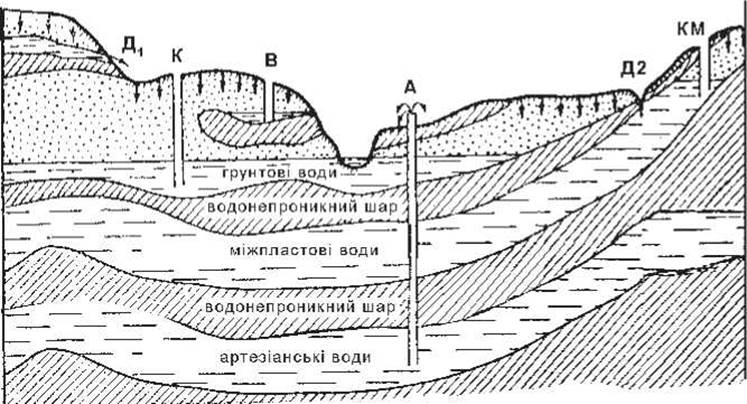
Fig. 3.1. Schematic diagram of groundwater occurrence:
D1 - descending spring; D2 - ascending spring; K - phreatic water well; B - perched water well; KM - interstratified water well (borehole); A - artesian borehole.
Subsurface waters, as they flow along the dip of the impermeable stratum, may become trapped between two layers of impermeable rock, predominantly clay. Such waters are called interstratified (confined) waters. When the overlying protective layer is cut—for example, by drilling a borehole—such water rises to the surface like in communicating vessels, and in some cases, may even gush forth as a fountain. Water that rises in a well above its original level is called pressure or artesian water. The depth of interstratified waters ranges from 15 to 1,000 meters or more. Typically, waters occurring at depths of up to 300 meters are exploited.
Interstratified waters differ from phreatic waters in their constant Temperature (5–12 °C), stable level, yield, and composition. They are transparent, colorless, and mostly devoid of taste and odor. The mineralization of deep underground waters can reach significant levels, but usually does not exceed 1000 mg/dm3, which does not impair the organoleptic Properties of the water or exert harmful effects on consumer health.
Due to prolonged filtration and the presence of an impermeable roof layer, interstratified waters feature high stability in chemical and bacterial composition. A high yield—ranging from 1 to 50 m3 per hour—and good water quality make interstratified waters the best source of water supply. However, if water from an overlying groundwater horizon infiltrates through cracks in the impermeable roof, abandoned wells or quarries, absorbing cesspools, or via leakage along casing pipes and poorly sealed wellheads, or due to a rising water table or flooding of the well Mouth, contamination of interstratified waters and waterborne epidemics may occur. Therefore, unusual temperature fluctuations or Changes in the chemical and bacterial composition of water from deep boreholes should be regarded as a warning sign of sanitary hazard at the source.
When underground water naturally reaches the land surface, it is called a spring. If the aquifer is intersected by a drop in relief, such as in ravines, these springs are termed descending. When interstratified water reaches the surface and gushes out under pressure, the spring is called ascending (Fig. 3.2 a, b). With a high yield, such springs can be used for water supply and even for constructing small water distribution systems, especially in mountainous terrain.
The possibility of spring water contamination cannot be ruled out. This can be identified by changes in water temperature, an increase in spring yield after rain, the appearance of turbidity, a rise in microbial counts, and other pollution indicators. The causes may include a thinning of the rock strata near the spring's emergence point, a breach in the impermeable roof layer, or poorly designed protective structures (captages).
Sanitary oversight of Field water supply involves monitoring the reliable provision of safe, high-quality water to military personnel and affected populations in accordance with established standards for drinking, cooking, and personal and public hygiene. Water must be wholesome, safe, and available in sufficient quantities to meet physiological, hygienic, domestic, and technical needs. Unit and formation commanders are responsible for organizing water supply, while in the field, this responsibility falls to their deputy commanders for logistics. Engineering, chemical, medical, and sanitary-epidemiological services also have specific duties regarding field water supply and must coordinate closely with one another.
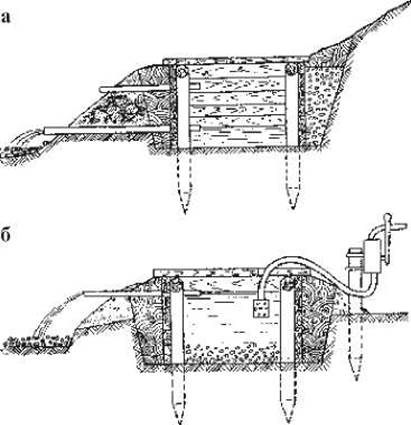
Fig. 3.2. Spring captage:
a) descending; b) ascending.
Last update: 10/08/2026
Editorial and Educational Adaptation: This material has been compiled based on the primary/original source text. The project team performed an editorial review, corrected technical inaccuracies, structured sections, and adapted the content for an educational format.
What was processed:
- elimination of formatting defects (OCR errors, structural breaks, corrupted characters);
- editorial organization of content;
- standardization of terminology in accordance with academic sources;
- verification of factual statements against the original source text.
All mentions of the author, publication year, and origin of the primary text have been preserved in accordance with the source.