MEDICAL BIOLOGY, ANATOMY, HUMAN PHYSIOLOGY AND PATHOLOGY - Ya.I. Fedoniuk 2010
ANATOMY, PHYSIOLOGY, PATHOLOGY
SECTION 2. THE LOCOMOTOR SYSTEM (THE MECHANISM OF MOVEMENT)
SKELEton OF THE TRUNK
2. THE THORAX
2.1. RIBS
The Ribs (costae) are narrow, long, curved flat bones. True ribs (the upper seven) attach independently by their anterior ends to the Sternum; false ribs (VIII, IX, X) connect via their cartilages to the Cartilage of the preceding rib before reaching the sternum; floating ribs (XI, XII) have their anterior ends terminating freely in the Muscles of the anterolateral abdominal wall.
Each rib consists of a posterior bony part and an anterior costal cartilage. The bony part comprises a HEAD, neck, and body. Between the neck and the body in the upper 10 pairs of ribs lies the rib tubercle. The body features external and internal surfaces, as well as superior and inferior borders. Along the internal surface of the inferior border runs the costal groove, which accommodates Vessels and nerves (Fig. 2.43 a). Therefore, during pleural cavity puncture, the needle must be inserted along the superior border of the rib.
Class="center">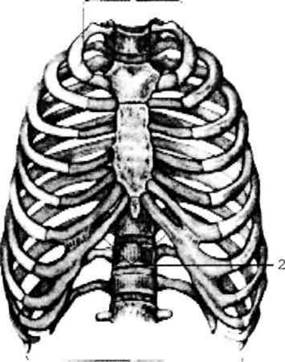
Fig. 2.42. Thorax; anterior view.
1 - superior thoracic aperture (outlet); 2 - infrasternal angle; 3 - inferior thoracic aperture (outlet).

Fig. 2.43. Second right rib (
The first rib, unlike all the others, has superior and inferior surfaces, as well as external and internal borders. On the superior surface lies the scalene tubercle (the attachment site for the scalenus Muscle). Posterior to the tubercle is the Subclavian Artery groove, and anterior to it is the subclavian vein groove (Fig. 2.43 b).
Last update: 08/08/2026
Editorial and Educational Adaptation: This material has been compiled based on the primary/original source text. The project team performed an editorial review, corrected technical inaccuracies, structured sections, and adapted the content for an educational format.
What was processed:
- elimination of formatting defects (OCR errors, structural breaks, corrupted characters);
- editorial organization of content;
- standardization of terminology in accordance with academic sources;
- verification of factual statements against the original source text.
All mentions of the author, publication year, and origin of the primary text have been preserved in accordance with the source.