MEDICAL BIOLOGY, HUMAN ANATOMY, PHYSIOLOGY AND PATHOLOGY - Ya.I. Fedonyuk 2010
ANATOMY, PHYSIOLOGY, PATHOLOGY
SECTION 1. ORGAN. ORGAN SYSTEM. ORGANISM
CIRCULATORY DISORDERS
7. EMBOLISM
Embolism refers to the transport by the bloodstream (or Lymph) of various foreign particles that have entered it, resulting in the occlusion of small-caliber Blood Vessels. These particles are called emboli.
Depending on the direction of blood flow, embolism is classified as orthograde, retrograde, or paradoxical. In the first case, the embolus moves in the direction of blood flow; In the second, in the opposite direction; and in the third, an embolus from the systemic Veins passes into the systemic Arteries, bypassing the Pulmonary Circulation (in congenital defects of the interatrial or interventricular septum).
Depending on the qualitative COMPOSITION OF THE embolus, classifications include: thromboembolism, fat, air, gas, tissue, and microbial embolism, as well as embolism by foreign bodies.
In thromboembolism, involvement of the pulmonary circulation is of paramount importance, primarily the pulmonary trunk and its main branches. This type of embolism is one of the most frequent causes of sudden death, particularly in postoperative patients. Embolism of the main trunk of the pulmonary artery or both of its branches
may lead to sudden death due to the cessation of Blood flow through the Lungs to the left side of The Heart. Fatal outcomes result not only from complete occlusion of the lumen of the pulmonary trunk, but also from a 3/4 reduction in its blood flow (Fig. 1.3). Stimulation of the receptors in the tunica intima of the pulmonary artery, even by a small thromboembolus, can cause sudden cardiac arrest due to spasm of the pulmonary artery, Bronchi, and coronary vessels (pulumonocoronary reflex). In pulmonary diseases (Pneumonia, tuberculosis, pneumosclerosis), a significantly smaller volume of blocked pulmonary blood flow is sufficient to cause death.
In fat embolism, fat droplets enter the bloodstream most commonly during fractures of tubular bones, surgical interventions, etc. Bone trauma after the age of 25–30 is particularly hazardous, as the Bone Marrow of tubular bones becomes predominantly fatty.
Air embolism most frequently occurs due to INJURIES OF THE neck veins (trauma, surgical Procedures). This is due to the negative blood pressure within these veins, as well as the fact that their walls are fixed and do not collapse. It can also be caused by improper intravenous injections (administering air along with the syringe contents). From the entry site, air bubbles travel via the veins to the right side of The Heart and the pulmonary arteries, where they become trapped, obstructing BLOOD FLOW IN the pulmonary circulation. Death may result from asphyxia due to the occlusion of the pulmonary artery branches or the majority of the pulmonary capillaries (2/3), or from damage to the Central Nervous system and myocardium—essentially, embolism of vital Organs.
Gas embolism occurs during a rapid transition from a zone of high to normal barometric pressure (hyperbaric chambers, caisson and diving operations) or from normal to low barometric pressure (depressurization of aircraft). Under these conditions, nitrogen, carbon dioxide, and partially oxygen are released into the blood. Bubbles of these gases obstruct the capillaries of the systemic circulation. Occlusion of the capillaries of the Brain AND SPINAL cord is particularly dangerous. In some cases, gas embolism may be observed in anaerobic (gas) gangrene.
Tissue (cellular) embolism is observed when Tissues are damaged As a result of trauma or a pathological process—for example, the dissemination via the bloodstream of bone marrow fragments in bone fractures, heart valve fragments in ulcerative endocarditis, Amniotic Fluid components during childbirth, or groups of malignant tumor Cells (metastasis).
Microbial or parasitic embolism occurs when clusters consisting of aggregated microbes, Fungi, Protozoa, or animal parasites are transported by the blood. This leads not only to Circulatory Disorders, but also to The formation of foci of suppurative tissue destruction, such as embolic purulent nephritis.
Foreign body embolism occurs when bullets, shell fragments, or other objects enter the lumen of large blood vessels. Due to the significant mass of foreign bodies, this type of embolism is frequently retrograde.
Embolism has detrimental effects on the body. It can lead to sudden death, generalized purulent processes, and organ infarctions. The Role of embolism in The Development of malignant tumor metastases has been well established.
Class="center">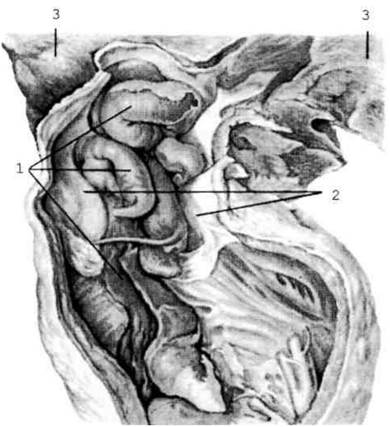
Fig. 1.3. Pulmonary Embolism: 1 - thromboembolus; 2 - pulmonary artery; 3 - lung.
Last update: 08/08/2026
Editorial and Educational Adaptation: This material has been compiled based on the primary/original source text. The project team performed an editorial review, corrected technical inaccuracies, structured sections, and adapted the content for an educational format.
What was processed:
- elimination of formatting defects (OCR errors, structural breaks, corrupted characters);
- editorial organization of content;
- standardization of terminology in accordance with academic sources;
- verification of factual statements against the original source text.
All mentions of the author, publication year, and origin of the primary text have been preserved in accordance with the source.