MEDICAL BIOLOGY, ANATOMY, HUMAN PHYSIOLOGY AND PATHOLOGY - Ya.I. Fedonyuk 2010
BIOLOGY
SECTION 1. BIOLOGICAL BASES OF HUMAN VITAL ACTIVITY
1.4. ONTOGENETIC LEVEL OF LIFE ORGANIZATION
1.4.2. Basics of human genetics
Sex Genetics; Mechanisms of Genetic Sex Determination
Since ancient times, people have sought Answers to the question: why are boys born in some cases and girls in others? How can it be explained that the sex ratio in nature, as a rule, is 1:1, meaning that for every 100 newborn males, there are 100 females? The chromosomal theory of heredity provided answers to these questions by establishing The Role of sex Chromosomes in sex determination. Sex, like any other trait, is genetically determined. In most dioecious species, including humans, sex is determined at the moment of Fertilization (syngamously) and depends on the combination of sex chromosomes from both parents in the zygote. Sex is inherited as a Mendelian trait. Sex segregation occurs just like in a test monohybrid cross at a ratio of 1 Я : 71 1. A distinction is made between the homogametic and heterogametic sex. The homogametic sex is one in which both sex chromosomes are identical. The heterogametic sex has different sex chromosomes. The homogametic sex produces one type of gamete regarding sex chromosomes, whereas the heterogametic sex produces two types. In humans, mammals, and Drosophila, the female sex is homogametic, and the male sex is heterogametic. During Meiosis, a female (XX) produces a single type of egg Cell (X), while a male (XY) produces Two Types of spermatozoa in equal proportions: half of the spermatozoa contain the X chromosome, and the other half contain the Y chromosome. In some organisms (birds, butterflies, reptiles), the female is the heterogametic sex, and the male is the homogametic sex.
The sex of the future Organism depends on the heterogametic parent, which produces two types of Gametes: whichever of these gametes takes part in fertilization will determine the sex of the offspring. Whether a girl or a boy is born depends on the type of sperm, since egg Cells are identical with respect to the sex chromosome. Two combinations are possible: 1) if an X egg cell is fertilized by an X sperm, two X chromosomes combine in the zygote: a female organism (XX) develops from such a zygote; 2) if an X egg cell is fertilized by a Y sperm, an X and a Y chromosome combine in the zygote: a male organism (XY) develops from such a zygote.
Class="center">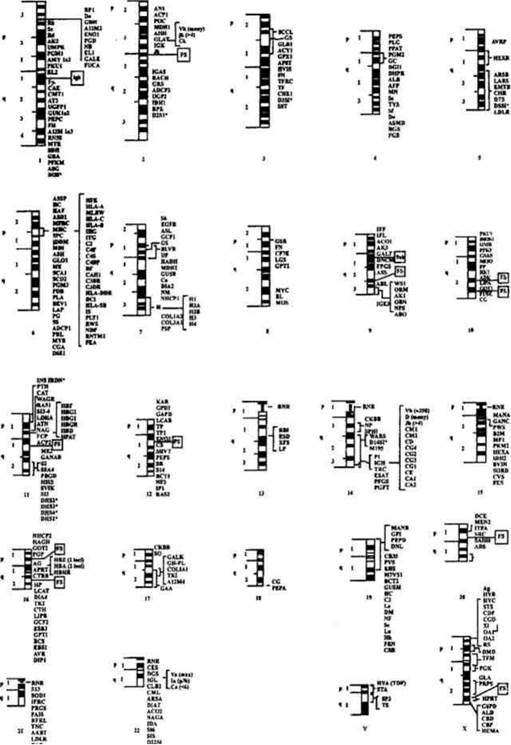
Fig. 1.64. Genetic Maps of Human chromosomes (V. McKusick, 1982)
The ratio of 17t :7t1 is ensured by the fact that the heterogametic sex (XY) produces two types of gametes, whereas the homogametic sex (XX) produces one type of gamete. The mechanism behind this ratio is analogous to a test monohybrid cross, where the heterozygote Aa produces two types of gametes, and the recessive homozygote aa produces one type (Fig. 1.65).
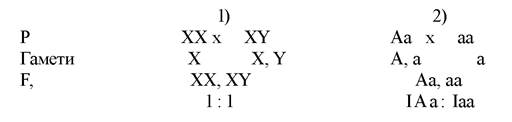
Fig. 1.65. Genetic diagrams illustrating: 1) sex segregation (1 Я : Л і) and 2) segregation in a test monohybrid cross (1Аа: 1аа).
In humans, the genotypic male sex is determined by the Y chromosome. If it is present in the individual's chromosome Complement, the organism belongs to the male sex. A person with a 47,XXY karyotype (Klinefelter syndrome) is male, even though they have two X chromosomes in their karyotype and underdeveloped Gonads. A person with a 45,XO karyotype (Turner syndrome) is female, even though she has only one X chromosome and underdeveloped Ovaries.
The Development of sexual traits occurs in two stages. At The First stage, at the moment of fertilization, sex is determined genotypically (CHROMOSOMAL MECHANISM OF sex determination). At the Second Stage, during ontogeny, sex differentiation takes place, which is The formation of a specific phenotype (male or female) resulting from the interaction between the genotype and environmental conditions of development. In humans, as in other organisms, the zygote is potentially bisexual. The factor that directs the phenotype toward the male pathway is the Y chromosome, which contains the corresponding Gene. If, during the 6th–10th weeks of Embryogenesis, an embryo carrying the Y chromosome fails to develop along the male pathway, it subsequently acquires female secondary sex characteristics.
Last update: 08/08/2026
Editorial and Educational Adaptation: This material has been compiled based on the primary/original source text. The project team performed an editorial review, corrected technical inaccuracies, structured sections, and adapted the content for an educational format.
What was processed:
- elimination of formatting defects (OCR errors, structural breaks, corrupted characters);
- editorial organization of content;
- standardization of terminology in accordance with academic sources;
- verification of factual statements against the original source text.
All mentions of the author, publication year, and origin of the primary text have been preserved in accordance with the source.