MEDICAL BIOLOGY, ANATOMY, HUMAN PHYSIOLOGY AND PATHOLOGY - Ya.I.Fedoniuk 2010
BIOLOGY
CHAPTER 1. BIOLOGICAL FOUNDATIONS OF HUMAN VITAL ACTIVITY
1.4. ONTOGENETIC LEVEL OF LIFE ORGANIZATION
1.4.2. Basics of human genetics
Sex-linked, sex-influenced, and sex-limited traits
Traits whose genes are located not in autosomes but in sex Chromosomes (X and Y) are called sex-linked, and the inheritance of such traits is termed Sex-Linked Inheritance. It was first established by T. Morgan while studying the inheritance of eye color (red and white) in Drosophila.
All genes localized in human sex chromosomes can be divided into three groups depending on the region of the sex chromosomes where they reside (Fig. 1.66).
Class="center">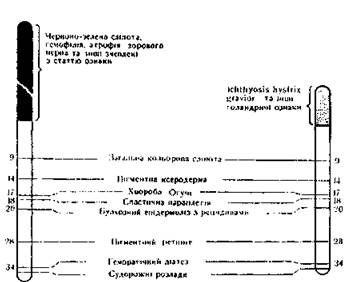
Fig. 1.66. Probable localization of genes incompletely linked to sex in the homologous regions of X and Y chromosomes.
The first group comprises genes that are completely sex-linked. They are localized in the non-homologous region of the X chromosome, which lacks a homolog on the Y chromosome, and are transmitted exclusively via the X chromosome. These include the recessive genes for hemophilia, color blindness, and the dominant Gene for hypophosphatemia (vitamin D-resistant Rickets).
The second group consists of a small number of genes, also completely sex-linked, but located in the non-homologous region of the Y chromosome. They are transmitted from father to all his sons, because a son receives his Y chromosome solely from his father (e.g., webbed toes, "hairy ears").
Traits whose genes are located in the non-homologous region of the Y chromosome are called holandric.
The third group includes genes that are incompletely (partially) sex-linked. They are located in the homologous Regions of the X and Y chromosomes, can be transmitted with either the X or the Y chromosome, and can transfer from one to the other during Crossing-over.
Top left: genes located in the X-chromosome region that has no counterpart on the Y chromosome; top right: genes located in the unpaired region of the Y chromosome; bottom right and left: genes located in the homologous regions of the X and Y chromosomes.
Genes for sex-limited traits can be located in either autosomes or sex chromosomes of both sexes, but they are expressed in only one of them. For example, baritone and bass are expressed only in males; milk yield and milk fat content only in cows; egg production and egg size only in hens.
Sex-influenced traits. The same allele can be dominant in individuals of one sex and recessive in individuals of the other sex, depending on the specific action of Sex Hormones. For instance, baldness is determined by a dominant allele (A), and its absence by a recessive allele (a) of the same gene. However, the female sex hormone suppresses the baldness gene, whereas the male hormone promotes it. Therefore, men with genotypes AA and Aa are bald, while those with genotype aa are not. Women with genotype AA are bald, whereas those with genotypes Aa and aa are not.
Last update: 08/08/2026
Editorial and Educational Adaptation: This material has been compiled based on the primary/original source text. The project team performed an editorial review, corrected technical inaccuracies, structured sections, and adapted the content for an educational format.
What was processed:
- elimination of formatting defects (OCR errors, structural breaks, corrupted characters);
- editorial organization of content;
- standardization of terminology in accordance with academic sources;
- verification of factual statements against the original source text.
All mentions of the author, publication year, and origin of the primary text have been preserved in accordance with the source.