Basics of Evolution - Korzh O.P. - 2006
Part II. MACROEVOLUTION
Chapter 16. Modern Problems of Evolution
16.4. Problems of Directed Evolution
J.B. Lamarck was one of the first to draw attention to a certain directedness in the evolutionary development of organisms. He established that all organisms possess an inner drive toward self-improvement, which ensures their continuous development and thereby drives progressive evolution. The Mechanism of this process involved the adaptive modification of Organs through use and disuse, with the direct inheritance of acquired beneficial traits by offspring. Despite a certain naivety, these ideas have proven quite viable and are still actively maintained today in the form of neo-Lamarckism.
Closely linked to the directed development of organisms are evolutionary schools such as orthogenesis (T. Eimer) and nomogenesis (L.S. Berg). Both theories posit that development is directed by certain natural laws that govern the process. Specifically, orthogenesis (straight-line development) attributes the direction of evolution to an internal driving force (including mystical forces, directed mutation, etc.) that steers organismal changes along a predefined path. Nomogenesis, in turn, explains evolution through the realization of internal laws during development (e.g., the execution of a genetically programmed blueprint). Both orthogenesis and nomogenesis stood in opposition to Darwinian tichogenesis, which viewed evolution as a random process.
Essentialism is a scientific paradigm that views all observable worldly phenomena as reflections of underlying essences. While phenomena may assume various forms, their essence remains immutable. Consequently, the members of a given Class of objects—including individuals within a specific population—represent diverse manifestations of the same underlying essence (archetype). Individual organisms are imperfect and thus variable expressions of their species archetype. Based on this premise, the directed development of organisms is entirely determined by the existence of the archetype and is therefore predictable, which contradicts modern scientific data.
Critics of Charles Darwin's ideas often compare natural Selection to a hurricane building a house out of bricks (along with other eccentric yet one-sided analogies). From this perspective, directed development—especially in the case of progressive evolution—cannot rely on random events, as this would raise yet another problem: teleology (purpose) in evolution.
It is rather difficult to refute these approaches because their arguments rely mostly on guesswork and assumptions due to a lack of scientific evidence. As for the purposefulness of evolutionary development, several issues arise here. Darwin himself never addressed Structure/149.html">The problem of teleology; he merely explained the mechanisms by which adaptive traits are formed.
Arguments for purposefulness in nature are invariably based on the outcomes of the evolutionary process, drawing primarily on phyletic evolution.
Indeed, the Evolution of the horse—from a small, five-toed ancestor to the modern, highly specialized single-toed form—resembles a straight line that seemingly had a predetermined end goal: the modern horse. However, such arguments only hold weight in retrospect, by fitting well-studied facts into desired theoretical frameworks. When it comes to predicting the future fate of any group, few would be willing to try and "catch the goal by the tail."
When examining the phyletic evolution of the horse (for details, see previous chapters), several undeniable facts should be noted. First, the catalyst for The Development of this steppe-dwelling form was the contraction of forest areas, which served as the ancestral habitat (note that modern horses do not inhabit forests). Second, a significant proportion of deviations from the general progressive trend, which were pruned away almost immediately, are ignored by the theories of orthogenesis and nomogenesis. Third, as already mentioned, the modern horse proved to be rather uncompetitive compared to artiodactyls; consequently, the entire perissodactyl Lineage is currently on a path of biological regression (surviving mainly in biotopes devoid of large predators and serious competitors). Can we truly speak of the purposiveness of a long evolutionary journey involving major Anatomical and morphological transformations that ultimately led to the extinction of the group?
The same can be said for Human Evolution as a whole (anthropogenesis). Following a more detailed study of paleontological material, it is no longer viewed as a unidirectional, predictable progression toward modern humans. Instead, it is often seen as the result of a fortunate convergence of circumstances for our species (discussed in more detail in the next part). The future destiny of humanity is equally unpredictable. So what kind of purposefulness can we possibly talk about?
According to modern evolutionary concepts, the general direction of organismal development is shaped by natural selection, which fixes adaptations that are favorable to the given environment. An Organism's active use of specific structures or organs stimulates the intensive action of selection based precisely on these traits. As a result, a distinct phylum is formed, creating the illusion of development directed toward a specific goal (in reality, the goal is simply to maximize the organism's fitness to its living conditions within the limits of its capabilities).
It should be noted that randomness is largely underpinned by regularities, with various constraints playing a crucial role by limiting The Scope of evolutionary transformations (Variability is not boundless). It is precisely the presence of these constraints that often dictates a specific direction (or several directions) in which development can occur (no matter how many times you throw a snake in the air, it will not learn to fly).
According to contemporary developmental biologists (such as S. Gilbert), animals share a remarkably limited number of core body plans. This is explained by at least Three types of constraints that restrict morphogenetic evolution. First, organisms are subject to physical constraints. The mechanical strength required of skeletal structures to support the body, along with the hydraulic and diffusion principles governing the exchange of matter and energy, impose strict limits on viable developmental pathways. The basic Organization of insects destines them to evolve as small animals (even giant dragonflies never exceeded 1 m in wingspan), while metabolic and energetic requirements prohibit the evolution of wheel-based locomotion, and so on.
The second type of constraint is related to morphogenetic rules of construction. For instance, when vertebrate limbs undergo modification, the conservatism of their overarching body plan is preserved. When elongated limbs are advantageous under certain conditions, this effect is achieved by lengthening existing key components rather than generating new, additional Bones and joints. Experimental research and comparative anatomy indicate strict limitations on limb development, resulting in only a few realized types (Fig. 16.3).
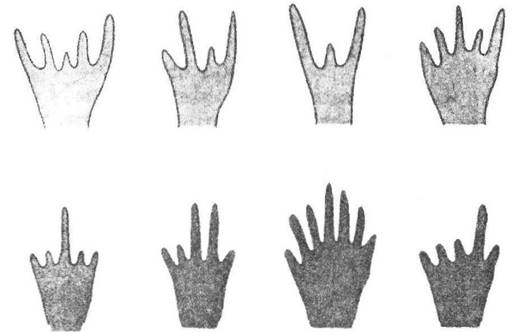
Fig. 16.3. Examples of morphogenetic constraints (after Thomson, cited in S. Gilbert, 1995):
top: forbidden variants of limb body plans in terrestrial vertebrates; bottom (from left to right): horse, deer, ichthyosaur, pterosaur
Finally, the Evolution of novel structures is significantly curbed by phyletic constraints rooted in the developmental genetics of respective organs. The foundation of such constraints lies in inductive interactions that ultimately culminate in The formation of a specific body plan. Today, scientists have concluded that Cytology/cytology/16.html">Early stages of Embryogenesis are quite flexible, yet this has little impact on subsequent ontogeny (mollusk larval forms may vary without altering the definitive form; sea urchins can even develop without a larval stage without changing the adult organism). Large-scale induction in vertebrate embryonic development occurs during Organogenesis, when features characteristic of the vertebrate subphylum are laid down. Once these vertebrate traits are acquired, the embryo can no longer transform into something else.
There is a whole range of other constraints associated with physical and environmental limitations. First and foremost, these include the confinement of life to planet Earth and its characteristic set of ecosystems. The PHYSICOCHEMICAL PROPERTIES OF the individual elements composing living matter further dictate its properties, imposing their own system of constraints, and so forth.
According to modern views, evolutionary theory not only accommodates METABOLISM/2.html">THE CONCEPT OF directedness but even considers it a direct outcome of elementary evolutionary forces.
In other words, directed development is driven, on the one hand, by the prolonged guiding influence of natural selection, and on the other, by a system of constraints.
At the same time, some evolutionists maintain that constraints can by no means steer the general course of evolution. Therefore, the problems of directionality, limitation, and especially the teleology of evolution remain open questions.
Last update: 07/08/2026
Editorial and Educational Adaptation: This material has been compiled based on the primary/original source text. The project team performed an editorial review, corrected technical inaccuracies, structured sections, and adapted the content for an educational format.
What was processed:
- elimination of formatting defects (OCR errors, structural breaks, corrupted characters);
- editorial organization of content;
- standardization of terminology in accordance with academic sources;
- verification of factual statements against the original source text.
All mentions of the author, publication year, and origin of the primary text have been preserved in accordance with the source.