Basics of Evolution - Korzh O.P. - 2006
Part II. MACROEVOLUTION
Chapter 16. Modern Problems of Evolution
16.3. Monophyly and Polyphyly in Evolution
One of the classical questions in the evolution of organisms is the monophyletic versus polyphyletic origin of life forms. This problem was raised as early as by J.B. Lamarck (an advocate of monophyletic development) and Karl von Baer (an apologist for polyphyly). However, The Essence of the problem at that time was somewhat different: debates centered around whether modern species originated from a single ancestral form through divergence (Lamarck) or from their own direct precursor (Baer). Polyphyly was envisioned as a multitude of parallel lines connecting ancestral species with modern ones without any branching, as all species were believed to have independent origins.
Nowadays, the problem has acquired a completely different meaning: following the ESTABLISHMENT OF THE probable hybridogenic origin of certain species, as well as the definition of Lichens as a complex of Fungi and Algae, polyphyly is understood As a result of synthesogenesis (Fig. 16.1). A polyphyletic group is considered to be one that originates from several ancestral forms. At the same time, it is now recognized that a monophyletic group cannot originate from a single ancestral individual (at best, from a population).
Class="center">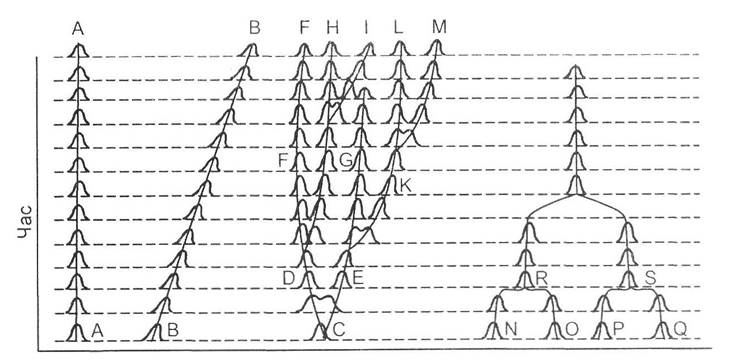
Fig. 16.1. Four main forms of speciation over time (after N.N. Vorontsov, 1999):
1 - stasigenesis; 2 - anagenesis; 3 - cladogenesis; 4 - synthesogenesis
Therefore, THE PRINCIPLE OF broad monophyly was proposed: a group of individuals is considered to have a monophyletic origin if it is initiated by a group of the same taxonomic rank (e.g., the Water/144.html">Origin of the Class Mammalia from the class Reptilia allows it to be considered monophyletic, despite the fact that various mammalian forms clearly originated from different reptile groups).
Monophyly is the foundation of modern systematics. Whenever a polyphyletic origin of a certain systematic group is established, the question arises as to whether its taxonomic status needs to be revised.
There are Examples of true polyphyletic origins of certain Organism groups at both macro- and microevolutionary levels. This primarily applies to the fairly widespread phenomenon of hybridogenesis, as well as synthesogenesis (symbiogenesis), where the combination of several organisms yields a fundamentally new form (lichens). In recent years, the view on THE ORIGIN OF The Introduction/5.html">Eukaryotic Cell as a result of symbiogenesis has gained popularity. It is believed that the eukaryotic cell was formed through several successive acts of Symbiosis involving a large anaerobic amoeboid cell with small aerobic Bacteria that gave rise to Mitochondria; spirochete-like bacteria from which flagella evolved; and blue-green prokaryotes—the ancestors of METABOLISM/14.html">Chloroplasts (more details on this in the next section).
Thus, it is now clear that the pathways of evolutionary transformations sometimes exceed the limits of our recent concepts. Therefore, N.N. Vorontsov proposes distinguishing four types of speciation over time (these same forms can also be considered for supraspecific taxa). The classical form involves The process of divergence (cladogenesis), through which the number of new species increases. Anagenesis (phyletic evolution) involves the Progressive development of a group driven by natural Selection, independent of its division into multiple branches. Stasigenesis is the long-term preservation of a species without fundamental changes, maintained by stabilizing selection. Synthesogenesis involves the hybridogenic formation of a new species.
Another aspect that should be considered relates to so-called reticulate (meshwork) evolution. At the microevolutionary level, processes of merging and splitting of various populations within a single species are the norm, as a result of which the graphical representation of phylogenetic relationships takes the form of a network or a structured mesh pattern (Fig. 16.2). However, similar relationships also exist at the macroevolutionary level, when related species form an entire hybridogenic complex.
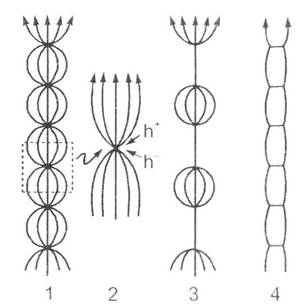
Fig. 16.2. Graphical representation of reticulate evolution (after Yu.I. Rozhkov, O.V. Pronyayev, 1994):
1, 3 - examples of microevolution with periodic splitting and fusion of populations; 2 - separate segment; 4 - ordered "reticulate" evolution
Last update: 07/08/2026
Editorial and Educational Adaptation: This material has been compiled based on the primary/original source text. The project team performed an editorial review, corrected technical inaccuracies, structured sections, and adapted the content for an educational format.
What was processed:
- elimination of formatting defects (OCR errors, structural breaks, corrupted characters);
- editorial organization of content;
- standardization of terminology in accordance with academic sources;
- verification of factual statements against the original source text.
All mentions of the author, publication year, and origin of the primary text have been preserved in accordance with the source.