BOTANY WITH BASICS OF HYDROBOTANY (AQUATIC PLANTS OF UKRAINE) - B.Ye. Yakubenko - 2011
X. SEED PLANTS
Family Typhaceae (Cattail family)
Perennial herbs with thick creeping rhizomes and unbranched stems. Leaves are distichous, linear. Flowers are unisexual, gathered into dense cylindrical spadices, with staminate flowers located in the upper part and pistillate flowers in the lower part. At the base of each part of the inflorescence, there are one or two large, quickly deciduous bracts. The perianth is reduced to Hair-like structures. Stamens are mostly three. Pistil is single, on a long stalk; the Ovary is unilocular, with a single ovule. The fruit is a nutlet with a long style and tufts of hairs at the base.
A small monotypic family with a single genus comprising about 30 species distributed in the Northern Hemisphere, 13 of which occur in Ukraine. The most common cattail species in Ukraine are two: narrow-leaved cattail and broad-leaved cattail.
Narrow-leaved cattail (Typha angustifolia L.). A plant with a cylindrical stem, 100-200(300-400) cm tall. The rhizome is thickened, up to 4 cm in diameter, branching, covered with quickly deciduous, two-ranked scale-like leaves. Roots are of two types: some are thin and branching, located in the Water, while others are thick, up to 30 cm long, situated in the soil. Leaves are linear, entire, flat, green, with a blade up to 2.5 m long and up to 14 mm wide. The spadix is cylindrical; the pistillate part is 1-20 cm long, and the staminate part is separated by a gap 1-10 cm long. Flowers are small; pistillate flowers are of three types: some form fruitlets 3-9 mm long; others have an underdeveloped ovule; and finally, some are sterile. Flowers are up to 10 mm long, with pointed dark brown bracts at the base. The axis of the staminate part of the inflorescence bears long hairs. It blooms from June to August. The fruit is a nutlet with a pappus located on a long stalk. It frequently forms hybrids with the broad-leaved cattail. It reproduces both vegetatively and by seeds.
It grows along waterbody banks, in lakes, river arms, floodplains, oxbow lakes, ponds, drainage canals, flooded quarries, and rice fields throughout Ukraine; it is rare in Crimea. It is pollution-tolerant. The wide ecological amplitude of the species determines The Diversity of its habitats, which include floodplain, deltaic, coastal, patch, and open-water habitats. The plant acts as a pioneer of coastal shallows, pits, and ditches.
It is a forage, bank-protecting, water-purifying, industrial, medicinal, food, and ornamental plant.
The rhizomes contain Proteins (up to 10%), fats (5.1%), fiber (up to 40%), CARBOHYDRATES (7.6%), oxalic acid salts, mucus, Tannins, and micro- and macroelements. The leaves contain ascorbic acid, protein (7.3%), fats, fiber, and micro- and macroelements. The pollen contains fats and carbohydrates. Thirty-four micro- and ultramicroelements have been discovered in various Organs of the cattail. In early summer, young shoots are consumed by crucian carp, grass carp, rudd, perch, common carp, and moth caterpillars. Leaf axils serve as egg-laying sites for jewel beetles, while thrips feed on the leaf sap.
The stems and leaves are suitable for manufacturing paper, decorative items, building Materials, artificial silk, and Cellulose production, and are used as an alternative energy source. The fruits are used as insulating material. Leaves can replace bast in grafting. Dried rhizomes are suitable for alcohol production. In folk medicine, cattail preparations are used as anti-inflammatory, softening, antiscorbutic, and hemostatic remedies. They are used to treat gastritis, enteritis, and dysentery. Pollen-based preparations stop uterine bleeding during childbirth, and leaf decoction is used for diabetes. The fluff is applied to Burns and frostbite. Fresh rhizomes are edible as a salad component and a seasoning for meat and fish dishes, while dried rhizomes can serve as a coffee substitute. From 1 hectare of thickets, 60-100 tons of raw biomass can be harvested.
Broad-leaved cattail (Typha latifolia L.). A plant with a thick, cylindrical stem, 100-200(300) cm tall (Fig. 210). Leaves are broadly linear, up to 20 mm wide. The pistillate spadix is cylindrical, 10-32 cm long, brown, continuous with the staminate one (not separated from it). The staminate inflorescence is slightly shorter than or equal to the pistillate one. It blooms from June to August. The fruit is a nutlet with a pappus.
Class="center">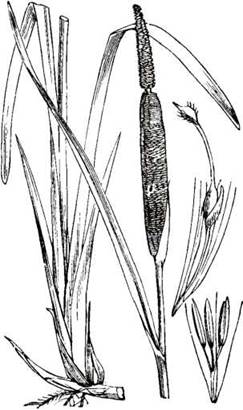
Fig. 210. Broad-leaved cattail
It grows along the banks of waterbodies with surface and soil waterlogging, on coastal shallows, in lakes, ponds, artificial reservoirs, and drainage canals throughout Ukraine (common), and sporadically in the Steppe zone.
It is a forage, industrial, food, bee-pollination, water-purifying, and bank-protecting plant. It is used in the same ways as the previous species.
In the Forest-Steppe and Steppe zones, Laxmann's cattail (Typha laxmannii Lepech.) is frequently encountered; it differs by having a short-cylindrical pistillate inflorescence, while the staminate inflorescence is narrow-cylindrical and located about 5 cm above the pistillate one. Its ecology and practical use are similar to those of the previous species.
Along the banks of mountain rivers and streams, Siberian cattail (Typha sibirica A. Krasnova) grows in Crimea and the Carpathians; Shuttleworth's cattail (Typha schuttleworthii Koch et Sond.) occurs in Transcarpathia; southern cattail (Typha australis Schum. et Thonn.) is found in the south of Ukraine; Zerov's cattail (Typha zerovii Klok.) occurs in floodplains and along river banks in the south of Odesa and Mykolaiv regions; Pontic cattail (Typha pontica Klok.) grows on the saline banks of estuaries in the southern Steppe, Sivash, and Crimea; and dwarf cattail (Typha minima Funk.) and Grossheim's cattail (Typha grossheimii Pobed.) are found in the Kilia Danube Delta.
Last update: 07/08/2026
Editorial and Educational Adaptation: This material has been compiled based on the primary/original source text. The project team performed an editorial review, corrected technical inaccuracies, structured sections, and adapted the content for an educational format.
What was processed:
- elimination of formatting defects (OCR errors, structural breaks, corrupted characters);
- editorial organization of content;
- standardization of terminology in accordance with academic sources;
- verification of factual statements against the original source text.
All mentions of the author, publication year, and origin of the primary text have been preserved in accordance with the source.