BOTANY WITH BASICS OF HYDROBOTANY (AQUATIC PLANTS OF UKRAINE) - B.Ye. Yakubenko - 2011
X. SEED PLANTS
Frogbit Family (Hydrocharitaceae)
Free-floating or submerged aquatic plants with basal or cauline leaves of various SHAPES AND SIZES. Inflorescence umbellate or flowers solitary, mostly actinomorphic, bisexual or unisexual (and then the plant is dioecious), with three to many stamens; gynoecium of three to six carpels, rarely 2 to 15. Ovary inferior. Flower formula: * P3+3 A3, 20G3-6(15). Fruit a berry-like capsule. The flora of Ukraine comprises four species belonging to four genera.
European frogbit (Hydrocharis morsus-ranae L.). A perennial floating plant with slender, submerged stems bearing lateral shoots that form overwintering buds at their tips (Fig. 173). Coated in mucus, these buds easily cling to the feet of birds and are thus dispersed. Leaves are orbicular or ovate with distinct Veins and two large membranous stipules, petiolate, and arranged in a rosette. Flowers are unisexual; inner perianth segments are white, outer ones green. Staminate flowers are clustered in groups within a single spathe, with 12 stamens connate at the base. Pistillate flowers are solitary on long pedicels, with six stigmas. Blooms from May to July.
Class="center">Water/water.files/image175.jpg" width="240"/>
Fig. 173. European frogbit
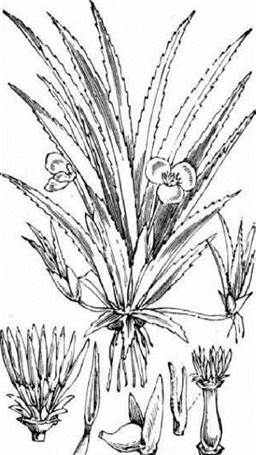
Fig. 174. Water soldier
Widespread throughout Ukraine in slow-flowing waters, ponds, drainage ditches, lakes, and oxbows. An ornamental, fodder, and medicinal plant. The chemical composition of the leaves has not been fully studied.
However, in folk medicine, the leaves are used as a sedative for hyperactive sexual desire and as an anti-inflammatory agent.
Not recommended for consumption in cases of diarrhea and hypotension. Harvesting should be done in ecologically clean areas, as the plant tends to accumulate radionuclides.
Nutritious feed for grass carp and common carp.
Suitable for cultivation in aquariums and artificial water bodies.
Water soldier (Stratiotes aloides L.). A perennial submerged plant with a shortened stem and leaves 15–45 cm long that emerge above the water surface in a rosette (Fig. 174). Leaves are trigonous-ensiform with spinose-serrate margins. Inflorescences are axillary; peduncles are long and flattened, with a two-leaved spathe. Plants are dioecious. Inner perianth segments are white. Staminate flowers are clustered in a single spathe, featuring 10–15 stamens with developed anthers and numerous filiform staminodes. Pistillate flowers are sessile, solitary or in pairs, with six stigmas. Blooms from May to August.
Found sporadically in backwaters, lakes, and ponds throughout Ukraine. An ornamental and fodder plant suitable for aquarium cultivation and landscaping artificial water bodies. Producing substantial biomass, it is used as pig feed and fertilizer. In natural water bodies, it serves as food for gastropods, bivalves, carp, and dipteran larvae.
Canadian waterweed (Elodea canadensis Michx.). A perennial aquatic plant with branched stems up to 30 cm long, submerged in water. Leaves are small, oblong or oblong-ovate, up to 10 mm long, finely serrate along the margin, arranged in whorls, and equipped with scalelike stipules (Fig. 175). Plants are dioecious; staminate plants are absent in Ukraine. Pistillate flowers are solitary, positioned on long pedicels in the leaf axils, enclosed in a two-lobed spathe, and reach the water surface. Perianth is white, with three stigmas.
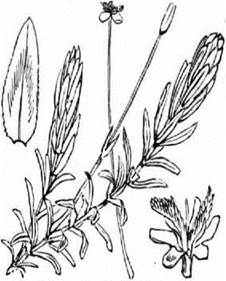
Fig. 175. Canadian waterweed
Found sporadically across Ukraine, with the exception of the Carpathians, Transcarpathia, and Crimea. A fodder and ornamental plant introduced from North America. It reproduces rapidly through vegetative propagation. Suitable for aquarium use, it helps purify water and provides excellent feed for carp, tench, roach, pigs, and other animals, as well as crustaceans, gastropods, and bivalves. Its leaves are consumed by the larvae of aquatic dipterans, hemipterans, beetles, orthopterans, and lepidopterans, and it often hosts aphids. Swans and whiskered terns nest in bays choked with dense stands of Canadian waterweed. It is an exceptional material for Laboratory studies of METABOLISM/14.html">Chloroplasts and cytoplasmic streaming. Intolerant of saline water and excess iron salts. In cases of mass proliferation, it clogs water bodies, hindering navigation and fishing.
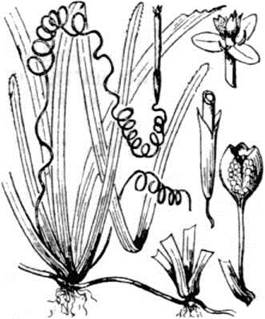
176. Spiral eelgrass
Spiral eelgrass (Vallisneria spiralis L.). A submerged dioecious plant with a creeping rhizome, shortened stem, and a rosette of long, linear leaves measuring 25–75 cm (Fig. 176). Staminate flowers are numerous, tiny, crowded into a spherical HEAD at the apex of the flowering stem, and covered by a single-leaved spathe. There are two stamens, one of which is a staminode. During pollination, the flowers detach and float on the water surface. Pistillate flowers are solitary, borne on long pedicels that subsequently coil into a spiral to reach the water surface. Perianth segments number three. Blooms in June and July.
Occurs in the southern Forest-Steppe and Steppe zones within the Dnieper, Southern Bug, and Dniester rivers.
Spiral eelgrass is one of the most popular aquarium plants, suitable for municipal wastewater Treatment, and its leaves are readily eaten by crucian carp.
Last update: 07/08/2026
Editorial and Educational Adaptation: This material has been compiled based on the primary/original source text. The project team performed an editorial review, corrected technical inaccuracies, structured sections, and adapted the content for an educational format.
What was processed:
- elimination of formatting defects (OCR errors, structural breaks, corrupted characters);
- editorial organization of content;
- standardization of terminology in accordance with academic sources;
- verification of factual statements against the original source text.
All mentions of the author, publication year, and origin of the primary text have been preserved in accordance with the source.