BOTANY WITH BASICS OF HYDROBOTANY (AQUATIC PLANTS OF UKRAINE) - B.Ye. Yakubenko - 2011
X. SEED PLANTS
Bladderwort Family (Lentibulariaceae)
Carnivorous, aquatic or marsh herbaceous plants with entire leaves collected in a basal rosette or leaves divided into segments. Flowers are zygomorphic; calyx 2- or 5-parted; corolla bilabiate, with a short tube and a spur at the base. Stamens two, attached at the throat of the corolla near the Base of the upper lip. Pistil one, with a unilocular Ovary, an extremely short style, and a trilobed stigma. Flower formula: ↑K(2),(5)C(2)+(2)A2G1. Fruit - a unilocular, many-seeded capsule.
The family comprises 4 genera and 180 species distributed in arctic, temperate, and tropical zones. In Ukraine, there are 2 genera and 7 species.
Common butterwort (Pinguicula vulgaris L.). A perennial herbaceous plant, 30-100 cm tall. Corolla bluish-purple, 15-20 mm long together with the spur; spur subulate, straight, half as long as the corolla. Leaves oblong-elliptic, obtuse, nearly sessile, collected in a dense basal rosette. Blooms in May-August.
Grows in moss bogs and marshy meadows in the Carpathians, Prykarpattia, Roztochya-Opillia, Western Polissia, and the Right-Bank Forest-Steppe. Protected, listed in the Red Data Book of Ukraine.
Lesser bladderwort (Utricularia minor L.). A perennial carnivorous plant, 5-25 cm tall; hydrophyte, hydatophyte, sciophyte, entomophil, hydrochore (Fig. 161). Roots reduced. Stems filamentous, 5-20 cm long, branching, freely floating in the surface Water layers, leaf arrangement alternate. Leaves tripartite, their segments repeatedly and dichotomously dissected into filamentous, glabrous (cilia-free) segments with small oblique-ovoid bladders up to 2 mm in diameter (sometimes absent).
Class="center">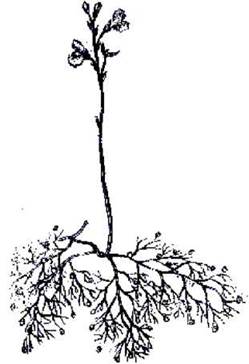
Fig. 161. Lesser bladderwort
All leaves are structurally identical and may bear trapping bladders 1-1.5 mm in diameter. The bladder has a valve that opens inward and traps small aquatic animals that enter it. Flowers zygomorphic, small, with bilabiate calyx and corolla.
Petals 7-10 mm long, pale yellow, with brownish-red stripes on the flat Swelling of the lower lip. Spur short, conic, shaped like a blunt tubercle. Lower lip of the corolla with downward-bent edges and a low swelling that does not block the entrance to the throat.
Inflorescence - a raceme of two to seven flowers. Flowering shoots colorless. Flowers small, bisexual. Fruit - a globose nodding capsule, up to 5 mm in diameter. Flowering is superaquatic, generative shoots rise 10 cm above the water surface. Blooms in June-August. Reproduces vegetatively (by turions and plant fragments), extremely rarely by seeds, of which a single plant produces from one to three.
An indicator of shallow, small, acidic, enclosed, and low-flow water bodies with a lowered water level or those drying up in the summer-autumn periods. A pioneer species of nutrient-poor water bodies at the initial stage of development.
A forage and ornamental plant. Grows in peat bogs and shallows of low-flow water bodies. Optimal depth ranges from 5 to 100 cm. Under conditions of water level fluctuation, the vitality of the species decreases. A widespread plant in Western Polissia, the Forest-Steppe (scattered), and the Steppe (in the north).
Intermediate bladderwort (Utricularia intermedia Hayne). A perennial herbaceous plant, 7-30 cm tall; hydrophyte, entomophil, hydrochore. Roots absent. Shoots of two types. Some have reduced, colorless, filamentous, simple or bi-tripartite leaves with bladders 2-3 mm in diameter at the ends, by which the plants anchor in the bottom silt. Other shoots are weakly branched, floating, up to 20 cm long, densely covered with green leaves without bladders. Leaves arranged in two rows, dichotomously dissected into filamentous segments (up to 1 cm), with 4-10 bristles along the margins. Flowering stem with 2-6 flowers on long pedicels. Flowers zygomorphic, with bilabiate calyx and corolla, 10-12 cm long, bisexual. Petals 12-15 mm long, light yellow, with reddish stripes in the throat; the swelling of the lower rounded lip blocks the corolla throat. Spur oblong, 8-15 (18) mm long, subulate-conic, several times longer than wide, appressed to the lower lip of the corolla. Inflorescence - a raceme of two to six flowers; fruit - a globose capsule. Flowering is superaquatic, generative shoots rise 10-15 cm above the water surface. Blooms in June-August. Vegetative Reproduction by SHOOT fragments and turions prevails over seed reproduction.
Grows in peat bogs, shallows of marshy oxbow lakes, and lakes in Polissia and the Forest-Steppe.
Common bladderwort (Utricularia vulgaris L.). A perennial carnivorous herbaceous plant, 30-100 cm tall; floating hydrophyte, sciophyte, entomophil, hydrochore. Roots reduced; the plant anchors in the muddy bottom by the lower part of its shoots or floats freely in the water Column. Vegetative shoots are of a single type, with numerous bladders (up to 200) and identical light-green leaves. Leaves sessile, 1-8 cm long, repeatedly pinnatisect into thin, filamentous, Ciliate segments. The leaves bear small, hollow internal bladders with Valves that crack when the plant is removed from the water. The entrance to the bladder is tightly closed by a valve that easily opens inward upon Touch, but as soon as external pressure ceases, the valve regains its previous position due to elasticity. When a small aquatic animal penetrates the bladder, it quickly dies, and its breakdown products are used for plant Nutrition. Leaf length 1.0-2.5 cm, bladder diameter 2-3 mm. The plant forms globose turions, up to 1 cm in diameter, from crowded leaves at the shoot apices, by means of which it overwinters. Flowers zygomorphic, large, bisexual, spurred. Calyx and corolla bilabiate. Petals 10-20 mm long, yellow, with orange stripes on the swelling of the lower lip and a brownish-red, obtusely conic spur. The upper lip nearly equals the swelling of the lower, obtuse, downward-bent lip. Flowering shoot brownish, 15-30 cm long. Inflorescence - a raceme of five to ten flowers. Fruit - a many-seeded globose capsule. Flowering is superaquatic. During the flowering period, pedicels rise 15-30 cm above the water surface. Blooms in June-July (September). Reproduces vegetatively (by shoot fragmentation and globose turions) and by seeds.
An indicator of eutrophic enclosed and low-flow water bodies, as well as mesotrophic water bodies undergoing increased trophic processes, with muddy, muddy-sandy, muddy-peaty, and peaty bottoms. A promising forage and ornamental plant. It is consumed by gastropod Mollusks (pond snails), aphids, and insect larvae.
Grows in lakes, oxbow lakes, standing water bodies, bogs, and ditches. Optimal depth 25-100 cm. Under conditions of water level fluctuation, individuals develop more weakly. A widespread plant in the Forest-Steppe, Polissia, the Steppe (rarely), Zakarpattia (sporadically), and Crimea (rarely).
Brem's bladderwort (Utricularia intermedia Hayne). A perennial herbaceous carnivorous plant, 5-50 cm tall; floating hydrophyte, pleustophyte, sciophyte, entomophil, hydrochore. Two Types of vegetative shoots are present: some bear green leaves without bladders, their segments obtuse at the apex but with a more or less long bristle-like tip and 4-12 bristles along the margins; others bear colorless leaves with narrower segments, but featuring bladders with inward-opening valves. In freely floating plants, transitional forms between both types of shoots are observed. Each green leaf has 8-10 bladders, and colorless ones have 1-8. Leaves have 9-25-50 linear segments. Roots reduced.
Inflorescence - a raceme of two to six flowers. Flowering shoot colorless. Flowers bisexual; calyx and corolla bilabiate. Corolla 7-10 mm long, yellow, with red stripes; spur short, cylindrical, tubercle-shaped. Lower lip of the corolla large, rounded, completely flat. Blooms in June-August. Fruit - a globose capsule. Reproduces vegetatively (by buds) and by seeds.
Found in Zakarpattia, rarely. Grows in marshy lakes, oxbow lakes, ditches, and peat bogs.
An indicator of oligo- and mesotrophic, usually enclosed water bodies and bogs with a constant water level and a muddy-peaty bottom.
A forage and ornamental plant.
In autumn, dense clusters of overwintering buds (turions) form at the stem tips of all bladderwort species. These drop to the bottom of the water body to endure the winter, and young plants develop from them in the spring.
Last update: 07/08/2026
Editorial and Educational Adaptation: This material has been compiled based on the primary/original source text. The project team performed an editorial review, corrected technical inaccuracies, structured sections, and adapted the content for an educational format.
What was processed:
- elimination of formatting defects (OCR errors, structural breaks, corrupted characters);
- editorial organization of content;
- standardization of terminology in accordance with academic sources;
- verification of factual statements against the original source text.
All mentions of the author, publication year, and origin of the primary text have been preserved in accordance with the source.