BOTANY WITH BASICS OF HYDROBOTANY (AQUATIC PLANTS OF UKRAINE) - B.Ye. Yakubenko - 2011
X. SEED PLANTS
Family Scrophulariaceae (Scrophulariales)
Mostly herbs, less commonly shrubs or trees (in the tropics). Leaves alternate, opposite, or whorled, without stipules. Flowers bisexual, zygomorphic, rarely nearly actinomorphic. Corolla four- or five-lobed, bilabiate, rotate, or funnel-shaped. Stamens mostly four, rarely two or five; pistil formed from two carpels, with a superior bilocular Ovary and numerous ovules. A nectar disk is present below the ovary. Fruit a capsule, rarely a berry.
Includes 300 genera and about 5,000 species distributed in the warm and temperate regions of both hemispheres. The flora of Ukraine comprises 28 genera and 205 species.
Water mudwort (Limosella aquatica L.). An annual plant, 3-8 cm tall, with a creeping, rooting SHOOT. All leaves basal, long-petiolate, linear-lanceolate, 3-5 mm long, entire. Flowers solitary, axillary, small; calyx Teeth acute, reflexed. Corolla ~3 mm, white or lilac, almost twice as long as the calyx. Flower formula: ↑K(5)C(2)+(3)A4G(2).
Grows in river and stream valleys, on wet soils in Transcarpathia, the basins of the Dniester and Dnieper, and less commonly along the Siverskyi Donets.
Shadow figwort (Scrophularia umbrosa Dumort., S. alata Gillb.). A biennial plant, 40-120 cm tall; uliginophyte, entomophile, barochore, anemochore. Stem ascending, quadrangular, winged, with four outgrowths, rooting at the nodes. Phyllotaxy alternate. Leaves ovate-oblong, 7-9 cm long, up to 4 cm wide, rounded at the base, crenate-serrate along the margin. Stem leaves differ from basal leaves; petioles winged. Inflorescence branched, consisting of three to four flower cymes. Flowers bisexual, zygomorphic, perianth double. Sepals round, with a wide white-membranous margin. Corolla zygomorphic, greenish-red-brown, 4-6 cm long. Flower formula: ↑K(5)C(2)+(3)A4G(2).
Fruit an ovate capsule, broadly ovate, 5 mm long. Blooms in June-August. Propagates vegetatively and by seeds. Honey-producing, medicinal, and poisonous plant.
Grows along the banks of rivers and streams, and in damp places. Occurs in Polissia and the Forest-Steppe, rarely in Transcarpathia in the Marmaros Basin, along the banks of the Tisza River, in the Steppe, and the foothills of the Crimea.
Genus Speedwell (Veronica). Annual, biennial, or perennial glabrous or pubescent herbs or small shrubs with opposite, whorled, or alternate entire leaves. Flowers zygomorphic, solitary in leaf axils or gathered into raceme-, HEAD-, or corymb-like inflorescences. Calyx dissected almost to the base into four or five lobes. Corolla blue, pink, white, or yellow with a short tube and a rotate four-parted (rarely five-parted) limb, the upper part of which is wider and the lower narrower. Stamens two, attached to the corolla tube, protruding far beyond the tube. Pistil with a long style and a small entire stigma. Flower formula: ↑K(4)C(4)A2G(2). Fruit a flattened or inflated, notched, obtuse or acute, bilocular capsule with few seeds, opening along two Valves. Up to 200 species of speedwell are known, 51 of which grow in Ukraine.
Marsh speedwell (Veronica anagallis-aquatica L., V. anagallis C. Koch.). A perennial plant, 15-80 cm tall; tenagophyte, entomophile, autochore (Fig. 159). Stem glabrous, creeping at the base, then ascending and branching, fleshy, obtusely quadrangular. Leaves sessile, semi-amplexicaul, entire or slightly serrate, glabrous, elliptic or lanceolate, 2-10 cm long, 1-1.5 cm wide.
Inflorescence a raceme, dense, many-flowered, emerging from the axils of opposite leaves. Pedicels 4-6 cm long, extremely thin, deflected at an acute angle from the inflorescence axis. Flowers bisexual, perianth double, zygomorphic. Corolla pale blue or pale violet, with blue Veins. Fruits are capsules, broadly oval, slightly narrowed toward the apex, shorter than the calyx. Blooms from April to September. Propagates by seeds.
Grows along the banks of streams, rivers, lakes, along canals, near water throughout Ukraine, but occurs rarely in the Crimea.
A food, fodder, and medicinal plant. Eaten by nutrias.
Water speedwell (Veronica anagalloides Guss.). A perennial herbaceous plant, 10-30 cm tall; tenagophyte, entomophile, autochore. Stem dense, solid, branching. Leaves sessile, semi-amplexicaul, or lower leaves short-petiolate, lanceolate, linear-lanceolate.
Inflorescence racemes, many-flowered, with a glandular-pubescent, rarely glabrous axis. Corolla 2-3 mm in diameter, whitish or dingy violet, with dark stripes. Fruit a capsule, oblong-elliptic, length almost twice exceeding the width. Blooms in May (June)-September.
Grows along the banks of streams, rivers, lakes, in the swamps of Polissia, in the Forest-Steppe, and much less frequently in the Steppe.
Beccabunga speedwell (Veronica beccabunga L.). A perennial herbaceous plant, 10-60 cm tall; hydroochtophyte, entomophile, autochore (Fig. 160). Stem ascending, fleshy, hollow, glabrous, round. Phyllotaxy opposite. Leaves petiolate, 4-7 mm long, broadly oval, with a rounded apex, slightly serrate along the margin, slightly fleshy. Vegetative lateral shoots often develop in the leaf axils.
Class="center">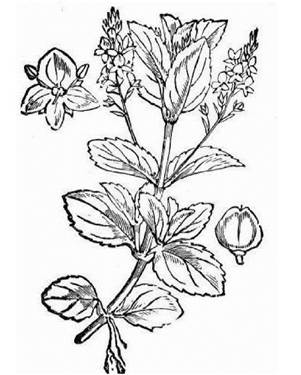
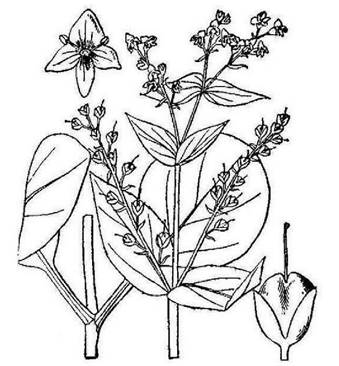
Fig. 159. Marsh speedwell
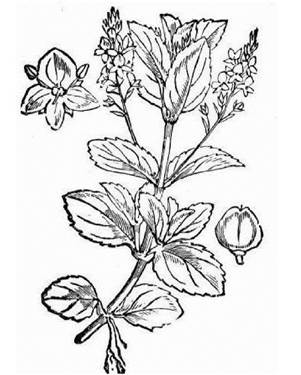
Fig. 160. Beccabunga speedwell
Inflorescence racemes, arranged in pairs in the leaf axils, obliquely directed upwards. Pedicels of almost equal length to the bracts. Corolla 4-9 mm in diameter, pale blue with blue veins, bright blue or dark violet, exceeding the calyx. Fruit a capsule. Blooms in May-September. Propagates by seeds and rhizomes.
In flowing waters, it forms a sterile, cold-resistant growth form capable of winter vegetation. The leaves of this form are more closely spaced and rounded. It is an edible plant.
It serves as a food source for freshwater crustaceans, particularly gammarids and amphipods.
It grows along the banks of streams, rivers, lakes, and in marshes throughout Ukraine, except in Crimea, where it is found only in mountainous areas and on the Southern Coast.
Marsh speedwell (Veronica scutellata L.). A perennial plant, 10-50 cm tall; uliginosophyte, entomophile, autochore. Stem ascending, slender, succulent. Leaves narrow-lanceolate, acute, distantly finely-toothed, sessile.
Inflorescences are racemes located in the axil of only one of two opposite leaves. Corolla pale blue or nearly white, with pink or dark blue veins, 4-5 mm in diameter. Fruit is a compressed capsule with a deep cordate notch at the apex. Blooms in May-September. Propagates by seeds.
It grows in moist meadows, marshes, and muddy river banks across most of Ukraine, though rarely in the Steppe zone, and only in the mountains of Crimea, where it is uncommon.
Marsh lousewort (Pedicularis palustris L.). An annual or biennial plant, 20-60 cm tall; pleistogeophyte, entomophile, anemochore. Stems ascending, branched, often reddish, covered with leaves towards the top. Leaves lanceolate in outline, pinnately dissected, with cartilaginously thickened terminal segments.
Inflorescence is a loose, spike-like raceme. Flowers bisexual, zygomorphic. Perianth double. Calyx tubular, bilobed, shorter than the corolla tube, with herbaceous incised-toothed lobes. Upper lip of the corolla with two acute teeth below the apex and two blunt teeth on the sides, lower lip Ciliate along the margin, pink. Floral formula: ↑K(5)C(5)A2G(5).
Fruit is an ovoid capsule, 3-16 mm long, obliquely notched at the apex, equal in length to the calyx or up to 1/3 longer than it. Blooms in June-August.
It grows in waterlogged meadows, sedge-hypnum fens, and peat bogs; rare in the Carpathians, frequent in Polissya and the Forest-Steppe regions.
Last update: 07/08/2026
Editorial and Educational Adaptation: This material has been compiled based on the primary/original source text. The project team performed an editorial review, corrected technical inaccuracies, structured sections, and adapted the content for an educational format.
What was processed:
- elimination of formatting defects (OCR errors, structural breaks, corrupted characters);
- editorial organization of content;
- standardization of terminology in accordance with academic sources;
- verification of factual statements against the original source text.
All mentions of the author, publication year, and origin of the primary text have been preserved in accordance with the source.