BOTANY WITH BASICS OF HYDROBOTANY (AQUATIC PLANTS OF UKRAINE) - B.Ye. Yakubenko - 2011
X. SEED PLANTS
Family Apiaceae (Umbelliferae) — Carrot or Parsley Family
Mostly herbs, rarely (in the tropics) tree-like plants with hollow stems and predominantly compound, deeply dissected leaves, often featuring swollen sheaths clasping the stem. The small, unisexual or bisexual flowers are gathered into compound or simple umbels or heads; an involucre is present at the base of simple umbels, and an involucel at the base of compound umbels, though these are sometimes absent. The flower has five perianth segments and five stamens. The calyx is reduced, five-toothed, or sometimes absent; the petals are free, often unequal in marginal flowers, with their tips incurved. The pistil is formed by two carpels with a 2-locular inferior Ovary. There are two styles, subtended at the base by a nectary disc. The floral formula is *K(5)C5A5G(2). The fruit is a schizocarp (cremocarp) consisting of two mericarps joined together by a carpophore. The back of each mericarp bears five more or less distinct Ribs, with oil tubes (vittae) located in the furrows or grooves between them.
Many umbellifers contain various Essential Oils in their fruits, leaves, and other Organs; hence, some species are cultivated as valuable essential-oil, spice, and garden crops. The family also includes a significant number of poisonous plants.
This is a large family comprising about 300 genera and over 3,000 species, distributed almost worldwide, but primarily in the North Temperate Zone and to a lesser extent in tropical mountains. The flora of Ukraine includes 66 genera and 155 species.
Marsh pennywort (Hydrocotyle vulgaris L.). A biennial wetland plant, (5) 10-60 cm tall; tenagophyte, entomophilous, hydrochore, ornithochore (Fig. 143). The ROOT System is secondary homorhizous, formed through The Development of adventitious roots at the nodes of the plagiotropic creeping stem. The stem is slender, creeping, 2-3 mm in diameter, up to 50 cm long, and roots at the nodes.
Leaves have long, erect petioles 5-15 (30) cm in length, attached to the center of a peltate blade 2.5-5 cm in diameter, with a crenate margin.
Class="center">Water/water.files/image144.jpg" width="266"/>
Fig. 143. Marsh pennywort
Inflorescences are few-flowered capitate umbels. Flowers are bisexual, nearly sessile, small, 2-3 mm in diameter. Petals are white. The fruits are schizocarps, 1.5 mm long and 2 mm wide, covered with reddish, laterally compressed warts. It blooms from June to August. It propagates by rhizomes and seeds.
It grows in bogs, sometimes in water, in marshy meadows, and in open alder swamps. It is extremely rare, found in the Western Forest-Steppe (Ternopil Region, in the vicinity of Buchach; Lviv Region, Kamianka-Buzka and Sokal Districts). The protected species is listed in the Red Data Book of Ukraine.
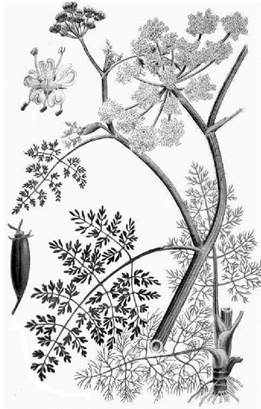
Fig. 144. Fine-leaved water-dropwort
Fine-leaved water-dropwort (Oenanthe aquatica (L.) Poir.). An annual, biennial, or perennial plant (terrestrial and amphibious forms growing in shallow water bodies are annual or biennial, while aquatic forms are perennial), 50-150 cm tall; therophyte, hemicryptophyte, heliophyte with a broad ecological amplitude; hydrochthophyte, helophyte, entomophilous, anemochore, hydrochore (Fig. 144). The root system is secondary homorhizous, with unthickened roots and thin, thread-like adventitious roots developing at the lower nodes of the stem. The stem is erect, hollow, furrowed, glabrous, branched, and thickened at the base, with a diameter of 3-8 mm. Heterophylly is characteristic: leaves submerged in water are ternate- or quaternate-dissected, with thread-like ultimate segments 18-60 cm long; aerial leaves are bipinnate or tripinnate, with a geniculately reflexed blade and small, ovate, pinnatifid segments 4-6 mm long and about 1 mm wide. The leaf blade exhibits considerable Variability.
The inflorescence is a compound umbel, up to 4 cm in diameter, with 7-12 rays on short peduncles. The inflorescence is leaf-opposed or axillary, lacking an involucre, but with involucels consisting of 5-10 linear-lanceolate bractlets 4-6 mm long and up to 1 mm wide. Flowers are bisexual, 5-merous, with lanceolate calyx Teeth and white petals. Fine-leaved water-dropwort is characterized by proterandry. The pistillate and staminate phases of flowering are temporally separated. In bisexual flowers, the pistil styles lengthen and spread apart only after the stamens have withered. The fruit is a light-brown cremocarp (schizocarp), ovoid to oblong, 2-3 mm long, with five broad, thread-like, slightly prominent ribs. A single specimen produces about 6,000 seeds. It blooms from June to September. It propagates vegetatively (rarely) and by seeds.
It is characterized by intraspecific diversity. Based on fruit shape, two varieties are distinguished: var. aquaticum (plants with oblong, cylindrical, or ovoid fruits, 4-5 mm long) and var. microcarpum (plants with elliptic fruits, 2-2.5 mm long).
It grows in bogs, wet meadows, and along the shores of eutrophic closed water bodies with fluctuating water levels during the growing season, in areas with a water depth of 0-50 cm. It occurs in water bodies situated at altitudes up to 500 m above sea level. The species is capable of developing on poor soils. It grows satisfactorily in areas experiencing increased anthropogenic eutrophication of water bodies and high water salinity. Under conditions of synanthropization, it achieves broader development and distribution. It is widespread throughout Ukraine, though rare in Crimea.
It is ornamental and medicinal (used for respiratory tract diseases, Bronchitis, Bronchial Asthma, as a diuretic for cystitis, and as a carminative and sedative for Stomach and intestinal pain and flatulence). It is considered poisonous, and livestock avoid it in pastures. However, it is consumed by beavers, nutrias, leaf beetles, weevils, narrow-winged moths, and dipteran insects, including mosquitoes.
Silaifruit water-dropwort (Oenanthe silaifolia M. Bieb.). A perennial herbaceous plant, 25-50 cm tall; hydrochthophyte, entomophilous, anemochore, hydrochore. Roots are cord-like and thickened. The stem is erect. The inflorescence is a 6-10-rayed umbel, up to 4-6 cm in diameter. The axes of the inflorescence are ribbed, scabrous, and thickened during fruiting. Styles are somewhat thick and straight. Fruits are mericarps, prismatic, truncate at the apex and base, 2-2.5 mm long. It blooms from June to August. It propagates by seeds.
It grows in bogs, wet meadows, and near water in Transcarpathia, the Right-Bank Forest-Steppe, the Right-Bank Steppe, Northern Crimea, and the southern coast of Crimea.
Cowbane or Northern water hemlock (Cicuta virosa L.). A perennial herbaceous plant, 50-100 cm tall; pleistohelophyte, anemochore, hydrochore (Fig. 145). The rhizome is erect, shortened, thick, fleshy, firm and rounded in early spring, elongated and transversely wrinkled in autumn, divided by transverse septa into several cavities. The stem is erect, smooth, rounded, with hollow internodes, bearing long adventitious roots at the lower nodes, and branched at the apex. Leaves are petiolate, bi- or tripinnately dissected, with narrow-lanceolate or linear segments that have sharply serrate margins. Leaves on flowering shoots are smaller and less divided than basal ones, with a prominent sheath.
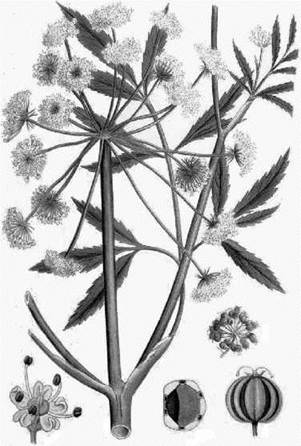
Fig. 145. Cowbane (water hemlock)
The inflorescence is a compound umbel with 10-20 main rays, lacking an involucre or having one consisting of 1-2 bracts; the involucel consists of 8-12 linear bractlets that are much shorter than the pedicels. Flowers are bisexual, small, with a reduced calyx and a corolla of five white petals. Fruits are nearly spherical schizocarps up to 2 mm long, each mericarp featuring five thick, flat ribs. It blooms in July and August. It propagates by seeds.
The plant is extremely poisonous! It has insecticidal and medicinal properties (used for psychoses and Epilepsy, and as an antispasmodic agent).
It grows in swamps, on wet meadows, along riverbanks, and in water. It is sporadically distributed throughout Ukraine, except for the Carpathians and Crimea, mainly in Polissia and the Forest-Steppe, while in Zakarpattia it is extremely rare.
Narrow-leaved water-dropwort (Sium sisaroideum DC.). A perennial plant 50-100 cm tall; hydro-ochthophyte, heliosciophyte, hemicryptophyte, entomophil, autochor, barochor, hydrochor (Fig. 146). Rhizome creeping, up to 30 cm long. Adventitious roots, thin, forming a fibrous root system. Stem erect, finely grooved, hollow. Leaves odd-pinnate: the lower ones have three to seven pairs of ovate-lanceolate, acute segments that are cordate at the base; the upper ones are ternate with narrow-lanceolate, pointed lobes. Leaf petioles lack transverse septa.
Inflorescence is a compound umbel. Flowers are bisexual, calyx teeth are barely noticeable, corolla is white. Involucre and involucels have five to seven linear-lanceolate leaflets, calyx teeth are short and inconspicuous. Fruits are mericarps, 2.5-3 mm long, with filiform ribs. It blooms in July-August. Reproduces vegetatively (via shoots, rhizomes) and by seeds. Forms an aquatic growth form with hygromorphic stems.
It grows in swamps, along the banks of rivers, lakes, streams, in drainage ditches, and on flood meadows throughout Ukraine, except for the Carpathians.
An indicator of newly formed alluvial sites, as well as areas subject to waterlogging and accumulation processes, and disturbed sites (drainage ditches).
An ornamental, essential-oil, medicinal, and poisonous plant; however, the root contains sugar, which earned the plant the name "sugar or sweet roots". It participates in the overgrowth of water bodies.
Greater water-parsnip (Sium latifolium L.). A perennial herbaceous plant (Fig. 147), 100-150 cm tall; hemicryptophyte, uliginosophyte, helophyte, heliosciophyte, hydro-ochthophyte, entomophil, barochor, hydrochor. Rhizome straight, thickened, up to 5 cm thick. Roots cord-like, up to 15-20 cm long, forming a dense fibrous system. Stem erect, sharply ribbed, branched at the top, 30-150 cm tall. The plant is heterophyllous: lower submerged leaves have blades dissected into fine filiform lobes; aerial leaves are odd-pinnate, 15-30 cm long and about 10 cm wide, consisting of three to seven oblong or lanceolate, sessile, finely serrate leaflets, 5-10 cm long and 1-2.5 cm wide. Leaf petioles have transverse septa.
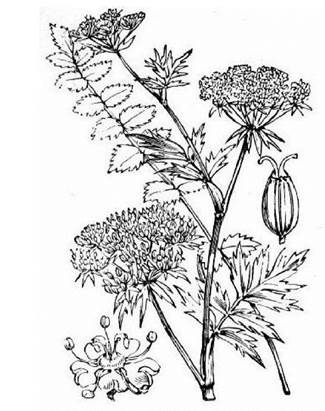
Fig. 146. Narrow-leaved water-dropwort
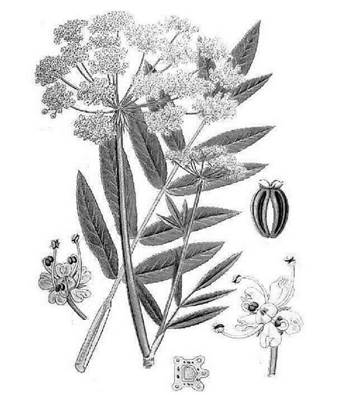
Fig. 147. Greater water-parsnip
Inflorescence is a compound 10-14-rayed umbel; apical umbels have up to 30 rays and are 6-12 cm in diameter. Involucre and involucel leaflets are linear-lanceolate, reflexed, and finely pointed. Flowers are bisexual, perianth is double, pentamerous. Calyx consists of five oblong or linear-oblong acute teeth. Petals are white, notched, broadly obovate, two to three times longer than the calyx teeth. Fruits are ovate or oval schizocarps (cremocarps), up to 3 mm long, with five filamentous protruding ribs. It blooms in June-August. Reproduces vegetatively (via rhizomes, root suckers) and by seeds. The onset of vegetation typically occurs in the coastal ecophase at a depth of up to 60 cm (forming f. submersa), while flowering and fruiting take place in the marsh and terrestrial ecophases (f. terrestris).
The plant is ornamental, medicinal, essential-oil-bearing, poisonous, bank-protecting, and a pioneer in the overgrowth of newly formed habitats. It is fed upon by leaf beetles, weevils, aphids, and lepidopteran larvae (caterpillars).
An indicator of meso-eutrophic water bodies with fluctuating water levels throughout the growing season, silty-clay deposits rich in calcium carbonate, areas with soil waterlogging, and habitats subject to prolonged flooding.
It grows on the banks and in shallow waters of freshwater, enclosed and stagnant water bodies, waterlogged meadows, and bogs across all Regions of the Ukrainian Forest-Steppe. A drop in water level stimulates its development. Intensified anthropogenic eutrophication of water bodies leads to a decline in population vitality and productivity.
Fool's water cress (Siela erecta (Huds.) M. Pimen.). A perennial herbaceous plant 30-80 cm tall; hemicryptophyte, helophyte, heliophyte, hydro-ochthophyte, entomophil, barochor, hydrochor. Rhizome thin, with creeping shoots and basal leaf rosettes. Plant is glabrous. Stems erect, nearly round, hollow, branched. Leaves are pinnately dissected, the lower ones petiolate with four to nine pairs of ovate-oblong incised-serrate lobes; the lowermost pair of leaves is smaller; upper leaves are reduced, sessile, forming an expanded sheath with a membranous margin.
Inflorescence is a compound 10-20-rayed umbel on a short peduncle; involucre and involucel consist of numerous lanceolate entire or incised leaflets. Flowers are bisexual, perianth is double. Calyx teeth are awl-shaped, corolla petals are white, styles are reflexed downward. Fruits are schizocarps, broadly ovate, up to 2 mm long. It blooms in June-August. Reproduces by rhizomes and seeds. Forms a floating growth form.
A promising forage, ornamental, and water-conserving plant. It grows in wet meadows, along riverbanks and ditches, in low-lying areas with surface and soil waterlogging, and extends into the water. An indicator of sites with permanent soil and intermittent surface waterlogging, as well as coastal zones of water bodies with fluctuating water levels. Distributed throughout Ukraine.
Marsh parsley (Ostericum palustre (Bess.) Bess.). A biennial plant, 50-80 cm tall. Stem erect, sharply ribbed-grooved, hollow (Fig. 148). Stem leaves number two to four; they are large, broadly triangular, with blades angled sharply downward, bipinnately or tripinnately dissected, featuring ovate, coarsely serrate lobes. Upper leaves have expanded sheaths deflected from the stem. Inflorescence is a compound umbel, 5-7 cm in diameter, with 8-30 rays. Involucre is absent, involucel consists of numerous linear-lanceolate leaflets. Flowers are bisexual, petals are white. Fruits are schizocarps, oval-oblong, 4-5 mm long. It blooms from May to August. Reproduces by seeds.
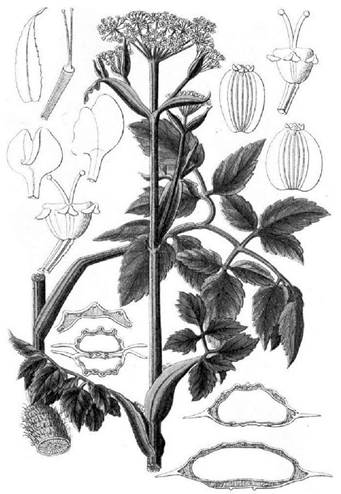
Fig. 148. Marsh parsley
It grows along the banks of water bodies, in waterlogged meadows, bogs, and alder forests in Polissia, the Forest-Steppe, and the Steppe.
Garden angelica (Archangelica officinalis Hoffm.). A biennial plant, 120-180 cm tall; uliginosophyte, entomophil, anemochor, hydrochor (Fig. 149). Rhizome straight, shortened, wrinkled. Stem erect, branched, grooved, hollow, thick, 1.5-6 cm in diameter. Leaves up to 80 cm long, with an inflated sheath, bipinnately or tripinnately dissected; ultimate lobes 5-8 cm long, trilobed, sharply serrate. Inflorescence is a compound umbel, 10-17 cm in diameter, with numerous pubescent rays, lacking an involucre. Involucels are multi-leaved, consisting of numerous linear leaflets equal in length to the pedicels. Flowers are bisexual. Calyx is reduced, petals are five, white or greenish. Fruits are schizocarps, broadly oval, 5 mm long, 3-5 mm wide, with convex median and winged marginal ribs. It blooms in June-August (September).
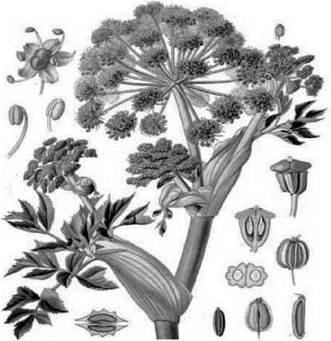
Fig. 149. Garden angelica
A medicinal, spicy, and essential oil plant (essential oil is extracted from the seeds), as well as a food plant (young green shoots and leaf petioles are used in confectionery).
Cultivated.
Grows along the banks of freshwater streams and flowing bodies of water, in alder forests, on waterlogged meadows, and in bogs across Zakarpattia, the Carpathians, the Forest-Steppe, and the Steppe zones.
Wild angelica (Angelica sylvestris L.).
A perennial herbaceous plant, 100-200 cm tall. The stem is erect, round, hollow, smooth, branched at the top, and slightly angled. Leaves feature broad, pouch-like inflated sheaths; their blades are broadly triangular, bi-to-tripinnatisect, up to 60 cm long, with ovate-oblong, finely and sharply serrated segments. Umbels are large, with 18-30 rays. Involucre is absent or consists of a few leaflets; involucels are multi-leaved. Petals are white. Fruits are cremocarps, 4-6 mm long, broadly oval, dorsally compressed, with central ribs; marginal ribs are wing-like. Blooms from July to September. Serves as a food source for weevils.
Grows singly in river valleys, damp forests, and wet meadows across most of Ukraine, except for Crimea. It extends into the Steppe zone exclusively along river valleys.

Fig. 150. Marsh milk-parsley
Marsh milk-parsley (Peucedanum palustre (L.) Moench, Calestania palustris (L.) K.-Pol., Selinum palustre L.). A perennial herbaceous plant, 50-120 cm tall; uliginosophyte, entomophile, barochore, hydrochore (Fig. 150). The stem is erect, hollow, ribbed-sulcate, and branched. Basal leaves are large, long-petiolate, deeply bi-to-tripinnatisect, triangular in outline, with oblong-linear acute segments. Stem leaves are less developed, short-petiolate, with the upper ones nearly sessile.
The inflorescence is a compound umbel with 15-30 rough-pubescent rays. Involucre and involucels consist of 7-12 ovate-lanceolate, oblong-acuminate leaflets with a white margin and Ciliate edges. Flowers are bisexual, pink before opening, later turning white. Fruits are broadly elliptical cremocarps, about 5 mm long. Blooms in July and August. Propagates by seeds.
The plant is consumed by beavers.
Grows in bogs and alder swamps in the Carpathians, Polissia, and the Forest-Steppe.
Last update: 07/08/2026
Editorial and Educational Adaptation: This material has been compiled based on the primary/original source text. The project team performed an editorial review, corrected technical inaccuracies, structured sections, and adapted the content for an educational format.
What was processed:
- elimination of formatting defects (OCR errors, structural breaks, corrupted characters);
- editorial organization of content;
- standardization of terminology in accordance with academic sources;
- verification of factual statements against the original source text.
All mentions of the author, publication year, and origin of the primary text have been preserved in accordance with the source.