BOTANY WITH BASICS OF HYDROBOTANY (AQUATIC PLANTS OF UKRAINE) - B.Ye. Yakubenko - 2011
X. SEED PLANTS
Buckwheat Family (Polygonaceae)
Herbs, less commonly shrubs or trees (in tropical regions). Leaves with stipules that fuse to form an ocrea. Flowers arranged in panicles, racemes, and spikes, featuring a simple, 3- or 6-merous perianth. Stamens number 3 to 9; pistil single, formed of 2 to 3 carpels; Ovary semi-inferior. Fruit is a nutlet; seeds contain starchy endosperm, with an embryo that is straight or curved. A characteristic feature of almost the entire family is the presence of calcium oxalate in the leaves and young shoots, and Tannins in underground Organs. Medicinal, vegetable, pseudocereal, and tannin-yielding plants are found among the members of this family.
A relatively large family comprising 40 genera and over 1,000 species distributed worldwide; in the flora of Ukraine, it is represented by 6 genera and 66 species.
Water smartweed (Polygonum amphibium L.). A perennial herbaceous plant, 15-50 cm long; aquatic geophyte, helophyte (terrestrial form), aero-hydatophyte, heliophyte, neutrophile, hemerophile, entomophile, hydrochore, zoochore (Fig. 119). Rhizome creeping, highly branched, sturdy, rooting at the nodes. Stems simple or branched, up to 20 cm long in terrestrial specimens and 100-200 cm in aquatic ones. The stems feature distinct nodes and internodes. Phyllotaxy is alternate. Leaves are floating. Leaf petioles are short, attached to the stem above the middle of the sheaths. They are cylindrical, usually Ciliate along the margin. Leaf blades range from oblong-elliptic to linear-lanceolate, acute, with a rounded base, entire, semi-coriaceous, appressed-hairy, often glandular, 5-12 cm long, 1.5-2 cm wide.
Class="center">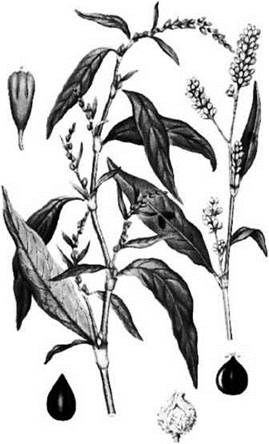
Fig. 117. Water-pepper or marsh pepper
Inflorescence is a dense spike, 3-5 cm long, emerging above the water. Flowers are small, 4 mm long, bisexual; perianth simple, petaloid, consisting of 5 (ranging from 4 to 6) white or pink petals fused to the middle. Androecium of 4-8 stamens; pistil with 2-3 styles and a bifid stigma. Floral formula: pistillate flower - *P4-6G(2-3), staminate flower - *P5A4-8. Fruit is a nutlet, lenticular, black, shiny, biconvex, covered with persistent perianth remnants, 2-3 mm long. Blooms from June to September. Aquatic forms produce floating leaves starting in late April. In the terrestrial form, development is accelerated by a month, but flowering occurs later than in aquatic forms. Propagates vegetatively via rhizome fragments and rarely by seeds.
Two natural forms are known: var. terrestre Leyss. — a terrestrial form with an erect, densely leafy stem and lanceolate, short-petioled leaves pubescent with appressed bristly hairs, and var. natans Leyss. — an aquatic form with floating, branched, long stems and long-petioled glabrous leaves.
It grows in standing and slowly flowing waters, in marshes, and along riverbanks across almost all of Ukraine, except for the Wormwood Steppe and Crimea.
An indicator of habitats with a high degree of water turbulence. A pioneer plant in the overgrowth of newly formed water bodies. When water bodies dry up, it produces a terrestrial form.
A promising ornamental, forage, fisheries-supporting, bank-protecting, medicinal, and tannin-bearing plant, as well as a weed in rice paddies and fishponds. This species is consumed by gastropod Mollusks (pond snails, ramshorn snails), narrow-winged moths, leaf beetles, weevils, dipteran insects including mosquitoes, fish of the carp family (Cyprinidae), geese, ducks, Russian desmans, beavers, and nutrias.
Water-pepper or marsh pepper (Polygonum hydropiper L.). An annual plant, 20-70 cm tall. Leaves lanceolate, sheaths almost glabrous (Fig. 117). Inflorescences long, interrupted. Perianth densely covered with punctate glands, pink, often greenish, 4- or 5-parted. Fruit is a nutlet, extremely convex on one side.
A medicinal, edible, vitamin-rich, and dye-yielding plant, also acting as a weed. It serves as food for leaf beetles, weevils, geese, ducks, and beavers.
It grows along the banks of water bodies, in meadows, and along ditches in damp forests throughout Ukraine, except for the Wormwood Steppe.
Panicled knotweed (Polygonum paniculatum Andrz.). An annual plant, 50-100 cm tall. Leaves oblong-lanceolate, 4-15 cm long, 0.2-3 cm wide, narrowed at the base into a short petiole, with an extended acuminate apex, pitted-glandular beneath, minutely bristly above. Sepals glandular, persistent in fruit, with exceptionally distinct Veins.
The plant is consumed by narrow-winged moths, leaf beetles, geese, and ducks.
It grows in damp meadows and sandy riverbanks in the Forest-Steppe and Steppe zones.
Dock Genus (Rumex). Perennial or annual herbs with entire leaves. Flowers small, pistillate and staminate, or bisexual, arranged in panicle-like inflorescences.
Perianth simple, calyx-like, consisting of six nearly free segments (three in each of two whorls). The inner whorl segments enlarge and enclose the fruit upon ripening. In some species, tubercles (callosities) develop on one (or all) of these segments. Stamens six, pistil with three styles and tassel-like stigmas. Floral formula: pistillate flower - *P3+3G(3), staminate flower - *P3+3A6, bisexual flower - *P3+3A6G(3). Fruit is a triquetrous nutlet. The genus comprises about 200 species, of which 24 occur in Ukraine. They grow in meadows, near water bodies, occasionally in forests, or as weeds.
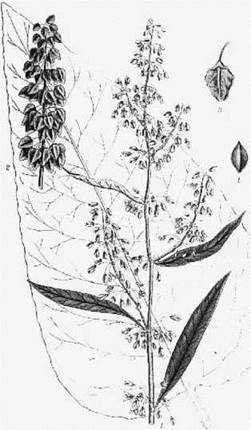
Fig. 118. Water dock
Water dock (Rumex aquaticus L.). A perennial plant, 50-150 cm tall; ochthohydrophyte, anemophile, anemochore, endozoochore (Fig. 118). ROOT system taproot-based, with a fusiform main root. Stem orthotropic, appressed-hairy, branched. Leaves acuminate, glabrous; lower leaves with long, channeled petioles, ovate or oblong-ovate, cordate at the base, unevenly crenate or nearly entire. Upper leaves lanceolate.
Inflorescence is a panicle up to 25 cm long, nearly leafless, with appressed branches. Inner perianth segments 5-6 mm long, ovate-triangular, entire or slightly toothed, without callosities, persistent in fruit. Blooms in June-July. Fruit is a nutlet. Propagates by seeds.
The plant serves as food for flies, mosquitoes, cutworms, geese, ducks, and beavers.
It is found along the banks of rivers and lakes, in damp forest clearings, marshy meadows, and rarely in Polissya and the Forest-Steppe regions.
Ukrainian dock (Rumex ucrainicus Fisch. ex Spreng.). A perennial herbaceous plant, 15-30 cm tall. The stem is branched from the base. Leaves have distinctly separated long petioles and are oblong-lanceolate, while the upper ones are linear. The inner perianth segments are up to 2 mm long, ovate-triangular, with a short awn at the apex and three small Teeth on each side.
It grows in damp sandy and saline habitats, along riverbanks in the Dnieper valley, the lower reaches of the Sula, Vorskla, and Samara rivers, along the Siverskyi Donets and Oskil rivers, and in the vicinity of Odesa, Mykolaiv, and Askania-Nova.
Golden dock (Rumex maritimum L.). A perennial herbaceous plant, 10-60 cm tall. The stem is branched at the top. Leaves are narrow-lanceolate or linear, tapering into a petiole, with the lower ones up to 25 cm long. Flowers are small, numerous, congested, and globular. Axillary flower clusters form a paniculate inflorescence covered with leaves towards the top. The inner perianth segments are up to 5 mm long, rhombic or triangular-lanceolate, with a tubercle, acute, bearing two to three long setaceous teeth on each side. The inflorescence is large, leafy, consisting of congested flower whorls. It blooms in June-July.
The plant serves as a food source for cyst-forming nematodes.
It grows in damp, predominantly saline habitats, meadows, marshes, and along the banks of water bodies across almost all of Ukraine, except for mountainous regions.
Water dock (Rumex hydrolapathum Huds.). A perennial herbaceous plant, 1-2 m tall; aquatic hemicryptophyte, heliosciophyte, acidophile, oxtohydrophyte, helophyte, anemochore, endozoochore. The Root System is taproot-like, up to 30 cm long, often with well-developed large lateral roots of two types (cord-like and fibrous). The stem is orthotropic, finely furrowed, and slightly branched. Leaves are broad-lanceolate, acute, narrowed at the base into a petiole, finely wavy along the margin, up to 40 cm wide; lower leaves are long-petiolate and broad-lanceolate, while upper ones are nearly sessile and narrow-lanceolate. The petioles at the apex are flat, without a groove.
The inflorescence is a panicle—long, broad, and dense. Flowers are bisexual. The inner perianth segments in fruit are 4-5 mm long, broadly triangular-ovate, with a shortly pointed apex, all featuring an oblong tubercle. The fruit is a nutlet, 3.5-4.5 mm long, nearly smooth, and brown. It blooms from June to August. It propagates by seeds and vegetatively. The dormancy period in Ukraine lasts up to 6 months. In October-November, the entire above-ground part dies off. Leaf blades are rolled up and tightly gathered into a compact rosette. In waterlogged habitats, they are twice the size of leaf blades of plants growing in non-waterlogged areas. Plants begin development In the second decade of April. A single specimen produces about 4-5 thousand seeds.
It grows along the banks of water bodies, often in water, in marshes, drainage ditches, and in depressions with surface and groundwater logging. Under conditions of excessive waterlogging, it produces reduced narrow-lanceolate leaves. It is widespread throughout Ukraine, except for the Carpathians and Crimea.
An indicator of littoral zones of water bodies with constant surface and groundwater logging, silty-peaty deposits, and marshy areas.
A promising tanning, medicinal, forage, ornamental, bank-protecting, and water-conserving plant. It serves as food for cyst-forming nematodes, gastropod mollusks (particularly pond snails), desmans, and beavers.
Last update: 07/08/2026
Editorial and Educational Adaptation: This material has been compiled based on the primary/original source text. The project team performed an editorial review, corrected technical inaccuracies, structured sections, and adapted the content for an educational format.
What was processed:
- elimination of formatting defects (OCR errors, structural breaks, corrupted characters);
- editorial organization of content;
- standardization of terminology in accordance with academic sources;
- verification of factual statements against the original source text.
All mentions of the author, publication year, and origin of the primary text have been preserved in accordance with the source.