BOTANY VOLUME 2 - PLANT PHYSIOLOGY - 2007
6. PHYSIOLOGY OF METABOLISM
6.9. Chemoautotrophy
Chemoautotrophic organisms (see Table 6.1) include exclusively chlorophyll-free prokaryotes (Bacteria and certain archaea that reduce CO2 using H2). Chemoautotrophs utilize the Electrochemical Potential difference of inorganic redox reactions to produce ATP, with inorganic substances also serving as primary electron Donors. The substances to be oxidized are taken up from the environment by Cells, which subsequently release the oxidation products back out.
Chemoautotrophic organisms differ from photoautotrophic ones in their mode of ATP and NADH + H+ production. While chemoautotrophic bacteria exhibit a carbon METABOLISM that is identical or very similar to that of autotrophic ones, archaea occupy a unique position. They lack The Calvin Cycle, which is why we will subsequently focus solely on Electron Transport and associated phosphorylation in chemoautotrophs.
6.9.1. Energy-Yielding Reactions
• Nitrification. Nitrifying bacteria are obligate aerobes that oxidize NH3 or NH+4, via nitrite as an intermediate, to nitrate (see Fig. 6.87). This process involves two ecologically closely linked groups of bacteria: nitrosating species (e.g., Nitrosomonas) convert NH3 into nitrite, while nitrifying species (e.g., Nitrobacter) convert nitrite into nitrate:
Class="center">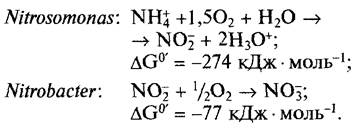
The close cooperation of these two genera (parabiosis) is necessary, on the one hand, because Nitrosomonas supplies the substrate for Nitrobacter, and on the other hand, because nitrite is toxic to Nitrosomonas (as well as to other organisms). The prompt removal of the excreted nitrite during nitrification is ensured by the fact that Nitrobacter is much more "starved" than Nitrosomonas, requiring it to process significantly more substrate to produce the same amount of energy. Nitrifying bacteria in the soil coexist with putrefactive bacteria, which release NH+4 from organic material. Nitrification is a crucial soil process for producing nitrate, which serves as the primary nitrogen source for higher plants. Under oxygen deficiency in Water-logged soils, nitrification is inhibited, yet it can occur near The surface of roots, which are supplied with oxygen via intercellular spaces and aerenchyma and partially release it into the surrounding environment.
• Sulfur Oxidation. A morphologically diverse group of colorless sulfur bacteria inhabits, for instance, nutrient-rich standing water puddles, particularly sewage irrigation fields. They are capable of oxidizing sulfur compounds, such as H2S generated during the decomposition of organic material or through sulfate reduction (during bacterial sulfate reduction in deep, oxygen-depleted Zones of the Black Sea).
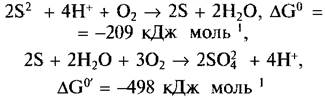
This reaction is carried out, for example, by the cyanobacterium Beggiatoa and the bacterium Thiothrix, which also temporarily store elemental sulfur within their cells. Most species of the obligately chemoautotrophic genus Thiobacillus oxidize various sulfur compounds to sulfate. Along with H2S, sulfides, and sulfur, these bacteria also oxidize sulfite (SO2-3), thiosulfate (S2O2-3), di-, tri-, and tetrathionates (S2O2-6, S3O2-6, S4O2-6), and thiocyanate (SCN-), thus playing a vital role in the natural Treatment of industrial wastewater. Thiobacillus thiooxidans produces massive amounts of H2SO4 and easily tolerates high acidity (up to 1 N sulfuric acid).
• Iron- and Manganese-Oxidizing Bacteria.
Species of the genus Thiobacillus (e.g., T. ferrooxidans) oxidize ferrous iron.

Regarding the long-known iron bacteria Gallionella ferruginea and Leptothrix ochracea, it remains somewhat unclear whether they are true chemoautotrophs or merely store iron compounds. Since iron oxidation yields very little energy, colossal volumes of substrate are processed; thus, iron bacteria contribute, for instance, to The formation of bog iron ore.
Manganese bacteria (e.g., Pedomicrobium manganicum) oxidize Mn2+ to Mn4+ accordingly.
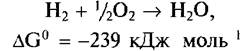
Widespread in soils, hydrogen bacteria—unlike nitrifying bacteria, certain thiobacilli, and ferrobacilli—are not obligate but facultative autotrophs; they can also subsist on Organic compounds. Certain species of the genera Pseudomonas (e.g., P. facilis) and Alcaligenes (e.g., A. eutrophus) use Hydrogenase to oxidize molecular hydrogen (a reaction analogous to an oxyhydrogen explosion).
Methanogenic bacteria (e.g., Methanomonas) oxidize methane to CO, while another group of bacteria oxidizes CO to CO2, specifically aerobes (e.g., Pseudomonas carboxydovorans) and anaerobes (e.g., Rhodopseudomonas gelatinosa).
Anaerobic, methanogenic bacteria utilize hydrogen for CO2 reduction, which originates from The activity of H2-producing microorganisms or from geochemical sources.
6.9.2. Electron Transport and Phosphorylation in Chemosynthesis
The redox potentials of substrates in chemoautotrophs vary widely, which also explains the great diversity of Electron Transport Chains among different forms. As a rule, these apparently involve c-type Cytochromes and cytochrome c oxidase (with the exception of archaea, which lack cytochromes). The terminal electron acceptor is oxygen in aerobic forms, and an oxidized inorganic compound (e.g., SO2-4, NO-3) in anaerobes. ATP is synthesized during electron transport, so energy conversion in chemosynthesis formally resembles phosphorylation in respiratory chains (6.10.3.3). However, The electron transport chains in chemosynthesis and Respiration differ and can coexist within the same cells side by side. Chemosynthetically generated ATP is utilized for CO2 fixation.
As a reductant for CO2, chemoautotrophs—like photoautotrophs—employ NADH + H+. Electrons for NAD+ reduction are likewise drawn from the respective inorganic substrate of the chemosynthesizing organisms. The more negative the Redox Potential of the donor compared to that of NAD+ (E0' = -0.32 V), the fewer difficulties arise along the electron transfer pathway (e.g., when using H2 as a substrate). Conversely, if the redox potential is higher than -0.32 V (e.g., E0' = +0.77 V for Fe2+/Fe3+), electron transport must utilize energy in the form of ATP. The latter, along with the ATP required for CO2 fixation, is generated by the oxidation reaction.
Substrates supply electrons rather than protons; therefore, the protons required for NAD+ reduction are provided by water. Water does not lose electrons in the process and thus does not undergo oxidative Cleavage.
Last update: 07/08/2026
Editorial and Educational Adaptation: This material has been compiled based on the primary/original source text. The project team performed an editorial review, corrected technical inaccuracies, structured sections, and adapted the content for an educational format.
What was processed:
- elimination of formatting defects (OCR errors, structural breaks, corrupted characters);
- editorial organization of content;
- standardization of terminology in accordance with academic sources;
- verification of factual statements against the original source text.
All mentions of the author, publication year, and origin of the primary text have been preserved in accordance with the source.