Plant Physiology - Musienko, M. M. 2001
Chemical and molecular composition, structure, and functions of the plant cell
Basic patterns of water uptake by the cell. Diffusion and osmosis
At temperatures above absolute zero, all molecules are in a state of constant, random, and spontaneous motion driven by their intrinsic kinetic energy. Diffusion is a spontaneous process that results in the net movement of a substance from a region of higher concentration to an adjacent region of lower concentration. Although individual molecules can move in any direction, the net flux of molecules is always directed from a source of high concentration toward areas of lower concentration. In other words, diffusion always proceeds from a system with a higher Free energy to one with a lower free energy. Free energy refers to the portion of a system's internal energy that is available to perform work. The Free energy of 1 mole of a substance is known as its chemical potential. Chemical potential is a function of concentration and serves as a measure of the energy a substance utilizes for movement or Chemical Reactions. The higher the concentration of a given substance, the greater its activity and, consequently, its chemical potential. Due to this continuous thermal motion, when two liquids or gases are mixed, their molecules become uniformly distributed throughout the available volume. This process of molecular dispersal is called diffusion. Diffusion can therefore be defined as the movement of molecules or ions from a region of high concentration to a region of lower concentration, or in other words, movement along a concentration gradient. Diffusive transport of a substance always occurs in the direction from higher to lower chemical potential. Actual diffusion of Different types of molecules or ions can occur simultaneously in various directions, with each type of molecule moving along its own concentration gradient. Given equal concentration gradients, smaller molecules and ions diffuse faster than larger ones. The rate of diffusion depends on Temperature, The Nature of the substances, and the concentration difference. When diffusing molecules or ions encounter a barrier in their path (such as a plant Cell membrane), their movement slows down or stops entirely. The Diffusion of Water directed from a region of higher chemical potential to one of lower chemical potential is termed osmosis. Osmosis is the movement of solvent molecules from a region of higher solvent concentration to a region of lower solvent concentration across a semipermeable membrane (Fig. 15).
Class="center">Living cell membranes allow only specific molecules or ions of solutes to pass through, exhibiting a selectivity that depends on the Nature of the membrane. Such membranes are referred to not as semipermeable, but rather as selectively permeable.
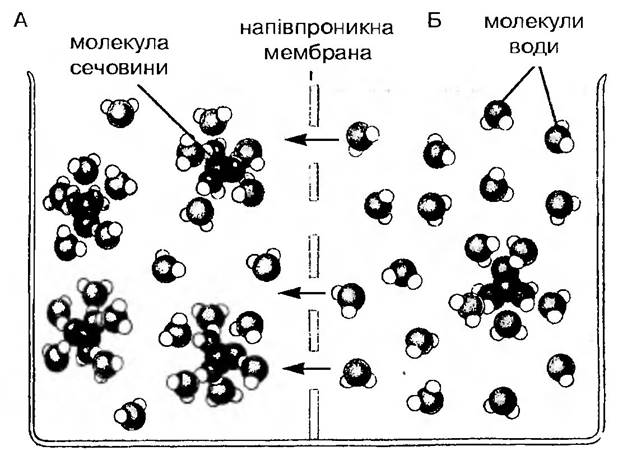
Fig. 15. Osmosis
In all biological systems, water acts as the solvent; therefore, for these systems, osmosis is simply the diffusion of water across a selectively permeable membrane. Suppose an aqueous solution A with a high solute concentration is separated by such a membrane from an aqueous solution B with a low concentration of the same solute. Solution A is hypertonic relative to solution B, whereas solution B is hypotonic relative to A. Under these conditions, water molecules will cross the membrane via osmosis from the hypotonic solution into the hypertonic one until equilibrium is reached. The solutions will then become equal in concentration, meaning they are isotonic. Note that iso- means "equal", hyper- means higher—in this case, referring to a higher concentration of solute particles;
whereas hypo- means lower, denoting a lower solute concentration (Fig. 16). Clearly, to achieve equilibrium, a certain pressure must be applied to the solution separated by the membrane, which is equivalent to the osmotic pressure of the solution. Osmotic pressure is the pressure generated in a solution separated by a semipermeable partition once equilibrium with pure water is attained. The more concentrated the solution, the higher its osmotic pressure. Recall that certain substances, particularly inorganic salts, undergo electrolyte dissociation when dissolved in water, which increases the total number of particles and, consequently, raises the Osmotic Pressure of the solution. Today, the term osmotic potential is more commonly used. Osmotic potential is equal to the difference between the chemical potential of the solution and that of pure water, and it is always negative. It indicates the extent to which the solute lowers the water's activity. The osmotic potential of a solution is manifested only in the presence of a solution — semipermeable membrane — solvent system. By attaching a manometer, one can measure the pressure that must be applied to the system to prevent water from entering the solution. In absolute magnitude, this pressure is equal to, but opposite in sign to, the osmotic potential of the solution. As water enters the vacuole, its volume increases and it dilutes The Cell sap, causing The Cell wall to experience pressure from the vacuole. The Cytoplasm itself is pressed against the cell wall, generating turgor pressure. Concurrently, an equal and opposite reaction of the cell wall against the cytoplasm arises, which represents the pressure potential. Once this potential reaches a critical value, further influx of water into the vacuole ceases. A dynamic equilibrium is established where the net flux is zero, even though water molecules continue to move rapidly across the membrane in both directions.
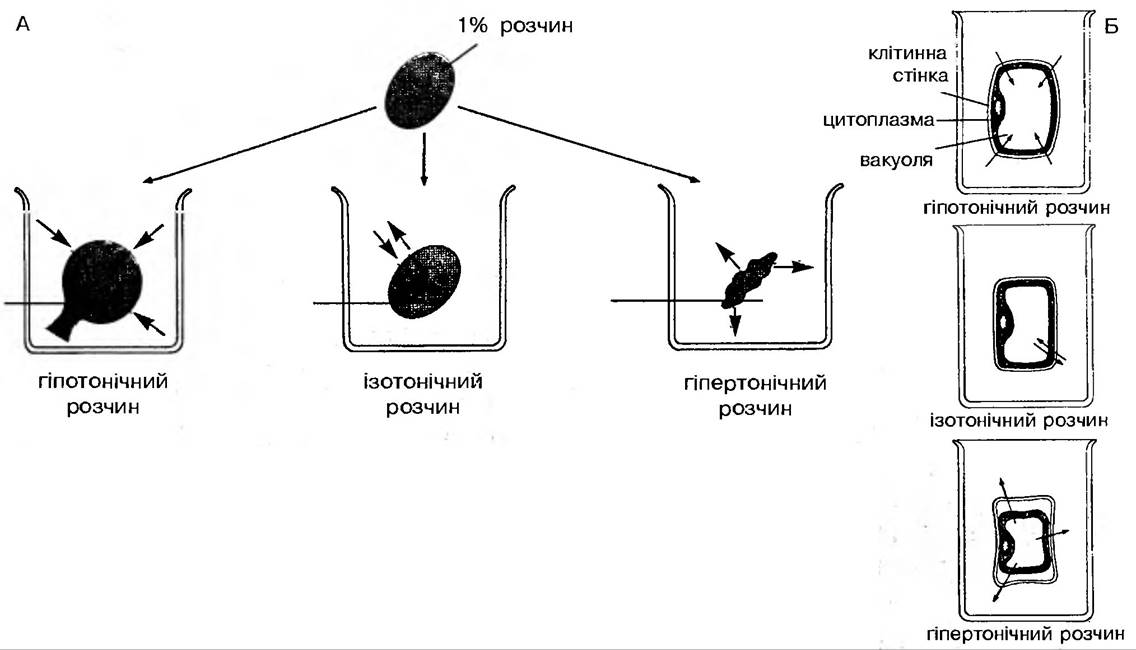
Fig. 16. Osmosis as the Movement of water across semipermeable membranes in solutions of varying concentrations:
A — solutions of different concentrations, B — cellular response to solutions of varying concentrations
Driven by the osmotic influx of water into the vacuole, hydrostatic or turgor pressure is generated. Turgor pressure is equal and opposite to the wall pressure.
Knowledge of osmotic potential is essential for various ecological studies. It is used to evaluate the ability of plants to absorb water from the soil and retain it regardless of environmental fluctuations. Osmotic potential typically ranges from 0.5 to 20 MPa. In aquatic plants, it is lowest, reaching about 0.1 MPa, whereas in many halophytes it can be as high as 20 MPa. In mesophytes, osmotic potential generally ranges from 0.5 to 3 MPa. It should be kept in mind that under METABOLISM/18.html">The Influence of various factors, its value can vary even between adjacent Cells within the same tissue. Within stem Tissues, the negative osmotic potential increases from the periphery to the center and from the base to the apex, whereas in roots, conversely, it gradually decreases from the base to the tip. In the xylem and phloem, its value is relatively low (0.1–0.15 MPa), whereas in leaves it ranges from 1 to 1.8 MPa. Different ecological groups of plants differ in their osmotic potential, making this parameter a useful characteristic of specific plant species in ecological research. Desert plants exhibit a more negative osmotic potential than steppe plants, which in turn have a more negative potential than meadow or aquatic plants.
Last update: 07/08/2026
Editorial and Educational Adaptation: This material has been compiled based on the primary/original source text. The project team performed an editorial review, corrected technical inaccuracies, structured sections, and adapted the content for an educational format.
What was processed:
- elimination of formatting defects (OCR errors, structural breaks, corrupted characters);
- editorial organization of content;
- standardization of terminology in accordance with academic sources;
- verification of factual statements against the original source text.
All mentions of the author, publication year, and origin of the primary text have been preserved in accordance with the source.