PLANT REPRODUCTION BIOLOGY - N. L. Kolyasnikova - 2017
CHAPTER 1. PHENOLOGY
Phenology as a science studies the interrelationships within periodic natural phenomena of the PLANT AND ANIMAL kingdoms and their environment. Phenological research is conducted by A wide variety of research institutions and organizations, primarily of biological and geographical profiles. These include botanical gardens, nurseries, agricultural and agronomic stations, game management enterprises, research stations in natural parks, and higher education institutions.
Forest phenology holds the same importance for forestry as agricultural phenology does for agriculture. The calendar of reforestation and forest-culturing operations is built on The basis of seasonal rhythms of forest phytocenoses. Interesting correlations have been revealed. For example, A.V. Tyurin determined the optimal periods for conducting forest-culture measures for the European part of the USSR—ranging from the beginning of alder or hazel flowering to the beginning of birch flowering. The phenophases of various plants were compared with the hydrothermal regime characteristic of the time of their occurrence. Foresters gained The ability to determine the optimal period for forest management operations and predict it to some extent without complex instrumental meteorological and hydrological measurements. To collect seeds of forest tree species, information on their ripening in different natural zones and diverse ecological conditions is necessary, along with yield forecasts.
The methodology of phenological observations on individual species distinguishes two stages: the Organization of observations and the execution of observations.
1.1 Organization of Observations
V.A. Batmanov distinguishes 4 Methods of phenological observations:
1. Conventional method. The researcher determines when a seasonal phenomenon occurs at a specified Location. The date is established.
2. Descriptive method. The researcher records the phenological state of the plants at the time of observation.
3. Ecometric method. The time and phenological state of the plants are known to the researcher, and it is required to indicate at which points in the territory the plant is in a particular phenological phase.
4. Integral method. The researcher knows the phenological phenomenon and the observation date, and determines the percentage of individuals in a certain phenological state.
The organization of phenological observations involves selecting the object and location of observations and establishing the schedule of observations. When choosing the observation object and site, it is necessary to describe the plant's Morphology (age, height, degree of development, etc.) and its location. Observations should be carried out periodically, according to a unified plan. During the growing season, they are conducted less frequently (every 3 days); during budding, flowering, and fruiting, more frequently (every day). During the period of relative dormancy, they are conducted once a month.
It is necessary to simultaneously observe the plants' habitat. Data from the nearest meteorological station regarding Temperature, humidity, and precipitation should be collected. It is essential to indicate the date of freezing of the upper soil layer in autumn, the freezing depth for the winter, the condition of the soil during snowmelt, and the date of complete soil thawing.
Observations can be single (observing a single object) or mass (conducted simultaneously at many points).
1.2 Phenological Phases and Their Designations
The cycle of seasonal plant development consists of morphologically distinct stages that successively replace one another in a regular pattern. Each such stage is called a seasonal or phenological phase of development. Typically, 5 phases (phenophases) are distinguished: vegetation, budding, flowering, fruiting, and senescence.
Phenophases are subdivided into subphases. Two cycles should be distinguished: the phases of development of vegetative Organs and the phases of development of Generative organs (Fig. 1, 2). Before starting observations, a recording form must be prepared. For letter designation of the phenological state of plants, a specific system of Abbreviations for phenophase names is adopted: budding - bud.; beginning of flowering - beg. fl.; vegetation - veg., etc. International publications usually use abbreviated Latin terms, for example, vegetation - veg.
In different systematic groups of Higher Plants and among representatives of various life forms, the morphology of seasonal development—and consequently of the developmental phases—varies.
Cycle of vegetative phases. In the seasonal development of Water/115.html">Vegetative organs of typical higher plants in extra-tropical zones, four groups of phases can be distinguished: spring resumption of vegetation, SHOOT outgrowth, summer vegetation, and senescence of vegetative organs.
Class="center">Fig. 1. Vegetative cycle of littleleaf linden: 1 - bud greening; 2 - leaf unfolding; 3 - summer vegetation

Phases of spring resumption of vegetation. In this group, woody plants include the phases of spring sap flow (bleeding), bud Swelling, and bud burst; herbaceous perennials include bud burst, renewal, and the appearance of sprouts (before leaf unfolding) or unopened first leaves (many monocots, umbellifers, etc.); plants in their first year of life include seedlings prior to the unfolding of the first true leaves. Nutrition of the plant during this period still occurs entirely at the expense of stored reserves. In winter-green plants, whose leaves begin to assimilate immediately after snowmelt or after the air temperature crosses the lower temperature threshold of vegetation, the spring resumption of vegetation as a qualitatively distinct group of phases is absent.
Phases of shoot outgrowth. The annual increment of shoots in woody plants and the outgrowth of herbaceous plants generally pertain to the first half of the growing season. Due to the asynchronous development of diverse types of vegetative shoots (main and lateral shoots of various orders, branching, elongated and shortened shoots), the phases of shoot outgrowth proceed differently across various biomorphs. For woody plants, these are the phases of foliation and shoot growth; for many perennial grasses, the phases of tillering, stem elongation, and foliation; for monocarpic plants in years preceding flowering, it often consists of a single phase—leaf outgrowth.
When observing shoot increment, one should note the number of formed internodes and the time when branching of the young shoot begins, if it branches.
The phase of summer vegetation occupies the period between the end of vegetative shoot outgrowth and preparation for winter dormancy. In woody plants, this phase begins when shoot growth is largely completed and young foliage has reached full development, whereas in herbaceous plants, it begins when the grass stand has recovered. Plastic substances are utilized primarily for The formation of reproductive organs and the accumulation of reserves: many species form tubers, bulbs, ROOT crops, and other storage organs for reserve substances. The summer vegetation phase can sometimes be interrupted by secondary flushes of growth.
Phases of vegetative organ senescence and abscission.
Annual plants die back entirely each year, with the exception of seeds. In all other plants, either all or a portion of the leaves or shoots die off annually. In extra-tropical zones, this process coincides with the period when plants prepare for winter dormancy.
In deciduous woody plants, the senescence of leaves takes the form of autumnal coloration—the transition from green to autumn foliage hues—followed by leaf fall. Autumnal foliage coloration is a classic example of a gradually developing phase. The simplest and most convenient milestones for precise recording are the onset of color change, peak coloration, and the end of leaf fall. The onset of color change is recorded on the day when roughly half of the leaves on a tree or shrub have turned yellow while the other half remain green. Peak coloration is noted on the day when all leaves in the plant canopy have shifted from their summer colors. For summer-green plants, peak coloration marks the end of both the assimilation and the growing seasons. The end of leaf fall is recorded on the day when all leaves have dropped or only withered leaves remain on the plant.
In herbaceous summer-green plants, the dieback of above-ground organs occurs in various ways. In some species, such as the majority of ephemeroids, autumnal dieback also proceeds in two phases: first, the coloration of the leaves, followed by the ultimate death of the shoots. In others, this dieback manifests as the drying of shoots without a preceding coloration phase.
Fig. 2. Generative cycle of small-leaved lime (Tilia cordata): 1 - budding; 2 - flowering; 3 - fruiting

Cycle of generative phases. Outgrowth of generative shoots. This occurs as an independent phase only in plants with specialized generative shoots. In plants whose flower stalks lack green leaves or bear only a small number of underdeveloped green leaves, the outgrowth phase is rapidly succeeded by the budding phase. The outgrowth of generative shoots is most clearly observable in plants with specialized generative-vegetative shoots that are morphologically distinct from vegetative shoots, yet bear true green leaves directly beneath the flowers or inflorescences. This phase is frequently termed stem elongation, or shooting in grasses.
Budding. The onset of budding is recorded on the day when the buds emerge from their protective scales and become visible to the naked eye. In cereal grasses and sedges, the budding phase is known as heading, and in paniculate grasses, as booting. Two subphases are typically distinguished during budding: tight (or young) buds and loose (or mature) buds. In plants with complex inflorescences (catkins, spadices, capitula), a distinction should be made between the formation of inflorescence primordia and the flowers themselves. The staminate catkins of certain trees and shrubs (birch, alder, hazel) and the inflorescence primordia of some other shrub species (such as wayfaring tree) are formed in the year preceding flowering.
Flowering. A methodologically flawless Definition of the onset of flowering is the determination of when anthers and stigmas mature. Mature anthers dehisce and release pollen, while mature stigmas open and become sticky. A bisexual flower is considered to have entered the flowering stage on the day either its anthers or stigmas reach maturity.
In simplified phenological observations, the beginning of flowering in plants with a developed perianth is determined by the opening of the first—though not isolated—perianths. In most cases, perianth opening correlates closely with the maturation of anthers and stigmas; therefore, perianth opening can be strongly recommended as an indicator of the onset of flowering.
Plants in temperate and cold climatic zones are typically characterized by a single flowering period per season. However, certain species flower a second time in late summer or early autumn. In some seasons, this secondary flowering encompasses a fairly wide range of species. Observations for each flowering cycle are conducted separately. Secondary flowering should not be confused with the prolonged cycle of primary flowering, which in some species persists until late summer or early autumn. Examples include various species of rose, snowberry, certain perennial clover species, speedwell, etc. (Fig. 3).
Fig. 3. Flowering dynamics of hybrid clover cv. Pervenets: Sp 1 - first-order inflorescence; Sp 2 - second-order inflorescence; Sp 3 - third-order inflorescence

It is also worth noting that monocarpic plants flower and fruit only once during the final year of their life, whereas polycarpic plants do so annually for A number of years once they reach maturity.
Fruiting. The initial subphase of fruiting is considered to be fruit set, which is typically recorded immediately after flowering as the Ovaries begin to enlarge. The most critical subphase of fruiting is fruit maturation, visually marked by external Changes in the fruits that correlate more or less closely with the biological ripening of the seeds. Each fruit type exhibits its own external ripening characteristics. Dry dehiscent fruits are deemed ripe at the moment of dehiscence. Caryopses exhibit waxy ripeness. In achenes, ripening is manifested by A change in seed coat coloration. Many fleshy fruits are considered mature once they acquire their "ripe" coloration and soften.
Seed dispersal (dissemination). The onset of this phase is typically identified by the appearance of the first—though not isolated—fallen ripe seeds or fruits on the ground beneath the respective plants: in dandelions, by the first dispersed seed heads; in willows and poplars, by the first pappus-bearing seeds drifting in the air. It is equally important to record the end of dissemination, which in some species occurs a few days after seed release begins, while in others it extends throughout the entire winter. This moment is determined either by the drop of all fruits or by the presence of only empty fruits remaining on the plant.
These observations are accompanied by studies of seed productivity. Seed productivity is one of the most vital indicators of a species' adaptation to specific habitat conditions. A distinction is made between potential seed productivity (PSP) and actual seed productivity (ASP). Potential seed productivity refers to the number of ovules produced per counting unit, such as a generative shoot or an individual plant. Actual seed productivity is the Number of viable seeds produced by a generative shoot or individual. The growing season concludes when the fruits are shed.
Various visual estimation methods exist. A visual scoring scale for flowering intensity was proposed by V.G. Kapper [19], and for fruiting by A.A. Korchagin (Tables 1, 2).
Table 1. V.G. Kapper's scale for assessing flowering intensity
Flowering degree |
Distribution pattern of cones or fruits on the tree |
|
Score |
Grade |
|
0 |
Absent |
No flowering |
1 |
Very low |
Very weak flowering (flowers present in small numbers on edge trees, on isolated trees, and in negligible amounts within stands) |
2 |
Low |
Weak flowering (fairly satisfactory and uniform flowering observed on free-standing trees and edge trees, and weak within stands) |
3 |
Moderate |
Average flowering (fairly substantial flowering on free-standing and edge trees, and satisfactory in middle-aged and mature stands) |
4 |
High |
Good flowering (abundant flowering on free-standing and edge trees, and good in middle-aged and mature stands) |
5 |
Very high |
Very good flowering (abundant flowering on edge trees, free-standing trees, as well as in middle-aged and mature stands) |
Table 2. Scale for visual assessment of fruiting in a mature tree
Fruiting degree |
Distribution pattern of cones or fruits on the tree |
|
Score |
Grade |
|
0 |
Absent |
No fruits on the tree; none can be detected even with binoculars |
1 |
Very low |
Isolated fruits on individual branches in the upper and middle PARTS OF THE crown, predominantly on its southern side |
2 |
Low |
Insignificant number of fruits on a few branches, mainly in the upper and middle sections of the crown, especially on its southern side |
3 |
Moderate |
Moderate number of fruits growing evenly or in clusters on a considerable number of branches in the upper and middle parts of the crown, especially on its southern side |
4 |
High |
Fruits distributed across almost the entire crown, particularly on the southern side |
5 |
Very high |
Abundant fruits throughout the entire crown |
The Essence of the classical phenological observation method is to determine the date when a seasonal phenomenon occurs at a given location. By visiting the site with greater or lesser regularity, the observer must record two dates: the last date when the target seasonal phenomenon was not yet observed (a), and the date when the phenomenon was first noted (b). Obviously, the true date of the phenomenon's occurrence (M) lies within the interval (a-b). The accuracy of the observation will depend on the length of the interval (a-b), in other words, on the frequency of site visits.
Lacking information on object development within the interval (a-b), we adopt as a null hypothesis the assumption that the probability of the target date occurring at any point within the interval (a-b) is equal—i.e., the distribution of possible occurrence dates is uniform. Consequently, based on the laws of uniform distribution, the most probable date of occurrence (M) will lie at the midpoint of the interval (a-b) and is determined by the formula: M = (a - b) / 2 (Table 3).
Table 3. Determination of the probable date for the onset of the budding phase in small-leaved lime in Perm (2016)
Name of the phenomenon |
Date when the phenomenon has not yet been observed |
Date when the phenomenon was recorded |
Most probable date of occurrence |
Beginning of budding phase |
May 23 |
May 27 |
May 25 |
1.3 Determining Long-Term Mean Dates of the Nature Calendar. Phenological Anomalies
Starting from the third year of observations, one can proceed to calculate multi-year mean dates. The mean is determined simply as the arithmetic mean. For example, for the dates June 1, June 3, and June 4, the arithmetic mean is June 3.
A phenological anomaly is the deviation of the timing of a seasonal phenomenon in the current year from its long-term mean date: A = D - Dmean. A "+" sign indicates that the specific date lags behind the long-term mean, while a "-" sign indicates that it occurs ahead of schedule.
To determine the relationship between the timing of certain abiotic seasonal natural phenomena and the key environmental factors driving them, researchers identify the temperature threshold at which plant physiological activity is most fully expressed. For temperate landscapes, the boundaries for the beginning and end of active physiological activity are defined by the crossing of the daily mean air temperature through +5°C in spring and autumn. In agro-climatic reference books, alongside the phenoclimatic indicator of +5°, the transition of the daily mean temperature through +10° is widely used, as the thermal thresholds of many agricultural crops are closer to +10°C (corn, sunflowers, melons, tomatoes). The transition through +15° is often used as a phenoclimatic indicator for the onset of summer. However, it is known that the further north and the higher in the mountains one goes, the lower the temperatures at which the phenological summer begins. In forest-tundra and tundra zones, periods with a sustained air temperature above +15°C are entirely absent; nevertheless, the phenological summer season in these zones is clearly expressed.
Another example of phenological mathematical modeling widely used in practice is the sum of positive temperatures over a specific growing or interphase period, formed by the positive values of daily mean temperatures over a given time. The starting point is when the temperature exceeds the threshold value. If +5°C is taken as the threshold, counting begins after the temperature crosses +5°C (accounting for the long-term mean value of the temperature sum above +5°). Examples: birch trees turn green at a temperature sum of 100 degrees; bird cherry trees bloom at 210 degrees; pine trees begin releasing pollen at 370 degrees; linden trees require 1050 degrees for flowering.
1.4 Phenological Spectra
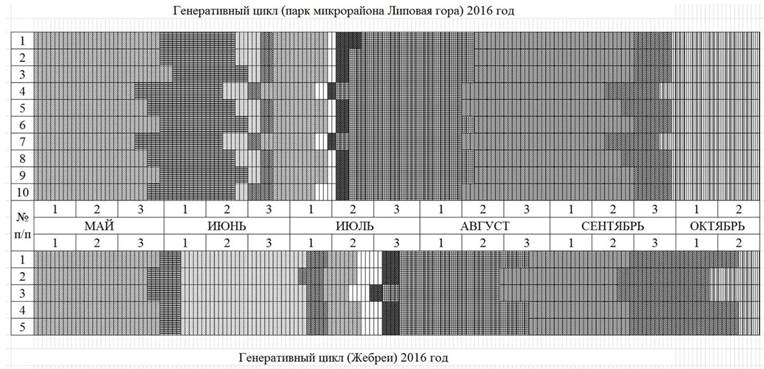
The most comprehensive data on phytocenosis phenology are provided by phenological spectra—summary representations of the seasonal development of all community species throughout the year (Figs. 4, 5).
Fig. 4. Phenological spectrum of the seasonal development of littleleaf linden in the city of Perm and its surroundings in 2016 (vegetative cycle)
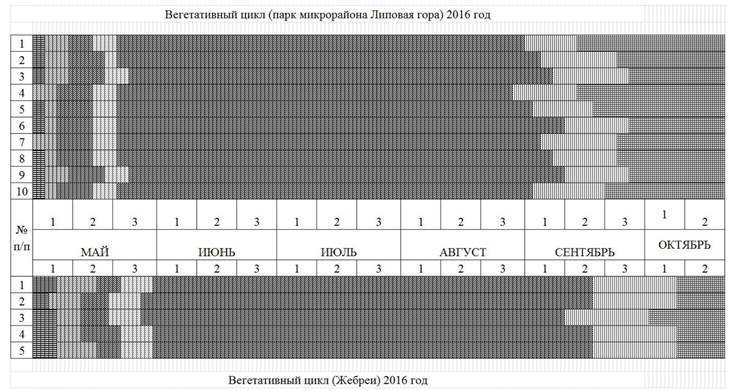
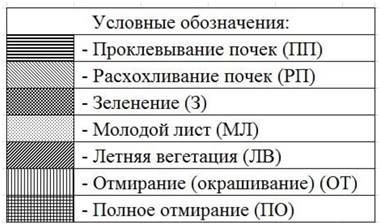
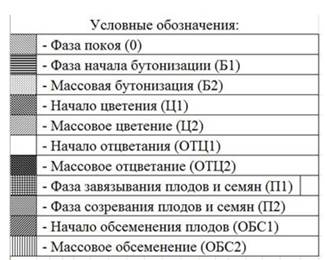
Fig. 5. Phenological spectrum of the seasonal development of littleleaf linden in the city of Perm and its surroundings in 2016 (generative cycle)
Phenospectra contain information on the phenology of each community species and the phenological state of all phytocenosis species on any given date. Tracking the seasonal dynamics of phytocenoses during the growing season through repeated, regular observations according to a specific program constitutes a unique form of phenological monitoring of phytocenoses. The Main Functions of phenological monitoring are:
a) systematic observations of the Current state of natural objects;
b) identification of factors and regularities governing the natural changes of observed objects in time and space.
Such research can be part of local biological monitoring or local ecological monitoring.
A phenological spectrum is a graphical representation of the seasonal development of plant species and their communities. Constructing a phenological spectrum is one of the widely used methods in geobotanical research. The main contribution to The Development of the phenological spectrum method was made by the geobotanist A.P. Shennikov, who coined the term "phenological spectrum."
1.5 Phenological Mapping
The primary reference documents that reveal the regularities in the spatial distribution of seasonal natural phenomena and other indicators of the seasonal rhythm of landscapes and their components are phenological maps. Their significance goes beyond a mere reference role, as they provide researchers with a powerful scientific method for comparing phenomena in both chorological and dynamic terms.
The dynamics of seasonal processes on phenological maps are usually depicted using isolines—isophenes—which connect locations with identical dates of seasonal phenomena onset or identical values of other phenological indicators.
Last update: 07/08/2026
Editorial and Educational Adaptation: This material has been compiled based on the primary/original source text. The project team performed an editorial review, corrected technical inaccuracies, structured sections, and adapted the content for an educational format.
What was processed:
- elimination of formatting defects (OCR errors, structural breaks, corrupted characters);
- editorial organization of content;
- standardization of terminology in accordance with academic sources;
- verification of factual statements against the original source text.
All mentions of the author, publication year, and origin of the primary text have been preserved in accordance with the source.