BIOTECHNOLOGY - V. H. Gerasymenko - 2006
Part II. Special Biotechnologies
Chapter 22. BIOTECHNOLOGIES FOR WASTE UTILIZATION AND BIOCONVERSION IN THE AGRO-INDUSTRIAL COMPLEX
22.3. NON-TRADITIONAL METHODS. BIOTECHNOLOGY FOR BIOGAS PRODUCTION VIA ANAEROBIC WASTE DIGESTION
22.3.7. Current State of Biogas Production in Ukraine
The state program for The production of machinery and technological equipment for Ukraine's agriculture for 1996–2005 provided for the manufacturing of equipment sets for anaerobic manure Processing with reactors ranging from 3 to 3000 m3. Currently, around 20 biogas plants of various capacities, featuring reactors with a volume of 1 to 500 m3, are either in operation or under construction in rural areas of Ukraine. This is entirely insufficient to meet the country's modern energy needs regarding The Use of non-traditional Energy Sources.
Certain experience in designing biogas plants (BGs) in Ukraine has been accumulated by enterprises such as UkrNDIagroproekt, Stelkom, Altek, and others, which possess the relevant design and engineering documentation. Unfortunately, however, for various reasons (primarily financial), large-scale commercially operated biogas plants do not yet exist in Ukraine.
Large-scale biogas plants make it possible to achieve sufficient profitability, organize the mechanization and automation of the anaerobic Digestion process, and ensure year-round biogas consumption.
A concept has recently been proposed that prioritizes the construction of large-scale biogas plants in Ukraine, specifically with a digester volume starting from 800 m3. Such plants can be established on cattle farms with a livestock population of 600 heads or more, pig farms with 6,000 heads or more, and poultry farms with 200,000 birds or more. To ensure profitability, the dry matter content in manure runoff should be 8–10% (8–12%), and the organic matter content should reach 85%. As a rule, this is ensured by scraper (conveyor) manure removal systems, whereas hydraulic flushing and sluicing systems fail to provide these conditions.
H. Heletukha and S. Kobzar (2001) determined the potential of manure (from cattle, pigs, and poultry) suitable for anaerobic digestion in Ukraine (Table 22.7).
Class="center">Table 22.7.
Manure Potential in Ukraine (Based on 1999 Data *)
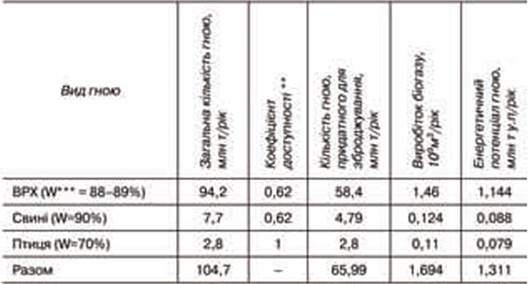
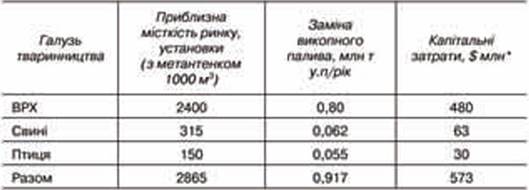
Taking into account the potential of manure suitable for anaerobic digestion and accumulated experience, an estimation was made of the number of biogas plants that could be constructed in Ukraine (Table 22.8).
The construction of 2,865 plants with an average digester volume of 1,000 m3 will make it possible to replace about 1 million tons of coal equivalent in rural areas, establish independent sources of electricity and heat supply as well as high-quality organic fertilizers, and make a significant contribution to improving the ecological situation in Ukraine.
The UkrNDIagroproekt association (Smirnov O., 2000) is engaged in developing plants for the anaerobic digestion of manure across farms of various scales: large, farming, and individual enterprises. Various modifications of farm-scale plants in both vertical and horizontal configurations have been developed. A vertical Reactor embedded in the ground helps reduce costs for body insulation and biomass heating within the reactor, but presents difficulties in discharging the digested biomass. A horizontally positioned reactor above the ground surface lacks this drawback, but requires mechanization to load the initial feedstock into a high-positioned loading funnel. The reactor is a pipe 1–1.2 m in diameter and 2.5–3 m in length, sealed with flanges at the ends. The working cavity of the reactor (pipe) is submerged up to half its diameter in a Water-filled tank equipped with a pipe system to maintain the required Temperature through hot water Circulation. The reactor is fitted with a frame mixer operating at ~2–3 rpm for 15 minutes every 2–3 hours. The reactor features a loading funnel, a sludge discharge pipe, and a gas outlet pipe equipped with a mud-and-water separator. The plant includes a gas holder with a floating cover and a boiler to maintain heat in the reactor. The plant's productivity reaches up to 4 m3 of biogas per day. This unit was assembled in Obukhiv, Kyiv Oblast, at a cost of $500–600 (Smirnov O., 2000).
Table 22.8.
Number of Biogas Plants Feasible for Construction in Ukraine's Agricultural Sector
(Heletukha H., Kobzar S., 2001)
In Kamianets-Podilskyi District, Khmelnytskyi Oblast (Krushnevych T. et al., 2000), construction has begun on a bioenergy complex featuring a fundamentally new technology for the methane digestion of poultry droppings, cattle manure, and pig slurry. This technology involves additional processing of digestion products to enrich and bind nitrogen (Gas Institute of the National Academy of Sciences of Ukraine, Altek LLC). The technological process provides for the compression, cooling, and purification of biogas.
Commercial biogas will be used as fuel in gas-diesel generating sets to produce electricity, while excess biogas will be supplied to other consumers or utilized for water heating. The technological needs of the energy complex will be met using the waste heat from engine exhaust gases and the heat from their cooling systems.
Calculations indicate that a livestock complex with 1,200 heads of cattle can yield 65 m3 of biogas per hour, amounting to 1,560 m3 per day and 569,400 m3 per year. In terms of calorific value, this volume of biogas is equivalent to 42.10 and 367,920 m3 of natural gas, and 315.4 tons of diesel fuel annually. The produced biogas can generate 1,314,000 kWh of electricity per year.
Estimated costs for establishing the bioenergy plant amount to $246,000. Construction is nearly 50% complete, but work has been suspended due to a lack of funding (Fig. 22.13).
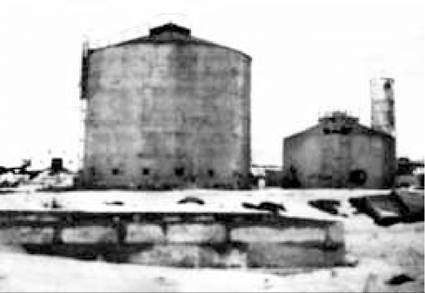
Fig. 22.13. Bioenergy complex in the Kamianets-Podilskyi district of Khmelnytskyi region
(according to T. Krushnevych, S. Pysariev, B. Katsynskyi, 2000)
The proposed bioenergy complex makes it possible to solve the following tasks: supplying the farm with its own electricity; increasing soil fertility (by 15-25%); exporting high-quality, eco-friendly organic fertilizer; ensuring environmental protection; and maintaining proper Sanitary and hygienic conditions on farms.
A large biogas plant (BGP) was built at the pig farm of the Agro-Oven company in the village of Olenivka, Magdalynivka district, Dnipropetrovsk region (Fig. 22.14) as part of a technical assistance project by the Government of the Kingdom of the Netherlands. The equipment was supplied by BTG (Netherlands), while design work, supervision, commissioning, and training were performed by UkrNDIahropromproekt and the Biomassa Research and Engineering Center. The facility is designed to process 80 t/day of slurry from a pig farm with a livestock population of 15,000.

Fig. 22.14. Biogas plant in the village of Olenivka, Magdalynivka district, Dnipropetrovsk region, Ukraine
(according to H. Haletukh, S. Kobzar, 2001)
The BGP consists of two methane tanks, two co-generation units (80 kW of electricity and 160 kW of thermal energy each), and a digested slurry dewatering system. The reactor volume is 1200 m3. The plant will operate under a mesophilic regime. The BGP provides for biomass heating and mixing.
Slurry enters the methane tanks from the pig farm through a mixing tank. After leaving the reactor, the digested slurry goes to a separator to be divided into Solid and liquid fractions.
A flexible plastic film gasholder in the form of a "tent" over The surface of the methane tank forms an integral unit with it. The tent gasholder has two layers of film: an outer layer capable of withstanding mechanical loads and an inner layer resistant to biogas. Air is pumped into the space between the layers, which additionally prevents the methane tank dome from deforming due to snow, wind, etc.
Biogas from the reactor is piped to a gas engine with an electric generator where it is converted into electricity, while exhaust gases pass through a heat exchanger to heat the circulation loop water. The heat generated by the engine is used to heat the methane tank, with the excess used for heating the farm, greenhouses, and for hot water supply, etc.
The economic efficiency of operating the plant is presented in Table 22.9
Table 22.9.
Estimated financial performance indicators of the Olenivka BGP

These calculations are valid for a BGP equipped with Dutch machinery. With partial equipment of the plant using Ukrainian machinery, its payback period can be reduced by at least half.
In addition to agricultural enterprises, significant potential for BGP Structure/175.html">Implementation exists in the food industry (sugar, alcohol, dairy plants, breweries, etc.), pharmaceutical and enzyme industries, sewage Treatment plants, public catering establishments, markets, and municipal solid waste management.
Ukraine's alcohol industry is one of the leading sectors in terms of waste and wastewater generation. According to M. Koshel et al. (2002, UkrNDIspyrtbioprod), there are over 80 alcohol distilleries in Ukraine, which annually generate about 4 million m3 of molasses vinasse, 3.6-3.8 million m3 of grain vinasse, and about 8 million m3 of lightly polluted wastewater. At most plants, molasses vinasse is not utilized; instead, untreated, it is discharged along with wastewater into settling ponds where it putrefies, polluting groundwater and air. At the same time, alcohol distilleries offer the most favorable conditions for organizing biogas production: waste is available at a temperature of 40-50 oC, along with secondary heat sources (condensates, lutrin water, etc.). All this makes it possible to organize biogas production without expending the obtained bioenergy fuel on heating the medium in the methane tanks.
UkrNDIspyrtbioprod has experience in methane Fermentation of alcohol plant waste, since as early as 1970, with their participation, a workshop for the production of feed vitamin B12 was put into operation at the Andrushivka Alcohol Plant, produced by methane-forming microorganisms. The workshop operated for over 20 years (until 1991), producing 250-300 kg of vitamin B12 annually (in terms of chemically pure substance) as well as biogas, the combustion of which in boilers saved about 13-15% of the fuel consumed by the plant as a whole.
Alcohol plant waste serves as an excellent nutrient medium for methane-producing Bacteria. The biogas yield during the fermentation of 1 m3 of this waste is 28-30 m3. A medium-capacity alcohol plant can produce 24 thousand m3 of gas per day, and about 6 million m3 per year. Burning the biogas will save about 4,800 tons of coal equivalent per year. In other words, thermal energy savings in ethanol production can reach 40%.
A characteristic feature of methane fermentation of alcohol industry waste is that approximately 95% of the decomposed organic matter is transformed into biogas, and only 4-5% is spent on the energy and synthetic needs of the bacteria. Therefore, bacterial biomass growth is relatively small, which leads to a long duration of methane waste fermentation. Shortening the fermentation period is achieved by: increasing the concentration of bacterial biomass by isolating and returning it to the methane tank, immobilizing bacteria on special stationary carriers, or using bioreactors with granulated biomass.
To utilize alcohol plant waste, UkrNDIspyrtbioprod (Koshel M. et al., 2002) proposed a bioreactor (Fig. 22.15) equipped in its upper part with a device (a biomass and biogas separator) that prevents biomass washout from the reactor and promotes its granulation. Thanks to this, a high biomass concentration (up to 60 g/dm3) is achieved in the bioreactor, making it possible to shorten the duration of methane fermentation from 10-17 down to 2 days. For a medium-capacity alcohol plant, it is most expedient to install four 600 m3 bioreactors. The installation costs will pay off within a year through fuel savings.
A technology has also been developed for utilizing waste from grain-processing alcohol plants to obtain dry protein feed in addition to biogas and vitamin B12 (Koshel M. et al., 2002). According to this technology, spent grain is separated using a centrifuge and then dried in a steam dryer. The liquid effluent is fermented by methane-producing bacteria in an anaerobic bioreactor to produce biogas. The biogas yield is 15 m3/ m3 of effluent.
Aerobic post-Treatment of the effluent that has undergone anaerobic fermentation is carried out in biological contactors (aeration tanks) using microorganisms immobilized on a stationary carrier. The fibrous carrier has a large specific surface area (1 kg of carrier provides 8-10 thousand m2 of area) and high adhesive capacity, due to which a significant number of microorganisms attach to it, contributing to the intensification of purification. In addition, the carrier is biologically inert and can operate without replacement for many years.
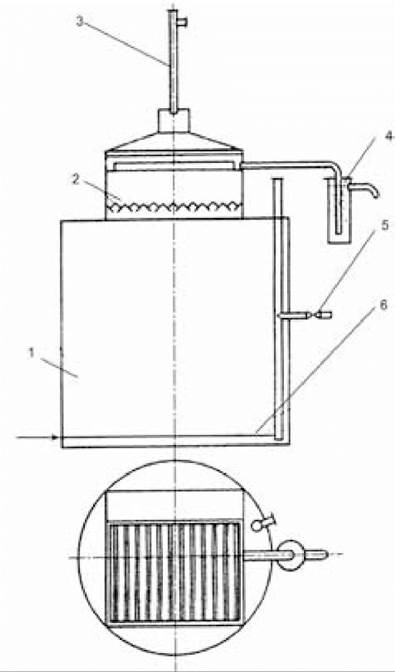
Fig. 22.15. Bioreactor for distillery waste fermentation
(adapted from Koshel M. et al., 2002):
1 — body; 2 — biomass separator; 3 — biogas pipeline;
4 — water seal; 5 — excess activated sludge removal pipeline; 6 — wastewater feed manifold
Last update: 11/08/2026
Editorial and Educational Adaptation: This material has been compiled based on the primary/original source text. The project team performed an editorial review, corrected technical inaccuracies, structured sections, and adapted the content for an educational format.
What was processed:
- elimination of formatting defects (OCR errors, structural breaks, corrupted characters);
- editorial organization of content;
- standardization of terminology in accordance with academic sources;
- verification of factual statements against the original source text.
All mentions of the author, publication year, and origin of the primary text have been preserved in accordance with the source.