BIOLOGY Volume 3 - A Guide to General Biology - 2004
21. REPRODUCTION
21.5. Sexual reproduction in flowering plants
21.5.6. Fertilization
Once a pollen grain lands on a compatible stigma, it begins to germinate (Fig. 21.29). The epidermal Cells of the stigma secrete a sucrose solution that stimulates germination and likely provides nourishment for the pollen grain. Through one of the pores present in the pollen grain wall, a pollen tube emerges, growing rapidly downwards through the style toward the Ovary. The growth of the pollen tube is directed by a Nucleus located at its tip, while growth stimulation is provided by Auxins produced by the gynoecium. Specific chemical substances guide the pollen tube toward the ovary (an example of chemotropism), though negative aerotropism—growth away from the air—may also play a role. As mentioned earlier, compatibility between the pollen and the Tissues of the style is also a crucial factor.
Class="center">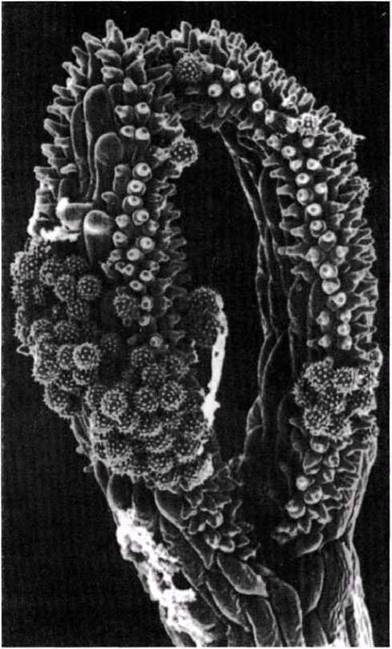
Fig. 21.29. Scanning electron micrograph of pollen grains on a flower stigma. The spiky surface of the pollen grains is typical of insect-pollinated flowers.
As the pollen tube grows, the generative nucleus of the pollen grain undergoes mitotic division to form two male nuclei, which function as male Gametes (Fig. 21.25). Unlike the motile sperms of lower plants, these are immotile and can only reach the female gamete within the ovule's embryo sac with the help of the pollen tube. The pollen tube enters the ovule through the micropyle, its tube nucleus degenerates, and the tip ruptures, releasing the male gametes near the embryo sac, which they then enter. One male gamete fuses with the female gamete to form a diploid zygote, while the other fuses with the diploid nucleus to form a triploid nucleus known as the primary endosperm nucleus. This process of double Fertilization is unique to flowering plants. Ultimately, it leads to The formation of two structures found within the seed: the embryo and the endosperm, which serves as a nutrient reserve for the germinating seed.
If, as is frequently the case, the gynoecium contains multiple ovules, each one must be fertilized by a separate pollen grain to develop into a seed. Consequently, different seeds within the same fruit may be fertilized by pollen grains from different parent plants.
Experiment 21.1. Observing pollen tube growth
Stigmas secrete a solution containing 2% to 45% sucrose. This solution helps pollen grains adhere to the stigma and promotes their germination. Adding sodium borate to the experimental solution prevents osmotic bursting of the pollen tube tips and stimulates their growth.
Materials and apparatus
Cavity Glass slide
Flowers with dehisced anthers, such as dead-nettle, wallflower, pelargonium, or balsam.
10–20% (w/v) sucrose solution containing 0.01% sodium borate
Acetocarmine or neutral red
Place a drop of the sucrose solution into the cavity of the microscope slide and introduce pollen grains into it by gently touching the drop with The surface of a dehisced anther. Examine the preparation under a microscope at various intervals over 1–2 hours. The nuclei located at the tips of the growing pollen tubes can be stained by adding a drop of acetocarmine or neutral red to the solution.
Last update: 06/08/2026
Editorial and Educational Adaptation: This material has been compiled based on the primary/original source text. The project team performed an editorial review, corrected technical inaccuracies, structured sections, and adapted the content for an educational format.
What was processed:
- elimination of formatting defects (OCR errors, structural breaks, corrupted characters);
- editorial organization of content;
- standardization of terminology in accordance with academic sources;
- verification of factual statements against the original source text.
All mentions of the author, publication year, and origin of the primary text have been preserved in accordance with the source.