BIOLOGY Volume 3 - A Guide to General Biology - 2004
21. REPRODUCTION
21.5. Sexual reproduction in flowering plants
21.5.7. Seed and fruit development
Following Fertilization, the ovule is referred to as the seed, and the Ovary as the fruit. During this process, several changes occur as described below. To better understand these changes, it is helpful to consult Fig. 21.30 and 21.25.
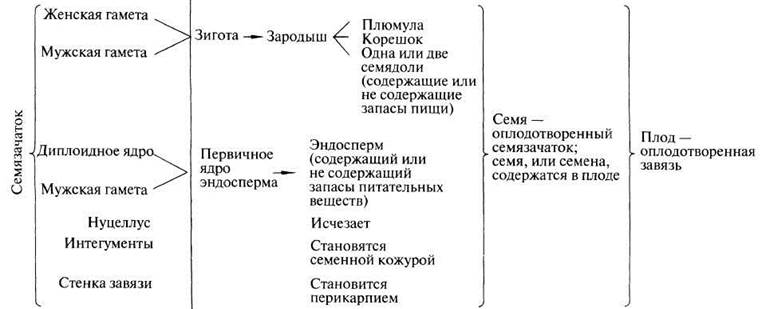
1. The zygote grows through repeated mitotic divisions, developing into a multicellular embryo consisting of a SHOOT apex, or plumule, a radicle, and one (in monocots) or two (in dicots) cotyledons. The cotyledons have a simpler Structure than the first true leaves; sometimes they become packed with nutrients and serve as storage tissue, as seen in peas and broad beans. The plumule consists of the stem, the first pair of true leaves, and a terminal bud.
2. The triploid primary endosperm Nucleus divides repeatedly by mitosis to form the endosperm—a mass of triploid nuclei separated from one another by thin Cell walls. In some cereals, such as wheat and corn, the endosperm retains its role as a nutrient storage tissue.
3. If the cotyledons act as the storage tissue, they grow at the expense of the endosperm, which may disappear entirely in the process. In certain seeds, nutrient reserves are stored in both the endosperm and the cotyledons.
4. As the growth of the embryo and storage tissue continues, the surrounding nucellus breaks down, supplying essential nutrients for growth. Subsequently, nutrients required for further development are provided by the vascular strand of the ovule stalk (funiculus).
5. The testa (seed coat) develops from the integument. It forms a thin yet tough protective layer.
6. The micropyle remains as a small pore in the testa, through which oxygen and Water enter during seed germination.
7. During the final stages of seed maturation, water content drops from the approximately 90% (by mass) typical of plant Tissues down to 10–15%. This is accompanied by a marked decline in metabolic activity and represents a crucial step in the transition of the seed into a dormant state.
8. As the seed develops, the ovary matures into a fruit, and its wall becomes known as the pericarp. While these changes vary among different plant species, they generally serve to protect the seeds and aid in their dispersal. Hormonal Regulation of fruit development is discussed in Section 16.3.5.
9. The remaining floral parts wither, die, and are shed, much like leaves on deciduous trees.
Some of the changes occurring after fertilization are summarized in Table 21.4. Stages of embryo development are illustrated in Fig. 21.30. Seed germination is covered in Chapter 22.
Class="center">
Fig. 21.30. Embryo development in a non-endospermic dicotyledonous seed, shepherd's purse (Capsella bursa-pastoris).
Table 21.4. Changes occurring in flowering plants following fertilization
Before fertilization |
After fertilization |
|
|
Last update: 06/08/2026
Editorial and Educational Adaptation: This material has been compiled based on the primary/original source text. The project team performed an editorial review, corrected technical inaccuracies, structured sections, and adapted the content for an educational format.
What was processed:
- elimination of formatting defects (OCR errors, structural breaks, corrupted characters);
- editorial organization of content;
- standardization of terminology in accordance with academic sources;
- verification of factual statements against the original source text.
All mentions of the author, publication year, and origin of the primary text have been preserved in accordance with the source.