BIOLOGY Volume 3 - A Guide to General Biology - 2004
25. APPLIED GENETICS
25.5. Transgenic Animals
25.5.2. Medical Protein Preparations Derived from Milk
One of the most promising areas of Introduction/32.html">Genetic Engineering is "pharming"—The production of relatively large quantities of rare and expensive medical Proteins using the milk of transgenic cows or sheep. The fact is that not all therapeutic Proteins can be produced using Bacteria in the manner described for Insulin and Human Growth Hormone. In many cases, proper protein expression requires precise folding or modification using cellular machinery found only in mammalian Cells. For example, a —COOH group must be attached to Certain Amino Acids of the factor IX protein after its synthesis. Although large-scale culturing of cells producing these proteins is theoretically possible, it is cost-prohibitive and technically challenging.
To date, the most successful approach for obtaining such proteins is The Use of milk from Transgenic Animals. This approach has been applied with great commercial success
by PPL Pharmaceuticals, a company founded in 1987 in Edinburgh to produce AAT (α–1-antitrypsin). The company owns flocks of sheep, each producing its own specific protein. The first animal to produce AAT was a transgenic ewe named Tracy. Although she is no longer used for protein production, her offspring carry the target Gene, making it possible over time to establish entire herds of transgenic sheep (Fig. 25.17). In appearance and physiological parameters, transgenic animals are indistinguishable from normal individuals.
Class="center">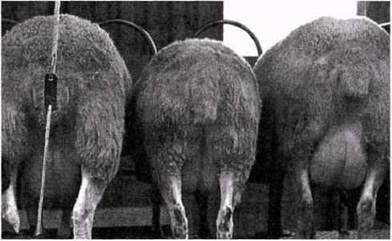
Fig. 25.17. Transgenic sheep awaiting milking. Their DNA incorporates the human gene responsible for producing the α–1-antitrypsin protein. This protein is synthesized in the mammary gland cells and secreted into the sheep's milk.
AAT is a human Blood protein. A mutation in the gene encoding this protein leads to uninhibited Elastase activity and ultimately to pulmonary emphysema (Section 9.7.3). Elastase is an enzyme produced by certain types of white Blood Cells that breaks down old, worn-out elastic fibers, thereby ensuring the turnover of elastic tissue in the Lungs. Normally, elastase activity is regulated by AAT, which acts as an enzyme inhibitor. (Smoking is believed to inhibit AAT, which is why it also leads to emphysema.) AAT is produced in The Liver and can be extracted from blood; however, it is impossible to meet the needs of all patients by relying solely on donor blood. Today, the gene encoding AAT has been integrated into the sheep genome, and Gene Expression takes place in its Mammary Glands. The use of transgenic sheep rather than cows for the industrial production of AAT is due to their shorter generation time and lower maintenance costs.
The gene encoding AAT is characterized by a high level of expression, meaning it remains active most of the time. As a result, AAT accounts for approximately 50% of the total protein content present in the milk (Fig. 25.18). The sheep's cells correctly modify the protein by attaching sugar molecules to form a glycoprotein. The Procedure for obtaining AAT is illustrated in Fig. 25.19.
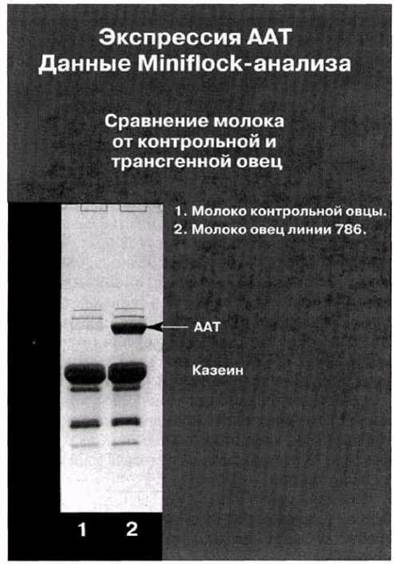
Fig. 25.18. Gel Electrophoresis of sheep milk proteins. 1 - normal milk; 2 - milk from a transgenic sheep; a new band corresponding to AAT is visible.

Fig. 25.19. Procedure for producing a transgenic sheep carrying a human gene, such as the gene encoding AAT.
Since all sheep cells contain the AAT gene, the question arises: through what mechanism is AAT produced exclusively in mammary gland cells? The answer lies in gene regulation. Every Cell in the body contains the complete Genetic Code, meaning that every bodily cell (regardless of whether it is female or male) carries the genes for milk proteins. However, for this gene to be expressed, its promoter—the adjacent DNA region—must be activated. When the AAT gene was cloned, it was linked to the promoter System of the β-lactoglobulin gene; in other words, the AAT gene was placed under the control of the promoter that switches on the genes for β-lactoglobulin, a protein found in very high concentrations in milk.
Genetically engineered AAT is currently undergoing clinical trials. This medication is expected to become commercially available in the coming years.
The insertion of a human gene into the sheep genome has also been utilized to produce factor IX, a blood-clotting protein whose deficiency causes one form of hemophilia (Section 24.6.1). A similar approach was used to produce a blood-thinning agent (tissue plasminogen activator). PPL Pharmaceuticals is currently working on producing "recombinant" fibrinogen—a key blood-clotting protein with a highly complex secondary and tertiary Structure. It is intended for use as a tissue adhesive to seal wounds following surgical Procedures.
Last update: 06/08/2026
Editorial and Educational Adaptation: This material has been compiled based on the primary/original source text. The project team performed an editorial review, corrected technical inaccuracies, structured sections, and adapted the content for an educational format.
What was processed:
- elimination of formatting defects (OCR errors, structural breaks, corrupted characters);
- editorial organization of content;
- standardization of terminology in accordance with academic sources;
- verification of factual statements against the original source text.
All mentions of the author, publication year, and origin of the primary text have been preserved in accordance with the source.