BIOLOGY Volume 2 - A Guide to General Biology - 2004
11. QUANTITATIVE ECOLOGY
11.2. Analysis of Biota
When studying the organisms inhabiting a given habitat (the biotic component of an ecosystem), it is necessary to characterize the community Structure, i.e., its species composition and the population sizes of different species. Obviously, finding and counting every individual in a population is not always feasible; therefore, specialized sampling Methods have been developed that do not always require the direct recording of every single Organism. In general, the higher the required accuracy, the more time must be spent to achieve it. Consequently, It is important to clearly define your objectives in advance. Furthermore, whenever possible, methods should be employed that do not disrupt natural communities.
In any case, reliable recording (tallying and/or collection) of organisms is essential. Since they occupy every conceivable microhabitat, surveying an area requires literally turning over every stone (just make sure to put them back afterwards!). At first glance, a square meter of meadow, sand, rocky shore, or riverbed may seem to be inhabited by a rather monotonous biota. However, by carefully sorting through the soil, closely examining plant shoots, roots, flowers and fruits, algal mats, or clumps of pond scum, you will almost certainly discover far more species than expected.
When recording data, you should strive to identify as many encountered taxa as possible directly in the field using specialized identification guides. Only if a species is clearly not rare in that Location (and globally) should a specimen be removed from nature for further laboratory analysis. The excessive zeal of collectors has already caused serious damage to many communities. If an animal is captured, every effort should be made to keep it alive so that it can subsequently be released back into a similar environment. Organisms should be identified as accurately as possible, i.e., down to the species level. This is not always achievable, but you should always aim for the lowest taxonomic rank accessible to you—Class, order, or family. The identification of each organism depends on your ability to use dichotomous keys. The principles of using them (and the principles of biological Classification in general) are discussed in detail in sections 2.15 and 2.16.
A list of all identified species in a given habitat provides a General Overview of community structure, allowing for a rough estimate of its species richness and diversity. (Various formulas have been proposed to calculate these parameters, which we will not discuss here.)
The assemblage of species provides insight into FOOD CHAINS AND food webs, but says nothing about the Quantitative Aspects of the community. The most adequate indices of biotic diversity for comparing ecosystems are calculated precisely by taking into account the number of individuals of each species, i.e., their population sizes. In addition, quantitative data make it possible to construct ecological pyramids (sec. 10.3.4).
All of this information depends on the methods used to collect it, and the methods, in turn, are determined by the lifestyle, behavior, and size of the organisms.
11.2.1. Methods for Sampling Organisms
When surveying (remotely counting, collecting, or trapping) organisms in nature, A number of rules should be followed, as outlined below.
1. Always observe safety protocols. Naturally, these rules depend on the object and conditions of your study. Discuss this matter in detail with an experienced field biologist before beginning fieldwork.
2. Always comply with local environmental regulations and land-use practices.
3. Protect the ecosystem in which you are working. Strive not only to avoid damaging it, but also to prevent any lasting alterations associated with your presence.
4. Before initiating any ecological study, be sure to obtain permission from the landowner.
5. Consult with local conservation organizations, universities, angling and hunting associations, etc., regarding where and what you are permitted to study and collect.
6. Avoid destroying organisms or removing them from their natural environment unless absolutely necessary.
7. As much as possible, leave the studied habitat undisturbed: return any displaced rocks, logs, etc., to their original positions.
8. If it is necessary to remove organisms from the environment for identification, limit yourself to the minimum number of specimens and make every effort to return them alive to their habitat.
9. Animals captured for laboratory identification should be kept individually to prevent them from harming one another—for example, do not place worms in the same container as crabs. Suitable collection containers include ordinary screw-top jars, plastic bottles and bags, test tubes, and the like.
10. Always record as much physical and geographical information as possible about the collection site and the prevailing weather conditions. Particularly important factors include:
a) parent material and substrate (mud, soil, grass, etc.);
b) surface characteristics (e.g., flat, south-facing slope with a gradient of X degrees, etc.);
c) soil or benthic sediment profile;
d) drainage;
d) substrate, Water and air Temperature;
e) substrate or water pH;
f) cloud cover and precipitation;
g) relative air humidity;
h) illumination (at least visually, but if possible, measured with a light meter);
i) wind speed and direction;
j) date and time of day.
An example of a standard data-recording sheet is shown in Table 11.2.
There are numerous methods for collecting (trapping) animals. An Overview of these methods is provided in Table 11.3, and some types of equipment used are illustrated in Figs. 11.5–11.10. Collected specimens must be removed from traps at regular intervals, identified, counted, and released whenever possible. Keep in mind that predators and prey may end up in the same trap simultaneously, leading to an undercount of the latter. If this probability is quite high, a destructive sampling method must be used—i.e., killing the animals immediately, for example, by pouring alcohol into the pitfall trap container. In general, any census method requires ingenuity and resourcefulness.
Sampling sites are rarely chosen at random; therefore, results should always be interpreted with caution, keeping in mind that they may deviate from the habitat's "average" parameters. Even if the species COMPOSITION OF THE community is represented quite thoroughly, its quantitative characteristics will likely be "skewed." The sampling method itself also affects the results (e.g., catching insects with a sweep net versus attracting them to sticky traps). Consequently, when discussing collected data, one should always account for potential reasons for their deviation from the true state of affairs.
Table 11.2. Field data sheet for recording soil, physical, geographical, and climatic parameters
Site...... Coordinates... ....................Date |
|
1. 2. |
Parent material Substrate/soil a) surface characteristics...... b) thickness of horizon A....... c) thickness of horizon B....... d) thickness of horizon C....... e) pH..................................... f) temperature...................... |
3. |
Topography a) slope aspect (degrees) b) elevation........................... c) relief............................. d) drainage............................. e) land use............................. f) tide/ebb, time......... water level |
4. |
Climate a) air temperature, amplitude b) precipitation.......................... c) cloud cover....................... d) relative humidity... e) wind direction............ f) wind speed.................. g) light intensity (horizontal), N....... S........ E........ W........ h) time of day...................... |
Table 11.3. Summary of various organism collection methods
Method |
Equipment and Procedure |
Organisms collected |
Beating |
A piece of fabric of a specific area stretched over a folding frame is placed under a branch, which is then shaken or struck. Organisms fall onto the fabric and are collected using an aspirator (see below) |
Flightless insects, larvae, spiders |
Aerial netting |
A gauze net is swept through the air, capturing various organisms. Any netting method can be standardized to ensure sample comparability—for example, analyzing each sample after 8 figure-eight sweeps |
Flying insects |
Sweeping |
A sturdy (nylon) net is swept through grass, bushes, canopies, or water |
Insects, small aquatic organisms |
Plankton tow |
A funnel-shaped net on a metal ring with a collection vial attached at its apex is towed through the water Column |
Plankton |
Sticky trap |
Black molasses is boiled with sugar, and this mixture is applied to a thick plastic film, which is pinned to heavy cardboard. Jam or beer can be added to the sticky coating as an attractant |
Flying insects |
Pitfall trap |
A jar is buried in the ground so that its rim is flush with the soil surface (it is best to place the jar on a small mound to prevent water from flowing in). The jar is protected from rain by a cover set on small stones. Either something sweet, such as jam, or spoiled meat is placed at the bottom as bait. The catch is regularly removed and the trap cleaned (Fig. 11.5) |
Terrestrial Arthropods |
Light trap |
A mercury-vapor lamp attracts flying animals, which strike the Glass and fall through a funnel into a container below. Before removing the animals from the trap, a cotton ball soaked in chloroform should be dropped inside to kill or anesthetize the catch (Fig. 11.6) |
Nocturnal flying insects, especially moths and caddisflies |
Small mammal live trap |
A Longworth trap (Fig. 11.7) is placed along an animal run. Nesting material is placed inside. Bait (grain, dried fruit, etc.) can be left both inside and outside. Initially, until the animals get used to the trap, it is best to leave it unset. Animals are caught alive, so the trap must be checked regularly. Some animals are very cautious and never enter, while others are caught repeatedly, which can complicate Population size estimation |
Shrews, mice, voles |
Disturbance (Puddling) |
This method is used in shallow running water. A net or plankton net is placed downstream from the sampling site; the bottom is scraped, stones are overturned, and silt is stirred up so that animals are dislodged into the water column and carried by the current into the net |
Aquatic arthropods |
Aspiration |
This method is used to collect small arthropods from a tray or directly from plants for more detailed examination or counting (Fig. 11.11) |
Small arthropods |
Hand sorting |
A sample of material (soil, grass, Algae, litter, etc.) is placed on the edge of a sorting tray, and small portions are searched by hand. Found animals are placed in a jar, and the sorted material is moved to the other side of the tray. The catch is then sorted in the same manner |
Small insects and their larvae, mites, enchytraeid worms |
Expulsion (wetting/flushing) |
Dissolve 5 ml of 4% formaldehyde in 50 ml of water and pour this solution over 1 sq. m of lawn or meadow. As earthworms emerge from the soil, they are immediately collected and rinsed with water to remove the formaldehyde |
Earthworms |
Flotation |
A known amount of soil is placed in a beaker with a saturated salt solution, stirred vigorously for a few minutes, and allowed to settle. In high-density liquid, small organisms float to the top. The top layer containing them is poured into a Petri dish and examined under a stereomicroscope. The specimens are then transferred to another Petri dish with 70% alcohol for fixation. Samples are mounted in glycerol on a glass slide, covered with a coverslip, and identified under a stereomicroscope or Microscope |
Small arthropods, eggs, cocoons, larvae, pupae |
Tullgren funnel (dry extraction) |
Many organisms inhabiting soil and litter move away from heat sources toward higher humidity. A soil or litter sample is placed on a sieve beneath a metal reflector with a 25 W lamp positioned about 25 cm above it (Fig. 11.8). Every 2 hours, the lamp is lowered by 5 cm until it is 5 cm away from the sample. The entire procedure takes 24 hours. All small arthropods crawl downward and fall through the sieve into a vessel containing alcohol |
Small arthropods (myriapods, mites, springtails, etc.) |
Baermann funnel (wet extraction) |
A soil sample is placed in a gauze bag and immersed in a funnel filled with water, above which a 60 W lamp Burns 25 cm high under a metal reflector (Fig. 11.9). The procedure lasts 24 hours. Driven by heat, the animals crawl out of the bag into the water and sink to the bottom of the funnel. By periodically opening the clamp, the catch is collected into a vessel with alcohol |
Small arthropods, enchytraeids, nematodes |
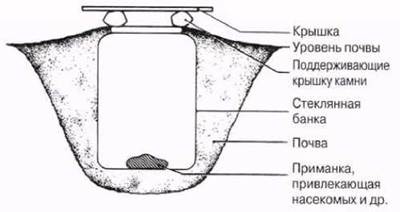
Fig. 11.5. Simple pitfall trap made from a glass jar buried in the ground.
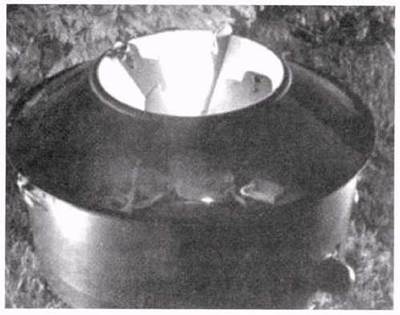
Fig. 11.6. Mercury-vapor light trap for catching insects.
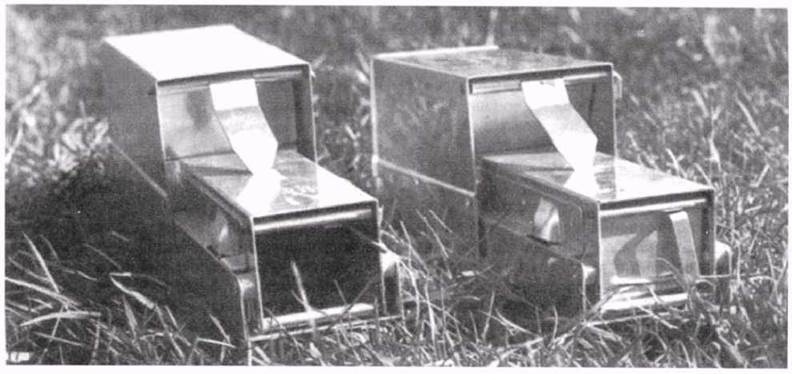
Fig. 11.7. Small mammal trap (Longworth live trap).
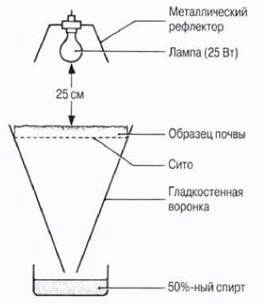
Fig. 11.8. Tullgren funnel.
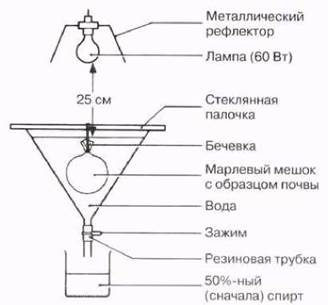
Fig. 11.9. Baermann funnel.
Last update: 06/08/2026
Editorial and Educational Adaptation: This material has been compiled based on the primary/original source text. The project team performed an editorial review, corrected technical inaccuracies, structured sections, and adapted the content for an educational format.
What was processed:
- elimination of formatting defects (OCR errors, structural breaks, corrupted characters);
- editorial organization of content;
- standardization of terminology in accordance with academic sources;
- verification of factual statements against the original source text.
All mentions of the author, publication year, and origin of the primary text have been preserved in accordance with the source.