BIOLOGY Volume 2 - A Guide to General Biology - 2004
11. QUANTITATIVE ECOLOGY
11.1. Methods for Measuring Environmental Factors
11.1.3. Climatic Factors
Several simple Methods for measuring a range of atmospheric and climatic parameters are described below.
Air humidity
Relative humidity is The ratio of The amount of Water vapor in the air to the amount corresponding to the saturation point at that Temperature. The latter value depends on temperature, because as air warms up, it expands and can hold more water molecules. Relative humidity is measured using a sling psychrometer (Fig. 11.2), in which two thermometers — with wet and dry bulbs — are mounted side by side on a swivel wooden frame. The frame is whirled like a football rattle until constant temperatures are established on both thermometers. These values are then compared using a psychrometric table or a specially calibrated slide rule supplied with the instrument to determine the relative humidity of the air. Relative humidity can also be used to find the dew point — the temperature at which the air becomes saturated with water vapor and the vapor condenses onto objects as water droplets.
Class="center">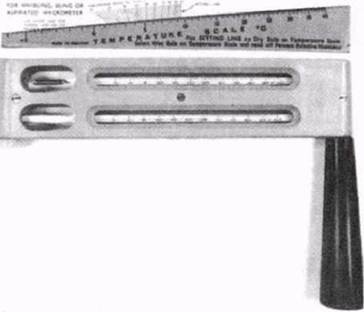
Fig. 11.2. Sling psychrometer.
Temperature
The temperature of air, water, and soil is easily measured with a mercury thermometer; however, a single temperature reading has limited informative value in ecology. It is much more important to know its fluctuation range over a given period. For this purpose, a continuous recorder or readings from specialized maximum and minimum thermometers are typically used.
The temperature of microhabitats or hard-to-reach locations, such as the center of a tree trunk, is determined using a thermistor, or thermal resistor (Fig. 11.3). This is an electrical conductor shaped as a thin probe that can be inserted into a very narrow crack. By measuring the resistance of the thermistor and comparing it with a previously compiled table where each resistance value corresponds to a specific temperature, the temperature of the environment in which the thermistor is placed can be established.
For microhabitats, it is also important to determine temperature amplitudes and extreme values (microclimate), because these very parameters often explain the absence of certain species from a given area, such as plants sensitive to frost.
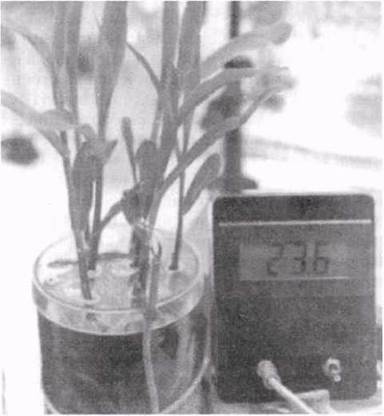
Fig. 11.3. Thermistor (thermal resistor) in action.
Light
Light varies in intensity, duration of illumination, and spectral composition (i.e., wavelength). All three parameters are ecologically important and are measured with specialized instruments. In practice, when comparing the illumination of different sites, it is usually sufficient to know the relative amount of light falling on a given area over a short period. An ordinary photographic exposure meter can be used for this purpose. To determine the amount of light received by an environment over a sufficiently long period, Ozalid paper with "accumulative" photosensitivity can be used.
Wind speed and direction
Wind speed and direction at a given moment do not provide substantial ecological information about habitat conditions. Therefore, It is important to know how frequently winds blow in a given habitat, as well as their speed and direction over a sufficiently long period. However, for most practical purposes, a standard weather vane and a simple anemometer (Fig. 11.4) are entirely adequate, allowing for easy comparison of wind direction and speed across different habitats.

Fig. 11.4. A simple anemometer that can be used to determine wind speed by the number of revolutions of the black vane per unit of time.
Last update: 06/08/2026
Editorial and Educational Adaptation: This material has been compiled based on the primary/original source text. The project team performed an editorial review, corrected technical inaccuracies, structured sections, and adapted the content for an educational format.
What was processed:
- elimination of formatting defects (OCR errors, structural breaks, corrupted characters);
- editorial organization of content;
- standardization of terminology in accordance with academic sources;
- verification of factual statements against the original source text.
All mentions of the author, publication year, and origin of the primary text have been preserved in accordance with the source.