BIOLOGY Volume 2 - A Guide to General Biology - 2004
19. HOMEOSTASIS
19.5. Endothermic animals
19.5.3. Heat loss
Endothermic animals have four mechanisms of heat loss, as outlined in Section 19.3.6: conduction, convection, radiation, and evaporation. In all cases, The rate of heat loss is determined by the Temperature gradients between the body core and its surface, as well as between the Skin and the environment. Heat loss can either increase or decrease depending on the rate of heat production and ambient temperature.
There are three key factors that limit heat loss, which we will examine below.
Rate of Blood flow between the body core and the skin
Heat loss through the skin via radiation, convection, and conduction depends on the volume of blood flowing through this organ per unit time. When blood flow is low, skin temperature approaches ambient temperature, whereas during high blood flow, it approaches the temperature of the body core. The skin of endothermic animals is richly supplied with Blood Vessels, and blood can flow through it via two main pathways: 1) through capillary beds in the dermis; 2) through arteriovenous (arteriolovenular) anastomoses in its deeper layers.
The muscular walls of arterioles can contract or relax, altering vessel diameter and the rate of Blood flow through them. The degree of contraction is regulated by sympathetic vasomotor nerves originating from the vasomotor center in the Medulla Oblongata, which in turn receives inputs from the thermoregulatory center in the Hypothalamus. In humans, the rate of cutaneous blood flow (per 100 g of tissue) ranges from 1 mL/min or less in the cold to 100 mL/min in high ambient temperatures, allowing heat loss to increase by a factor of 5 to 6. When arterioles constrict, blood is shunted into low-resistance anastomoses connecting Arteries to Veins, bypassing the capillaries for the most part (Fig. 19.12). This is a typical response that reduces heat loss. Conversely, when arterioles dilate, blood flow is directed primarily into the capillary bed, thereby increasing cutaneous blood flow and enhancing heat dissipation.
Sweating and cutaneous evaporation
Sweat is a watery fluid containing 0.1–0.4% sodium chloride, sodium lactate (a salt of lactic acid), and urea. It is less concentrated than Blood Plasma and is produced from interstitial fluid by Sweat Glands under the control of sympathetic Neurons, which receive appropriate signals from the hypothalamus. In humans, sweating is initiated whenever core body temperature rises above the normal average of 36.7 °C. Under temperate conditions, a human secretes approximately 900 mL of sweat daily, but in extreme heat with adequate Water and salt intake, this volume can increase up to 12 L.
19.2. The latent heat of vaporization of sweat is 2.45 kJ/mL. Calculate what fraction (%) of energy is expended on sweating by a miner who secretes 4 L of sweat per day and consumes 50,000 kJ of energy over the same period.
As sweat evaporates from the skin surface, the body loses energy in the form of latent heat of vaporization, leading to a decrease in core body temperature. At low ambient temperatures, high humidity, and in the absence of wind, the rate of evaporation decreases.
Many mammals are so densely furred that sweating can only occur on hairless Regions of the body, such as the paw pads in dogs and cats or The surface of the ears in rats. These animals increase heat dissipation by licking their fur, followed by the evaporation of moisture, as well as by rapid shallow breathing (“panting”), in which heat is dissipated from the moist surfaces of the Mouth and nasal mucosa. In humans, horses, and pigs, sweat can be secreted across the entire body surface.
Experiments have shown that sweating is a direct result of elevated core body temperature. Studies on humans and animals have demonstrated that when internal body temperature drops—due to drinking ice-water or cooling the carotid arteries with ice packs applied around the neck—less sweat is produced, even when the skin is exposed to heat. Reversing the experimental conditions yields the opposite effect. Because the carotid arteries supply blood to the hypothalamus as well, these experiments have helped clarify its role in thermoregulation. Changes in the temperature of this Brain region can be tracked quite accurately by placing a thermistor against the tympanic membrane. Fig. 19.13 presents data obtained from an experiment involving a nude human subject inside a temperature-controlled chamber. After analyzing these graphs, answer the following questions.
Class="center">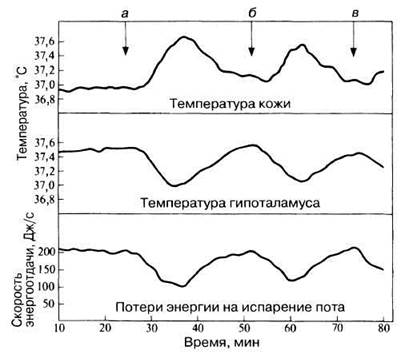
Fig. 19.13. Graphs showing the relationship between skin temperature, hypothalamic temperature, and the rate of sweat evaporation in a human subject inside a thermostatic chamber (45 °C). The subject drank ice-water at the times marked a, b, and c.
19.3. Why was the subject given ice-water only 20 minutes after THE START OF the experiment?
19.4. Describe the relationship between hypothalamic temperature and the rate of sweating.
19.5. Why does skin temperature rise shortly after drinking ice-water?
Thermal insulation between the body core and the environment
Thermal insulation of the body is provided by a layer of stationary air trapped between hairs on the skin and by fat deposits in the dermis and subcutaneous tissue. Feathers, fur, and clothing maintain a boundary layer of air, and since air is a poor heat conductor, it reduces heat loss. The degree of thermal insulation achieved depends on the thickness of this air layer. In response to low temperatures, reflex contraction of the arrector pili Muscles (or feather-erecting muscles) thickens the layer of trapped air. While this response is conserved in humans, our sparse body Hair limits the visible effect to "goosebumps." Humans compensate for the lack of fur through the insulating properties of clothing. Many mammals, particularly those that do not hibernate in winter, exhibit seasonal accumulation of a thick layer of subcutaneous fat. This layer (sometimes up to 50 cm thick), known as blubber, provides exceptional cold protection for aquatic mammals, especially those inhabiting cold waters (whales, seals, walruses, sea lions).
Last update: 06/08/2026
Editorial and Educational Adaptation: This material has been compiled based on the primary/original source text. The project team performed an editorial review, corrected technical inaccuracies, structured sections, and adapted the content for an educational format.
What was processed:
- elimination of formatting defects (OCR errors, structural breaks, corrupted characters);
- editorial organization of content;
- standardization of terminology in accordance with academic sources;
- verification of factual statements against the original source text.
All mentions of the author, publication year, and origin of the primary text have been preserved in accordance with the source.