BIOLOGY Volume 1 - A Guide to General Biology - 2004
4. ENZYMES
4.4. Enzyme Inhibition
4.4.3. Non-competitive Irreversible Inhibition
Certain substances cause irreversible Enzyme Inhibition. Let us consider two Examples of this phenomenon.
Very low concentrations of heavy Metal Ions, such as mercury (Hg2+), silver (Ag+), and arsenic (As+) ions, as well as certain iodine-containing compounds, completely inhibit certain Enzymes. These substances bind irreversibly to sulfhydryl groups (—SH) within the enzyme molecule (Fig. 4.13), and these sulfhydryl groups may be located either within or outside the Active Site. In either case, the enzyme's Structure is disrupted, and it loses its catalytic ability. Precipitation of the enzyme protein may also occur.
Class="center">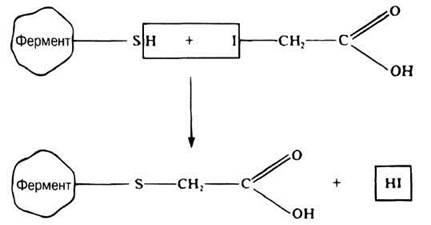
Fig. 4.13. Irreversible enzyme inhibition by iodoacetic acid. Iodine reacts with The sulfhydryl groups of the enzyme.
Another example of irreversible inhibition is the action of diisopropylfluorophosphate (DFP), a compound belonging to the nerve agent group. DFP binds to a Serine amino acid residue located in the Active Site of the enzyme acetylcholinesterase. This enzyme inactivates acetylcholine, which acts as a neurotransmitter. One of the Functions of acetylcholine is to ensure the transmission of nerve impulses from one neuron to another across the synaptic cleft (Chapter 17). Almost immediately after transmitting a given impulse, acetylcholinesterase inactivates acetylcholine by cleaving its molecules. If acetylcholinesterase is inhibited, acetylcholine accumulates, nerve impulses follow one another in rapid succession, and the Muscle fails to relax for an extended period. Ultimately, paralysis ensues, and death may also occur because the chest Muscles are likewise affected, resulting in respiratory arrest. Some currently used insecticides (such as parathion) exert the same effect on insects. They are also capable of damaging the human nervous and muscular systems.
4.4. Explain why changing the Substrate Concentration has no effect on non-competitive inhibition.
Last update: 06/08/2026
Editorial and Educational Adaptation: This material has been compiled based on the primary/original source text. The project team performed an editorial review, corrected technical inaccuracies, structured sections, and adapted the content for an educational format.
What was processed:
- elimination of formatting defects (OCR errors, structural breaks, corrupted characters);
- editorial organization of content;
- standardization of terminology in accordance with academic sources;
- verification of factual statements against the original source text.
All mentions of the author, publication year, and origin of the primary text have been preserved in accordance with the source.