Protein Structure and Function. Application of Bioinformatics Methods - John Rigden 2014
Prediction of Protein Function Based on Theoretical Models
Practical Application
Prediction of Ligand Specificity
One of the most fundamental functional predictions that can be derived from a protein model is Ligand Specificity. Often, if The Structure of protein A bound to ligand X is known, it is of interest to predict whether protein B, which is homologous to protein A, will also be specific for X or, in fact, bind a different ligand Y. Such an analysis relies on the assumption that the binding site in Proteins A and B is located in the same spatial position. This is typically true for homologous proteins and, in the case of Enzymes, is supported by the presence of nearby key catalytic residues. Next, a model of protein B is built using the structure of protein A as a template, and an examination of this structure—specifically by comparing it with the structure of A—reveals whether any changes have occurred within the binding site. For instance, a reduction in its size would be interpreted as a decrease in the size of the ligand it binds.
An early example of work in this field is the modeling of Brain lipid-binding protein (BLBP), based on the STRUCTURE OF THE related fatty acid-binding protein (Xu et al. 1996). The interactions of known Fatty acids with BLBP were modeled in studies aimed at elucidating the molecular basis for the twenty-fold stronger binding of docosahexaenoic acid compared to the shorter oleic and arachidonic acids. The model demonstrated that the two extra atoms in the former acid can fit into the protein cavity, enhancing favorable hydrophobic interactions. The calculated extra binding energy, derived from the additional hydrophobic contact area, is approximately 2 kcal/mol, which correlates well with the difference in affinity among these acids. Based on this validated model, the authors were able to predict that even longer fatty acids would not form additional contacts and, therefore, would not exhibit higher affinity.
The molecular basis for varying specificity can sometimes be surprisingly simple. This is precisely the case with phosphate Donors in certain 6-phosphofructokinases—glycolytic enzymes that catalyze The transfer of a phosphate group from a donor, which can be ATP, ADP, or inorganic pyrophosphate. ATP- and pyrophosphate-dependent enzymes are evolutionarily related, whereas ADP-dependent phosphofructokinases belong to a different structural Class. It was previously noted that the ATP-dependent enzymes of trypanosomatids are more closely related to certain pyrophosphate-dependent enzymes than to the well-known ATP-dependent enzymes of Bacteria and mammals (Michels et al. 1997). Later, modeling revealed that the specificity for either ATP or pyrophosphate can be pinpointed to a single amino acid residue: Gly in ATP-dependent enzymes and Asp in pyrophosphate-dependent ones (Lopez et al. 2002). As shown in Fig. 12.5, the aspartate at this position causes steric and electrostatic clashes with the a-phosphate of bound ATP or ADP, effectively restricting the binding site to dimensions suitable only for pyrophosphate. This strikingly simple mechanism of specificity was confirmed by converting a pyrophosphate-dependent enzyme into an ATP-dependent one through a single amino acid substitution of the corresponding aspartate to Glycine (Chi and Kemp 2000).
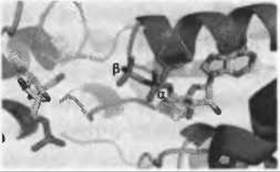
Fig. 12.5. (For the color version of this figure, see the insert.) The catalytic site of E. coli 6-Phosphofructokinase with bound fructose 6-phosphate and ADP (PDB code 4pfk). Ligands are shown as colored rods (fructose 6-phosphate on the left and ADP on the right). ATP-dependent enzymes, such as this one, possess a glycine residue in the catalytic center (not shown). Modeling the placement of an aspartate at this same position (shown in pink), analogous to that observed in pyrophosphate-dependent enzymes, demonstrates that this residue is responsible for altering the specificity toward the phosphate donor (see text)
Last update: 06/08/2026
Editorial and Educational Adaptation: This material has been compiled based on the primary/original source text. The project team performed an editorial review, corrected technical inaccuracies, structured sections, and adapted the content for an educational format.
What was processed:
- elimination of formatting defects (OCR errors, structural breaks, corrupted characters);
- editorial organization of content;
- standardization of terminology in accordance with academic sources;
- verification of factual statements against the original source text.
All mentions of the author, publication year, and origin of the primary text have been preserved in accordance with the source.