BIOCHEMISTRY - L. Stryer - 1984
VOLUME 3
Part IV INFORMATION
CHAPTER 27. PROTEIN SYNTHESIS
27.22. Some Short Peptides Are Synthesized without Ribosomes
We now turn to another mechanism of peptide bond formation in biological systems. As an example, let us consider The Biosynthesis of gramicidin S, a cyclic peptide antibiotic consisting of two identical pentapeptides joined HEAD-to-tail (Fig. 27.25). This antibiotic is produced by certain strains of the spore-forming bacterium Bacillus brevis.
Class="center">Fig. 27.25. Amino Acid Sequence of gramicidin S, a cyclic peptide composed of two identical pentapeptide units

The biosynthesis of gramicidin S proceeds in the absence of Ribosomes or mRNA. It requires a much simpler synthetic apparatus consisting of only two Enzymes, EI and EII. Enzyme EII (mass 100 kDa) activates phenylalanine, whereas the remaining four Amino Acids of the pentapeptide moiety are activated by EI (mass 180 kDa). In addition, both enzymes participate in peptide bond formation.
In this system, Amino acids are activated through The formation of enzyme-bound thioesters. Instead of the 3'-terminal hydroxyl group of tRNA, the activated amino acids are attached to The sulfhydryl groups of EI and EII:

When L-Proline, L-valine, L-Ornithine, and L-leucine are incubated with EI in the presence of ATP, they form thioester bonds with specific sulfhydryl groups of EI. Similarly, D-phenylalanine in the presence of ATP forms a thioester bond with EII.
Peptide Synthesis in this system is initiated by the interaction of EI and EII. The D-phenylalanine residue attached to EII is transferred to the imino group of the L-proline residue attached to EI, yielding a dipeptide. Subsequent reactions involve EI alone. The activated carbonyl group of the proline residue within the dipeptide reacts with the amino group of the valine residue attached to the same enzyme to yield a tripeptide. This process is repeated with the participation of ornithine and then leucine, ultimately resulting in an enzyme-bound pentapeptide. With the formation of each new peptide bond, the growing peptide is transferred to a fresh sulfhydryl group. Finally, the activated pentapeptides attached to two different EI molecules react with each other to form cyclic gramicidin S.

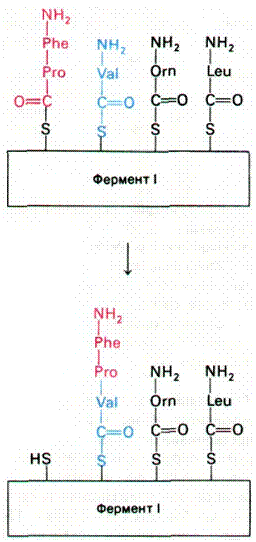

Two features of this biosynthetic pathway deserve note.
1. The amino acid sequence of gramicidin S is determined by the spatial Organization and Specificity of enzymes EI and EII. At least one protein subunit is required per peptide bond. Consequently, this mode of synthesis is less economical than the ribosomal mechanism. For this reason, Peptides containing more than roughly 15 residues are not synthesized by this pathway.
2. The synthesis of gramicidin S resembles fatty acid synthesis in that thioesters serve as the activated intermediates in both processes. Furthermore, EI contains a covalently linked phosphopantetheine residue. This thiol presumably transfers the growing peptide chain from one site on EI to the next. Fritz Lipmann suggested that the synthesis of Polypeptide Antibiotics might represent an evolutionary relic, echoing a primitive Protein Synthesis mechanism utilized at the dawn of evolution. The synthesis of ribosomal Proteins may have evolved from fatty acid synthesis.
Last update: 06/08/2026
Editorial and Educational Adaptation: This material has been compiled based on the primary/original source text. The project team performed an editorial review, corrected technical inaccuracies, structured sections, and adapted the content for an educational format.
What was processed:
- elimination of formatting defects (OCR errors, structural breaks, corrupted characters);
- editorial organization of content;
- standardization of terminology in accordance with academic sources;
- verification of factual statements against the original source text.
All mentions of the author, publication year, and origin of the primary text have been preserved in accordance with the source.