Protein Chemistry. Structure, Properties, Research Methods - Shendryk, A.N. 2022
Protein Structure
Protein Structure
Chemical Fragmentation: Preliminary Protein Studies Prior to Sequencing
Before proceeding with sequencing, the protein undergoes several preliminary analyses:
1. Purification.
2. Determination of the type and number of prosthetic groups. Sometimes the prosthetic group is separated from the peptide chain prior to sequencing.
3. Determination of the presence of intra- and intermolecular Disulfide Bonds. This type of bond is not present in all Proteins, but when present, it usually plays a crucial role. Such bonds are detected by chemical modification:
Class="center">
Reduction is a selective and convenient method for cleaving S-S bonds. A typical Procedure involves treating the protein with an excess of a low-molecular-weight thiol. Commonly used thiols include: Cysteine, reduced Glutathione, 2-mercaptoethylamine, thioglycolic acid, mercaptoethanol (HSCH2CH2OH), Cleland's reagent (HSCH2(CHOH)2SH), etc.
Following reduction, SH groups are readily oxidized by atmospheric oxygen, leading to the reformation of S-S bonds. Therefore, the reduced SH groups are protected directly within the reaction mixture where the reduction was carried out.
To protect SH groups, the following Reagents are used: ethyleneimine

4-vinylpyridine

and A number of other alkylating agents.
Disulfide bonds can also be reduced using Other reagents, such as sodium borohydride. However, these techniques find virtually no application in Protein Chemistry due to Side Reactions. For instance, sodium borohydride cleaves peptide bonds, and diborane reduces carboxyl groups.
Sometimes the reduction of S-S bonds in proteins is carried out electrochemically using a dropping mercury electrode. Performic acid is frequently used for oxidation.
In addition to disulfide bonds, proteins contain Other types of intermolecular bonds that are difficult to analyze and selectively cleave. These include the aldimine bond (I) in Collagen, desmosine (II) and isodesmosine in Elastin, isopeptide bonds between the ε-amino group of Lysine and the amide group of glutamine (III) in extracellular structural proteins, and presumably di- and trityrosines (IV).

To identify the aldimine bond in collagen, it is first stabilized within the protein by reduction with sodium cyanoborohydride. Enzymatic Hydrolysis is then performed, and the cross-linked Peptides are isolated. These fragments are identified using a tritium-labeled reducing agent.
Desmosines in elastin are detected by reducing the protein with NaBD4 in Water or D2O. Hydrolysis is carried out, and the Amino Acids are analyzed chromatographically or by mass spectrometry.
The most well-known type (III) isopeptide fragment is ε-(γ-glutamyl)lysine. Following complete enzymatic hydrolysis of the protein, this fragment can be detected directly using Amino acid analysis Methods.
4. Determination of the presence of cysteine sulfhydryl (S-H) groups in the protein. One of the effective methods involves treating the protein with 5,5′-dithiobis-2-nitrobenzoic acid (Ellman's reagent). It reacts selectively with free SH groups, yielding a modified protein and a colored thionitrobenzoate anion (λmax = 412 nm). This allows for quantitative analysis following appropriate calibration.
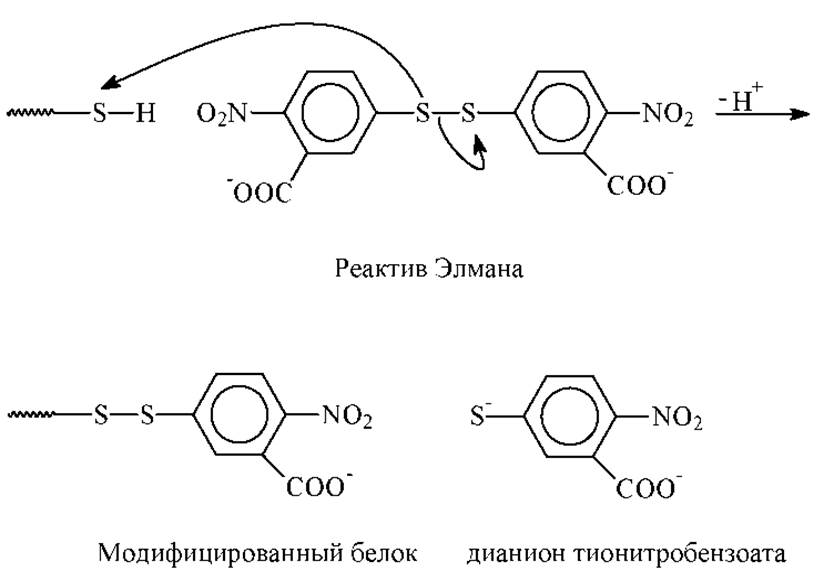
5. Pretreatment of proteins possessing a quaternary Structure to separate (dissociate) intact aggregates and isolate individual peptide chains. Dissociation of protein aggregates is achieved by simple yet effective techniques: pH adjustment, surfactant Treatment (such as sodium dodecyl sulfate), mild heating, and repeated low-amplitude freeze-thaw cycles.
Last update: 06/08/2026
Editorial and Educational Adaptation: This material has been compiled based on the primary/original source text. The project team performed an editorial review, corrected technical inaccuracies, structured sections, and adapted the content for an educational format.
What was processed:
- elimination of formatting defects (OCR errors, structural breaks, corrupted characters);
- editorial organization of content;
- standardization of terminology in accordance with academic sources;
- verification of factual statements against the original source text.
All mentions of the author, publication year, and origin of the primary text have been preserved in accordance with the source.