Protein Chemistry. Structure, Properties, Research Methods - Shendryk A.N. 2022
Protein Structure
Protein Structure
Chemical Fragmentation - Sequencing of Peptide Chains on Solid-Phase Supports
In 1971, American biochemist Larsen proposed a solid-phase (SP) peptide Amino Acid Sequence analyzer. The working principle of this analyzer is based on the covalent binding of a peptide to an insoluble support, followed by the sequential Edman Degradation of Amino Acids from the peptide chain. The support loaded with the peptide is placed into a Column, and solutions of the appropriate Reagents are used as the eluent. The SP-sequenator is more technologically advanced than the liquid-phase one. It allows for the analysis of 500 pmol to 20 nmol of peptide and the determination of sequences of 20-30 amino acid residues. Larger Peptides can also be analyzed.
Supports for solid-phase sequenators. Copolymers based on cross-linked polystyrene or porous glasses are used as supports for SP-sequenators.
Polystyrene-based supports. Examples of the synthesis of certain cross-linked polystyrene resin supports are shown in the scheme.
Polymers for SP-sequenators must meet two basic requirements:
1. the Functional groups of the polymers must be accessible to peptides and reagents;
2. the resin must be mechanically and chemically stable under the conditions of the Edman reaction.
Glass-Based Supports. In 1973, porous glass beads of the following composition were proposed as supports for SP-sequenators: 96% silica, 3-4% B2O3, 0.5% Na2O, and trace amounts of other metal oxides. They are produced as untreated porous beads modified by various chemical Methods.
Glass beads are highly resistant to mechanical damage, but their properties deteriorate noticeably over time under the action of trifluoroacetic acid (TFA). They are also very sensitive to hydrogen fluoride (hydrofluoric acid).
Class="center">
Chemical modification of glasses
Introduction of amino groups. To obtain aminopropyl glass (APG) and ß-N-aminoethyl-(3-aminopropyl) glass (ß-APG), porous CPG beads are treated with 3-aminopropyltriethoxysilane (APTES) and ß-aminoethyl-(3-aminopropyl)trimethoxysilane (AEAPTMS), respectively.

Preparation of isothiocyanate glass. For the Synthesis of the isothiocyanatoaminopropyl support, the amino groups of aminopropyl glass are activated with p-phenylene diisothiocyanate (DITC-glass).

Limitations. DITC-glasses can only be used to analyze peptides containing Lysine or aminoethylcysteine residues, through which the peptide chain is attached to the support (glass). Peptides containing these residues within the internal sequence can only be analyzed up to those residues, i.e., up to the points of attachment. The method is not applicable to Arginine-containing peptides.
Binding of peptides to the support
The decisive step in SP-sequencing is the attachment of the peptide to the support, a process known as immobilization. Two primary methods are used to attach peptides to SP-supports.
1. Attachment via the α- and ε-amino groups of the peptide chain. Peptides with lysine or aminoethylcysteine residues located either within the chain or at the C-terminus of the peptide are efficiently attached via their free amino groups to styrene-based resins or aminopropyl glasses using DITC.
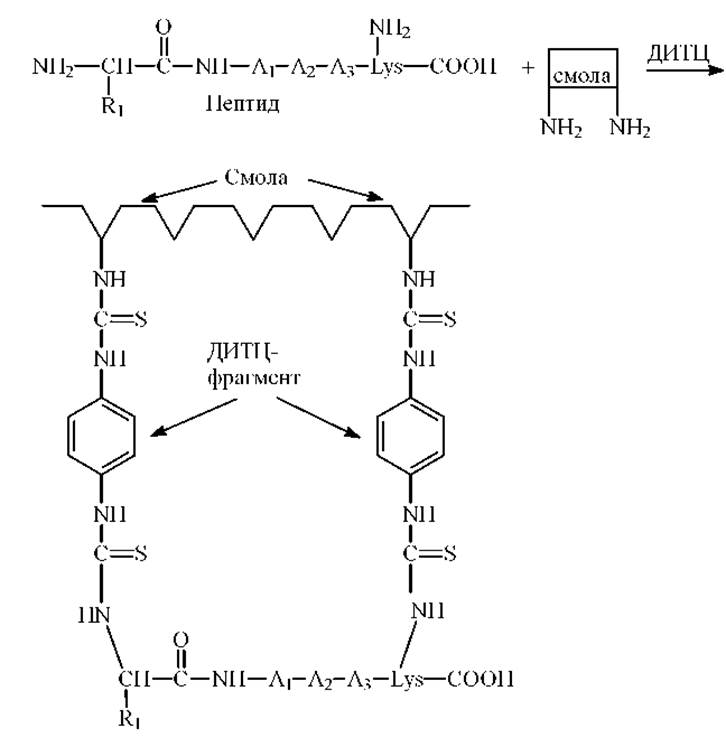
2. Attachment via the carboxyl group. The carboxyl group of the C-terminal amino acid of the peptide can be covalently linked to aminopolystyrene and aminopropyl glass using a carbodiimide. This method is applicable to virtually all peptides and can be used in a micro-scale format.
Peptide sequencing on solid-phase supports is carried out using the Edman method or its modifications described below.
1. The FITC-DABITC method. DABITC is an analog of FITC (4-N,N-dimethylaminoazobenzene-4'-isothiocyanate):

DABITC forms a hydantoin with an extinction coefficient twice as high as that of FITC. This significantly increases sensitivity and allows for the analysis of 10-50 pmol of sample.
Disadvantage of DABITC: at normal temperatures, it does not react quantitatively. Therefore, double carbamoylation is applied — first with DABITC and then with FITC.
2. The DNS-Edman method. In this method, prior to each cycle of peptide chain degradation, a specific aliquot of the solution is taken to analyze the N-terminal amino acid as a dansyl derivative. The remaining peptide solution is then analyzed using the Edman degradation. This omits the washing step of PTC-peptides from excess FITC and its by-products, thereby reducing sample loss during the analysis.
Last update: 06/08/2026
Editorial and Educational Adaptation: This material has been compiled based on the primary/original source text. The project team performed an editorial review, corrected technical inaccuracies, structured sections, and adapted the content for an educational format.
What was processed:
- elimination of formatting defects (OCR errors, structural breaks, corrupted characters);
- editorial organization of content;
- standardization of terminology in accordance with academic sources;
- verification of factual statements against the original source text.
All mentions of the author, publication year, and origin of the primary text have been preserved in accordance with the source.